

The History of Halloween and Its Global Influence
Halloween, celebrated on October 31, has a history that spans over 2,000 years, evolving from ancient pagan rituals to one of the most globally recognized holidays. Its roots lie in the Celtic festival of Samhain, which marked the end of the harvest season and the onset of winter, a time the Celts associated with death. Over the centuries, Halloween has transformed from a deeply spiritual and communal festival into a heavily commercialized event that influences culture, economics, and societal norms worldwide.
Ancient Celtic Roots and Roman Influence
The origins of Halloween can be traced back to the Celtic festival of Samhain in ancient Ireland, the UK, and northern France. Samhain, observed on the night of October 31, marked the end of the summer harvest and the beginning of winter. The Celts believed that on this night, the veil between the living and the dead was thinnest, allowing spirits to cross into the world of the living. People lit bonfires and wore costumes made of animal skins to ward off spirits, while food offerings were left to appease them. These rituals were essential to protect communities from harm and to predict future events during a time of uncertainty.
As the Roman Empire expanded and conquered Celtic territories, Roman traditions merged with Samhain. Two Roman festivals, Feralia, which honored the dead, and Pomona, a celebration of the harvest goddess, influenced the evolving customs. The practice of bobbing for apples, a common Halloween game today, has roots in Pomona's association with apples.
Christianization of Halloween
With the rise of Christianity, pagan festivals like Samhain were reimagined within a Christian framework. In 609 AD, Pope Boniface IV designated November 1 as All Saints' Day (also known as All Hallows' Day) to honor saints and martyrs. The evening before, October 31, became known as All Hallows' Eve, which later evolved into Halloween. By the 11th century, All Souls' Day was added on November 2 to commemorate all faithful departed. The celebration of these days involved bonfires, parades, and costumes, much like the earlier Samhain traditions, but with more religious overtones.
Medieval traditions like souling, where people would go door-to-door offering prayers for the dead in exchange for food, particularly soul cakes, became a precursor to modern-day trick-or-treating. Similarly, guising—where children would dress in costumes and perform small tricks or songs in exchange for food or coins—developed in parts of Scotland and Ireland.
Halloween’s Migration to America
In the 19th century, waves of Irish and Scottish immigrants brought Halloween customs to the United States, where it gradually became a widespread celebration. In America, pumpkins replaced the traditional carved turnips, leading to the iconic jack-o’-lanterns that now symbolize Halloween. Over time, the holiday shed much of its religious and supernatural focus, becoming a more community-based event with games, parties, and costumes.
By the 1920s and 1930s, trick-or-treating became a central part of Halloween in the U.S., cementing it as a child-friendly holiday. This practice grew even more popular in the post-World War II era, when suburban growth and consumer culture surged. Candy manufacturers capitalized on Halloween, and by the 1950s, giving out candy became the norm.
Modern Halloween and Its Global Impact
Today, Halloween is a massive cultural phenomenon, particularly in the United States, where it is the second-largest commercial holiday after Christmas. The global spread of Halloween has been fueled by American pop culture, particularly through movies, television, and advertising. Countries such as Canada, the UK, Australia, and Japan have adopted Halloween traditions, often combining them with local customs. For instance, in Mexico, Día de los Muertos (Day of the Dead) coincides with Halloween but retains its unique cultural practices.
Halloween has not only shaped pop culture but also created economic impacts. The holiday generates billions of dollars in revenue annually, with sales of costumes, decorations, candy, and entertainment, such as horror films and haunted house attractions. Its influence can be seen in the growing popularity of costume parties and horror-related events around the world.
Halloween’s Cultural Significance
Beyond its economic footprint, Halloween reflects society’s fascination with the supernatural and the unknown. It serves as a way for people to confront fears about death and the afterlife, albeit in a more playful and commercialized context. The holiday has also become a platform for self-expression, where individuals of all ages can temporarily take on different identities through costumes.
In conclusion, Halloween has transformed from an ancient Celtic ritual into a global celebration that influences modern culture, commerce, and social practices. Its journey through time has reshaped the way people interact with themes of life, death, and community, demonstrating the enduring power of traditions to adapt and thrive across different societies and eras.
About the Creator
Keep reading
More stories from writers in Horror and other communities.
Killing him slowly
There’s an intruder in my house again. He stumbles through the door, wet carrier bags in hand. He’s bought me offerings. I show my appreciation, letting him caress my beautiful body. He wants to touch me. I rub myself against his legs. He sighs, dropping the bags. He can’t resist touching me. Running his hand slowly down my spine, I arch my back towards his caress, let out a low purr. It’s what we both need.
By N J Delmas6 days ago in Horror
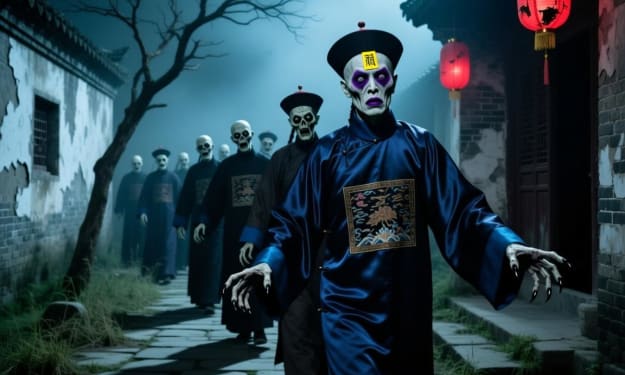
Rumors of China's Three Great Zombies
Today, let's talk about those zombie rumors that are engraved in folk memory and are becoming increasingly evil as they spread. This is not a scene that can be solved just by jumping around and sticking a yellow talisman in movies. Each scene carries a real era, location, and scalp tingling details, especially the 1872 incident in Pingxiang, Guangxi, where the government sealed off mountains and burned forests, resulting in heavy casualties. More than a hundred years later, when it comes to it again, it can still make people's necks feel cold. Today, I will slowly tell you about these three zombie rumors from beginning to end.
By Aiden Wangabout 6 hours ago in Horror
Instructions Included Challenge Winners
For the Instructions Included challenge, we asked writers to tell a story through instructions and to trust the form to carry what could not be said outright. Across the top entries, that trust paid off in many different ways.
By Vocal Curation Team6 days ago in Resources


Comments
There are no comments for this story
Be the first to respond and start the conversation.