

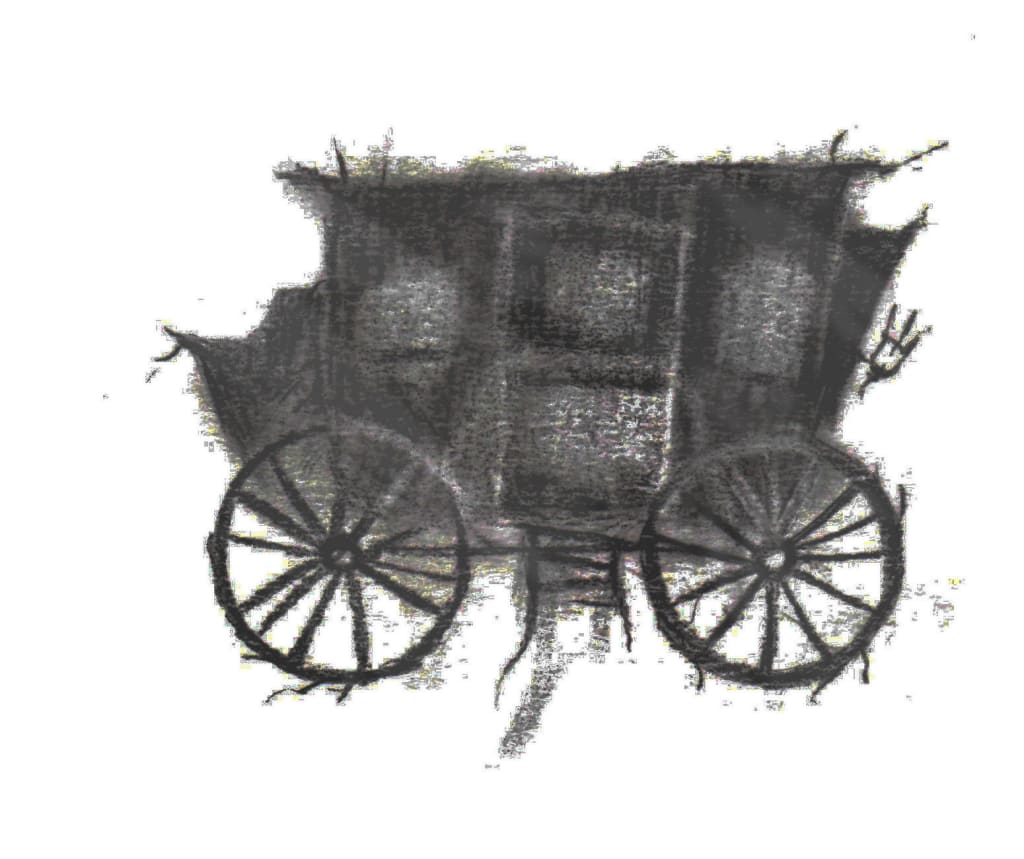
In the town of Alabaster there’s told a legend between the townsfolk that is only whispered in broken voices and somber tones. On moonless nights, under the canopy of an empty sky, where the blanket of night cloaks all but the hands in front of you, are these tales whispered not as lore or myth, but as omens and warnings.
Braxton Yeates had never heard of such stories before the night both business and fate brought him to the small hillside town settled just beyond the plain. Its alluring name was thought to have originated from only the lips of outsiders who visited the isolated town but spoke only briefly of its chief significance. For the town was like no other in its region. Every stone, from its walls to its roads to its buildings of various degree and significance were all stained white; like alabaster. There were no stones in the walls, nor on the streets, or in the houses that were alabaster or even inheritably white. More curious was the speculation and rumor surrounding the origin of this foreign oddity. Some passed it off as the aging of the stone, but still more cradled the notion of otherworldly forces and swore by all that is holy and right that Alabaster was cursed down to its very last pebble. Many do go but to the limits of the perimeter of the plain where the town stands as a monolith; an alter for evil to work all its damning and blasphemous rites. Still fewer sail even within a mile of the sea set on the other side of the town, just beyond the tranquil plain where the waters rage wild as though some unforeseen tempest is to arrive but never does. And those few unlucky fishermen caught in the swells and currents who never return are thought by many but believed by few to have been pulled under, ship and all, by the very tentacles of Leviathan himself. For few old timers of Alabaster have stated that they themselves have seen a lashing of tentacles belonging to the great abyssal beast that stirred up such a rage within the sea that it capped the waves so and turned them as white as alabaster.
Braxton hadn’t heard of these legends, either. But if he had heard of them, he would have dismissed such nonsense in the haste of meeting his partner. Still, there was no need to fret over any means of distraction. Within the confines of the stagecoach he had only the rustling of leaves, the whinnies of the horses and the occasional motivational Yah! following the crack of the driver’s whip to preoccupy him as he ambled on to make his appointment.
Braxton therefore spent his time sorting through freshly printed pocket watch brochures and magazines. Time was his business and selling pocket watches around the countryside was his living. As an adolescent, he had taken upon the task of selling them door-to-door as means to support his impoverished parents and siblings. He had come of age to work and his cousin had shown him the method of salesmanship before succumbing to a fever brought on by influenza.
It was a daunting and tedious task for young Braxton. He was fifteen and had been introduced to the burden and responsibilities of labor by circumstances beyond his control. However, as he grew used to it, obligation became pleasure, and pleasure became passion. And at the worthy age of twenty-four he was awarded the standing of the head of his division. If time was his religion then he was surely a priest. Braxton took it so seriously, in fact, that the very notion of his being late to anything would almost drive him to the point of panic. But he had no concern for this now. Business had always allotted an amassed amount of time that could thwart any attempts to hinder a timely arrival. Braxton patted the briefcase that lay to his side, the proof of his religion and the testament to his faith.
The clearing was not far now and Braxton could see it from the coach’s window. He checked his watch; about five minutes to go. But not a minute later the stagecoach came to a stop. He looked out the window to find it sitting on the perimeter of the plain.
Perplexed, Braxton exited the coach and walked to where the driver sat.
“Driver, why have we stopped? The town’s all the way over there.”
He waited for a response, but there came none.
“Well, aren’t you going to answer me? Why have we stopped?”
The driver didn’t even look down. He kept his gaze forward to the town resting on the hill across the plain.
“Hey, I’m talking to you. What is the meaning of this? I paid you to take me to that town so take me there!” Braxton grew angry.
“Why can’t you do that? I gave you money!”
The driver broke his rigid, statuesque pose only to reach inside his coat pocket and withdraw two pieces of silver.
“Keep it.” He replied and dropped the currency at Braxton’s feet.
Braxton’s nostrils flared and he stamped his.
Braxton briskly removed his belongings from the passenger compartment and returned to confront the driver.
“I’m going to report you. Mark my words. I’ll see you on the streets soon yet!”
The horse whinnied in protest of its master’s pull, turned around and headed back through the groves. Braxton just stood there in anger and disbelief, shaking his head as he watched the coach disappear amongst disturbed clouds of dust. Now alone and standing before the plain, Braxton looked over at the town and measured the distance in which he had to go. He looked at his watch and marked the time. He was still in the clear. Accepting the fact that he now had to make his way by foot, he picked up his belongings, as well as his currency, and started to make his way across the plain towards the town.
The day was cool and better fit for the mandatory hike Braxton had to endure. The plain was particularly windy, which forced him to stop momentarily to button his cloak the best he could and keep his hand upon the brim of his hat to keep it atop his head. The wind was fierce not so much by force but by a chill that seemed unnatural for the day’s weather. It had been relatively warm before he ventured out onto the plain and so the wind should have been but a few degrees cooler. But that wasn’t the case at all. The wind also carried with it an unsettling noise; a strange hiss that sounded as though it were seeping through some tight quarters. Yet, there was nothing but the knee-high lengths of yellowing grass that were but pushed down momentarily by it. It felt almost as though the wind were whispering to itself and then to Braxton. Yet, this Braxton pondered not as he climbed the hill leading toward the town’s wooden gate.
Upon reaching it Braxton noticed that it wore the same color as the surrounding walls. White. And it seemed to have been painted on, but by no craftsman or artisan. Rather, it appeared to have been thrown on in a reckless haste. The paint was dry but wore a moist, salty aroma like that of the sea.
It made perfect sense to him. The sea was not a half-mile away and the wind present in the plain wore that strange damp, salty scent as well. What did not make sense was why the gate appeared to be locked. Braxton pushed on the gate but it would not give little more than an inch.
He then knocked and waited.
When Braxton stroked his hair back into place he noticed his hands now wore the same color as the gate and surrounding wall. He was sure it was dry. It even felt dry when he pushed upon the door. And it felt dry resting on his hands and knuckles. He pulled a handkerchief out of his pocket, spit in his hands and proceeded to scrub, but was interrupted by the abrupt scraping of wood against itself.
Braxton jerked up and saw momentarily a flash of eyes through a peephole.
“What do you want? What is your business here?” A rasping voice followed as an eye again floated around the perimeter of the hole.
“I’m here to meet a business partner of mine. I sell watches.” Startled, Braxton held a brochure up to the floating eye.
There was a moment of silence, which was abruptly broken by the sound of scraping wood then of the rattling unhinging of chains.
The gate creaked open but an inch like it had done when Braxton had pushed upon it.
This time, however, he pushed upon it with the handkerchief and it swung open recklessly, as if kicked. Hesitantly, he entered the town and saw not a man or woman or child on the street. Not even the gatekeeper was there. The man whose raspy, antagonistic voice he had heard not a minute ago was nowhere to be seen. And there was no place anyone could hide in such a short time. Braxton was alone. But was he before? Had the voice he had heard inside the gate been nothing short of his imagination? And if it was, the gate was most certainly locked before. Who or what had unlocked it? All this perplexed Braxton, but did not distract him from his business within the town.
Braxton found himself walking along cobbled streets that were stained white like the stones that encompassed the walls. Everything was stained white. As he walked along streets with names he could not read and shops, whose stained windows did not permit him to see, a sense of caution now welled up within him. In all of his travels, the likes of such a town as this he had not experienced before. Now, Braxton was more eager than ever to conduct his business and leave. The streets, alleys, shops and buildings posed only to pay architectural homage to what seemed to be a once pleasant and productive town. But now it held all the silence and stillness of a cemetery. The only thing that broke this presence was the reverberant echoes of Braxton’s steps as he sought guidance to locate a place he had only read of in recent correspondence.
The letter had come one morning whilst Braxton was away and he had happened upon it as he organized a pile of papers that had grown great due to his neglect. He had questioned the resident maid about it and received no resolve to his question. The letter was written by a man that Braxton hadn’t met before but had heard of due to his business in several towns where he had made a name for himself. His name was Madison and only that. He had no known first or last name.
Still, his reputation had no cause for Braxton questioning such an anomaly, as Madison was one of the leading men and women’s clothing manufacturer representatives around. A substantial margin of Europe bore his name on their wardrobes. And now, as it seemed and, as the letter had indicated, they wanted to merge with the watch company Braxton represented. For this and only this did Braxton suppress his curiosity of how such a letter of mystery had made it into his study. And now he was looking for a restaurant, one that Madison had named in the letter that Braxton were to meet him in.
A restaurant called le Porte. The Doorway.
About the Creator
Keep reading
More stories from Alder Strauss and writers in Horror and other communities.
The Wicker Chair
The day passed by ordinarily, without the strangest of happenings. The chair did not once more that day groan like it had done before. Maybe the man was crazy in thinking that the noise it produced sounded human, or was even alive. Inevitably, night came and the two slept soundly: a benefit of a southern summer’s night.
By Alder Strauss5 years ago in Horror
He wasn't Santa
He wore black instead of red and he had a gaunt face. His teeth were yellow and jagged. He spoke in a dialect not of this world. There was a lot of clicking of his forked tongue when he spoke. He handed little Judy Miller a shiny red box. She took it and watched as the creature walked out the front door. She stood there a moment or two looking at the package. She wanted to open it. The present was from Santa, or so she thought. She placed it under the tree and headed up to her bedroom. She curled up all nice and comfy in her bed. She fell asleep and entered a nightmare. She went downstairs to find her parents, Stacy and Jeff butchered beyond recognition. She also found her little brother Donny; he was dead as well. She woke up crying.
By DJ Robbins2 days ago in Horror


Comments
There are no comments for this story
Be the first to respond and start the conversation.