
The Foster House Whispers
Grief takes many forms, but none as terrifying as hope twisted into obsession.

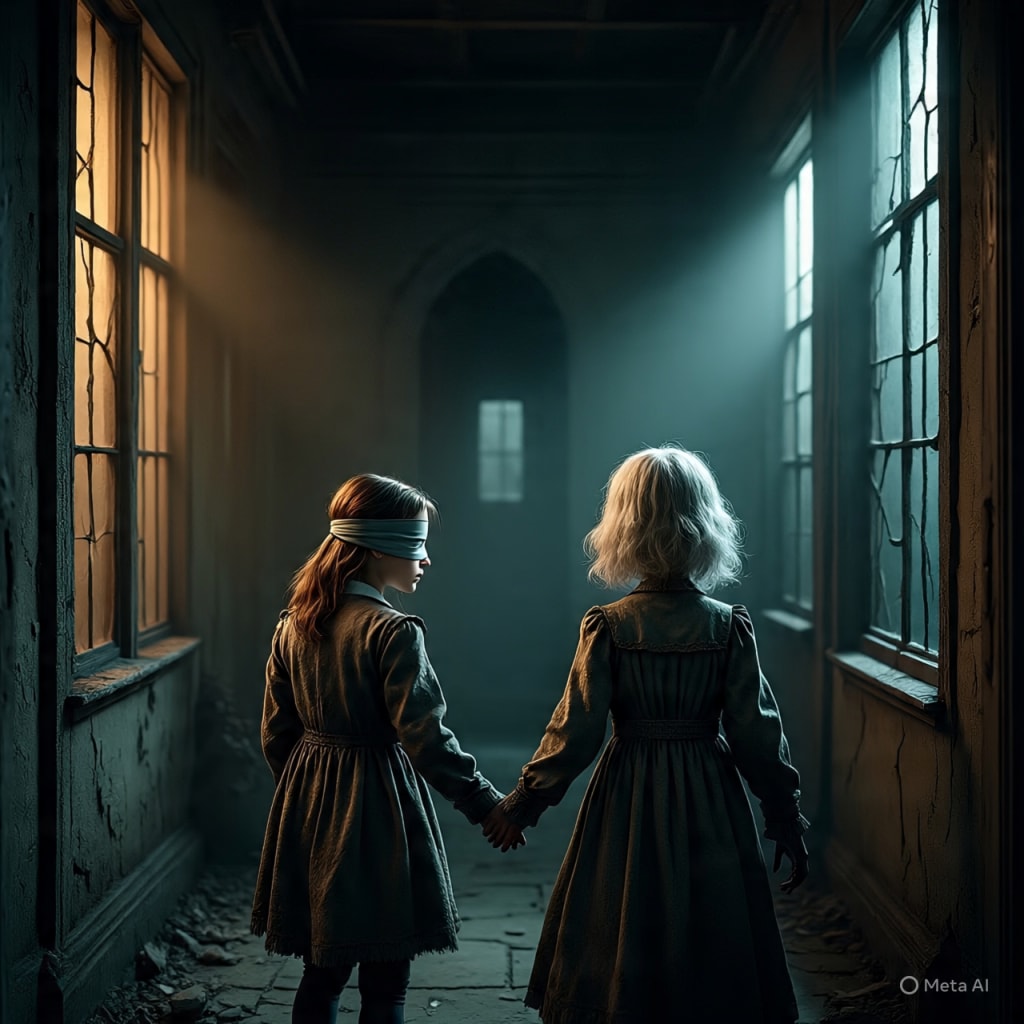
The Foster House Whispers
Grief takes many forms, but none as terrifying as hope twisted into obsession.
My best friend used to be terrified of horror films. Even a paper cut in a movie could send her turning away, mumbling how she couldn’t watch. But something changed over the years. These days, she’s the one dragging me into dimly lit theaters, whispering, “Let’s see if this one leaves a mark.”
That’s exactly what Bring Her Back did—it left a mark. A deep, unsettling one.
The movie doesn’t scream in your face with theatrics. It doesn’t flood the screen with gore. Instead, it creeps under your skin with every passing scene. It’s the kind of horror that haunts you not because of what’s shown, but what’s hinted at—the slow unraveling of reality, the quiet screams in silence, and the way love can twist into something monstrous when grief grips too tightly.
The plot is deceptively simple. Two recently orphaned step-siblings are sent to live with a foster mother who, on the surface, seems gentle, nurturing. But the house they enter is drowning in sorrow—a sorrow so thick, it seems to live in the walls.
The foster mother, played masterfully by Sally Hawkins, is not the sweet matriarch you’d expect. Known for her warm roles, she transforms here into someone driven by grief, someone who’s lost a child and refuses to let go. Her pain is not loud—it whispers, manipulates, and moves like smoke. Her affection for the younger sister feels unnatural, obsessive even, while her treatment of the older brother borders on cruelty masked as discipline.
You feel for the boy. Billy Barratt’s performance as the older sibling is raw and powerful. He’s not just adjusting to loss—he’s sensing that something in this house is deeply wrong. It starts with small things: locked rooms, hushed conversations, a mysterious videotape, and a third child in the house who is rarely spoken of. The foster mother lies about him. Avoids his name. When he does appear, he brings with him a sense of dread so sharp you feel it cut through the screen.
This mysterious child is played by Jonah Wren-Phillips in what I can only describe as a chilling, emotionally shattering role. His scenes create the kind of body horror that doesn’t rely on gore, but on movement—distorted, unnatural, and utterly wrong. You want to look away, but you can’t. He becomes the physical embodiment of grief left to rot.
Then there’s the younger sister, played by newcomer Sora Wong, who absolutely stuns in her first role. Her character, like her, is partially sighted—a fact that is central to the film. There’s something tragic and strong in her gaze. She doesn’t see the danger coming in the usual way, but she feels it, intuitively, instinctively. She’s the heart of the story, and the key to the foster mother’s twisted plan.
The deeper the siblings dig, the more they uncover signs of a ritual—some desperate attempt by the foster mother to reverse fate, to bring her child back. The videotape they find shows fragments of it—strange symbols, whispered chants, and a girl who looks disturbingly like the younger sister.
But this is not a film about ghosts or demons in the traditional sense. It’s about human grief—unfiltered and untreated. It shows how the refusal to let go of someone can birth monsters—not the kind with claws and fangs, but those that wear familiar faces and speak softly.
There are jump scares, yes—a kitchen scene with a watermelon will never leave me—but the real terror lies in the silence. In the moments between words. In the long, lingering shots of a hallway that feels too quiet.
I found myself clenching the armrest not because something was jumping out, but because the dread was unrelenting. Every scene added to it, layer after layer, until it was suffocating.
And yet, you care. That’s the genius of it. This isn’t horror for the sake of fear—it’s horror that says something. About loss. About memory. About what it means to hold on too tightly and the damage we can do when we can’t let go.
As the credits rolled, neither of us spoke. The lights came up, but the weight of the film stayed with us like a bruise you keep pressing to make sure it’s still there.
I’ll be thinking about Bring Her Back for a long time. Not just because of the chilling scenes or the haunting performances—but because it reminds us that sometimes, the scariest thing isn’t what’s lurking in the dark.
It’s what grief turns us into when we think no one’s watching.
About the Creator
Saeed Ullah
the store
Keep reading
More stories from Saeed Ullah and writers in Horror and other communities.
The Shattered Veil
The Shattered Veil A Descent Into Light and Madness The personality changes again—just like that. Not in weeks or months, but in moments. One moment calm, the next unraveling. A transient soul, flickering between forms, between thoughts. There is a strange comfort in the instability. A familiarity in being lost.
By Saeed Ullah 7 months ago in Horror
I wanted to title this something different, but worried that my chosen title might cause problems entering the United States in the future so this is the new title. It's the greatest title. No one has ever written a title better than this. (All titles unrelated to content).
Let me be honest. I am finding this difficult. Now, I like a challenge, a stretch, a bit of an obstacle course. “Write about the decline of the British Empire in the form of a narrative poem in which your protagonist is an artichoke” I read, and flex my fingers. “Write a haiku to evoke the sensation of sibilance using only the first half of the alphabet.” “Well”, I think to myself, “this should be fun.” But “write about a system that isn’t working”? A system that isn’t working? Now? In 2026? ONE system? My favourite system that isn’t working? The sexiest system that isn’t working? The one giving me the most angst day to day? The one giving me the most existential dread? I am, as I say, finding this difficult. I will own that I have contemplated writing a thousand words on why the steady “all on” setting on my fairy lights is the EIGHTH of seven options which must be sequentially activated to get there, because that is a system that some fool came up with and it definitely doesn’t work, and now who is paying the price, eh? But how can I write about my fairy lights when…. When…. When….
By Hannah Moore4 days ago in Humans


Comments (1)
Hi