
The Forgotten Room (part 1)
Some doors in your childhood home should never be opened.

When my parents passed away within months of each other, I was left with their century-old house on Pine Hill Road. I hadn't visited much in the past decade, too busy with life, career, and obligations in the city. But now I stood before the weathered blue door of my childhood home, keys in hand and grief sitting heavy on my shoulders.
It was never a place I disliked, but there had always been something off about it. A creaky silence that settled after dusk. The way the walls whispered when the wind blew. And then there was the room at the end of the hall—the one we never entered.
Mom used to call it the sewing room, though I never once saw her sew. Its door was always shut, and I never heard a sound from it. Once, when I was seven, I asked her what was inside.
“Old memories,” she said quietly. “Some are best left alone.”
Now, alone and melancholy, I wandered the house with a mug of lukewarm coffee. Dust lay in thick blankets on forgotten furniture. Family photos tilted askew on the walls. Every corner held a memory. Laughter, arguments, birthdays. And then… the end of the hall.
The door was still there—brown, plain, silent. My hand hovered near the knob. I'd never dared open it before. But something pulled me forward now, like a string tied to my chest.
The knob was ice-cold. It turned easily.
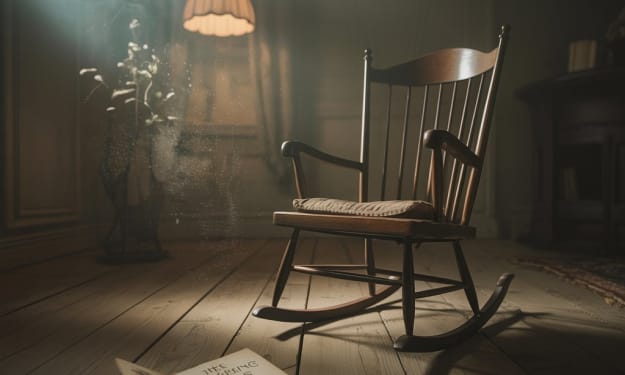
Inside was dim. The blinds were drawn, and the air was heavy with the scent of time—old paper, dry flowers, and something sour beneath it. The room was almost empty, save for a wooden rocking chair in the corner and an antique vanity covered in a white sheet.
I stepped in, heart beating faster. The room didn’t feel right. I couldn’t explain it, but the air felt thick, like stepping underwater. I pulled the sheet off the vanity. Beneath it was a mirror, cracked down the middle. Dust clung to it, yet I could still see my reflection. Except—no. That wasn’t me.
I blinked hard.
My reflection didn’t blink back.
It tilted its head slowly, lips curling into a smile I wasn’t making.
I stumbled backward, breath caught in my throat. The room suddenly felt colder. The light from the hallway dimmed.
Then the rocking chair creaked.
I turned, and for a split second, I saw something seated there—a shadow with long hair, its face hidden. It rocked slowly, rhythmically, as if it had been waiting. Watching.
I ran.
Slamming the door behind me, I leaned against it, panting. My skin prickled with cold sweat. But even then, I heard the soft creaking from within.
Rocking.
That night I couldn’t sleep. I told myself it was stress, grief, exhaustion. But the image of that grinning reflection haunted me.
The next morning, I called the local historical society. A woman named Sandra picked up. When I mentioned the house on Pine Hill and the strange room, she went quiet.
“That house… belonged to the Wexlers before your family bought it,” she said. “In the 1920s, their daughter, Margaret, went missing. Rumors say she was locked away by her parents. She was different. They called her mad.”
“What happened to her?”
“No one knows. The parents died mysteriously. Neighbors said they heard crying and laughter coming from the attic—or the sewing room.”
I hung up.
That evening, I returned to the room with salt, candles, and a prayer I half-remembered from my grandmother. I left the door open, lit the candles, and whispered an invitation to peace.
The rocking stopped.
The mirror, still cracked, showed only my reflection.
I shut the door gently, this time with reverence instead of fear.
Some rooms are not forgotten.
They are simply waiting for someone to remember.
About the Creator
Keep reading
More stories from Hammad khan and writers in Horror and other communities.
The Echoes Beneath the Floorboards
When Mira bought the old Victorian home on the edge of Fairweather Street, she wasn’t looking for a fresh start. She wanted silence. The kind of silence that only old wood and forgotten rooms could offer. After a messy breakup and the death of her mother, Mira needed a place that didn't ask questions.
By Hammad khan8 months ago in Horror
📢 Raise Your Voice Thread: 03/05/2026
Our “Raise Your Voice Threads” are hosted most alternating Thursdays at 12PM ET to offer creators more avenues to uncover exceptional stories on Vocal. As we are continuously searching for fresh creators and inspiring stories, this thread provides an opportunity to exchange and discuss the stories that have moved and motivated us on Vocal.
By Raise Your Voice by Vocal4 days ago in Resources


Comments
There are no comments for this story
Be the first to respond and start the conversation.