
The Forgotten Passenger
The Vanishing of Rezaul Karim: A Mystery That Lingers in the Shadows of Time

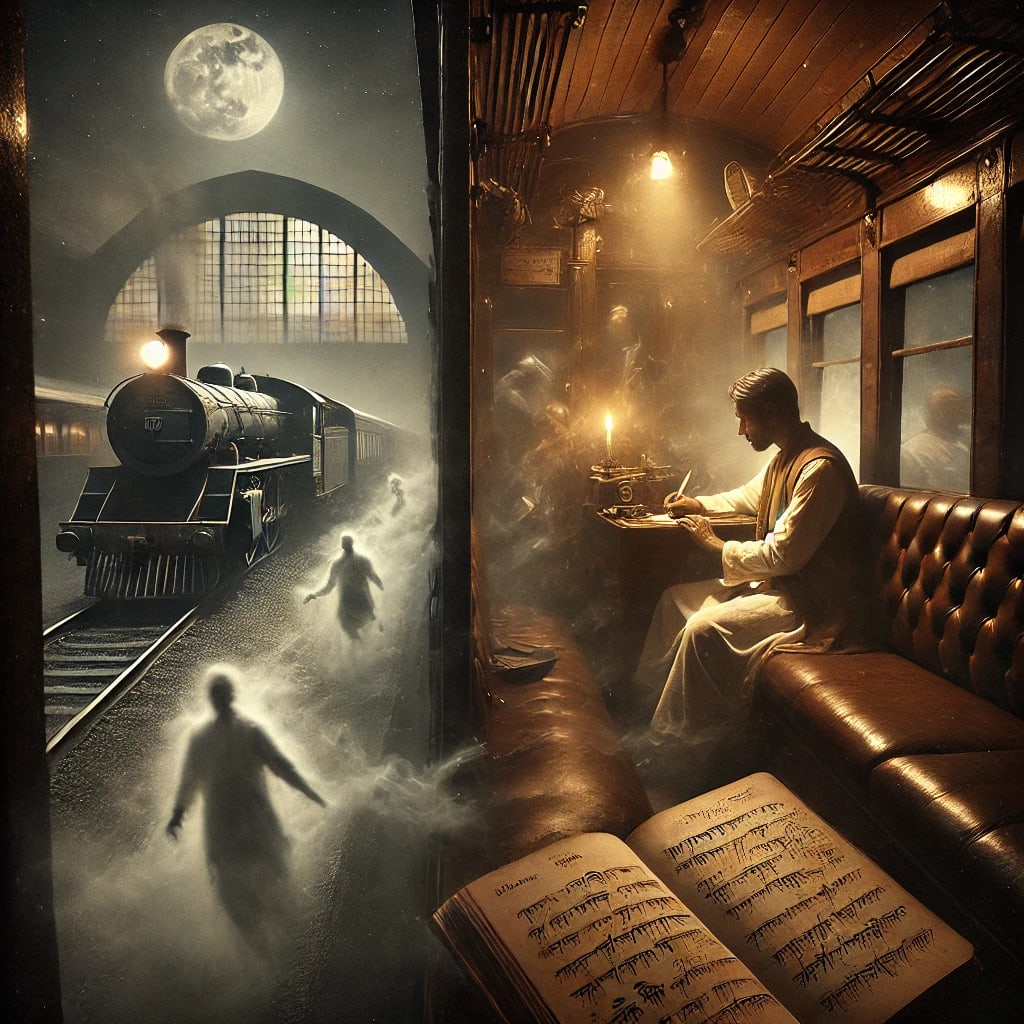
The year was 1910, and the city of Calcutta pulsed with life. The air was thick with the scent of burning coal and the distant aroma of street vendors selling chai and fried snacks. The streets, a chaotic blend of horse-drawn carriages, rickshaws, and the occasional automobile, bustled with people moving about their daily routines. The imposing façade of Howrah Station loomed over the riverbanks, its iron and stone structure standing as a gateway between past and future, tradition and modernity.
On that evening, as the last train to Dhaka prepared for departure, the station was unusually quiet. The usual frenzy of hawkers and coolies had faded, leaving only the echoes of hurried footsteps and the murmur of departing passengers. Steam hissed from the locomotive, curling into the night air like a ghostly apparition.
Among the travelers stood a man draped in a simple white kurta, a faded brown shawl draped over his shoulders. His face, gaunt and shadowed under the dim station lights, carried an air of familiarity. He had no luggage, only a worn leather-bound notebook clutched tightly to his chest. His eyes, dark and brooding, scanned the platform before he stepped onto the train’s last carriage, settling into a dimly lit compartment.
Across from him sat a British officer, his uniform impeccably pressed, the brass buttons gleaming under the gaslight. He regarded the man with a mixture of curiosity and suspicion but said nothing. The train lurched forward with a shrill whistle, its iron wheels rolling against the tracks, slicing through the thick silence of the night.
The man in the kurta was Rezaul Karim, a name that once echoed through the corridors of the revolutionary press. A journalist by profession, he had written for The Bengal Gazette, a publication notorious for its relentless criticism of the British Raj. His words, sharp as a sword, had called for justice, for resistance, for the awakening of a slumbering nation.
Then, he had vanished.
Rumors had swirled—some claimed he had been imprisoned, others whispered that he had fled to France, like many other revolutionaries. Some even suggested he had been killed, his body disposed of in the Hooghly River, never to be found.
But here he was, traveling alone on a near-empty train bound for Dhaka, his notebook filled with inked words that no one else had yet seen.
The train rattled through the countryside, past sprawling fields and quiet villages bathed in moonlight. The officer across from him dozed off, his head tilted against the wooden paneling. Rezaul, however, did not sleep. He scribbled in his notebook, his mind brimming with thoughts that demanded to be recorded. He wrote about the struggle of his people, about the men and women who had given their lives for a cause greater than themselves. He wrote about the betrayals, the sacrifices, and the dream of a free India—one that had yet to be realized.
As the night deepened, the rhythmic clatter of the train tracks became a lullaby to most passengers, but Rezaul remained awake. He felt the weight of his own words pressing upon him, a responsibility he could not ignore. He was carrying more than just ink and paper—he was carrying a truth that could not be silenced.
Then, sometime past midnight, something changed.
The compartment door creaked open slightly. A gust of wind rushed in, fluttering the pages of his notebook. Rezaul looked up, expecting to see a ticket inspector or a wandering passenger.
But no one was there.
He glanced toward the officer, who remained asleep, undisturbed. Slowly, he rose from his seat and stepped into the narrow corridor. The train swayed gently, the oil lamps casting flickering shadows on the walls. He peered into the other compartments, but they were empty, their occupants sound asleep.
A strange unease settled in his chest.
He returned to his seat, clutching his notebook tighter. Something was amiss, but he could not place what it was. The air felt heavier, the silence deeper.
Then, as suddenly as it had come, the feeling vanished.
The train continued its journey into the night.
By dawn, the locomotive steamed into Dhaka Station. Passengers stirred from their sleep, gathering their belongings as the train came to a halt. The officer stretched, blinking against the morning light. The other passengers began to disembark, their tired faces eager for the day ahead.
But when the conductor came to check the compartments, he paused.
The last carriage was empty.
Rezaul Karim was gone.
His notebook lay open on the seat, ink smudged by the wind that had rushed through the compartment. Its pages were filled with his final thoughts—his fears, his hopes, his last testament to a nation in chains. But of the man himself, there was no trace.
The railway staff searched the entire train. They questioned the passengers, the officer, the station workers. No one had seen him leave. No one remembered him stepping off the train. It was as if he had dissolved into the very air, vanishing like the morning mist.
The story of The Forgotten Passenger spread like wildfire. Some believed he had been taken by British intelligence, spirited away in the dead of night before he could publish his final words. Others insisted he had jumped off the moving train, choosing to disappear rather than be silenced. And then, there were those who swore they had seen his ghost—standing at the very edge of Howrah Station, notebook in hand, waiting for a train that would never arrive.
Years passed, and the memory of Rezaul Karim faded into history, his disappearance becoming just another mystery whispered among revolutionaries. But his words endured. His notebook, discovered by an unknown hand, was passed down through generations, its inked pages a reminder of a battle yet to be won.
And sometimes, on lonely nights when the last train to Dhaka rumbles through the darkness, travelers claim to hear the faint rustle of paper, the hurried scribbling of a pen against parchment.
As if somewhere, in the echoes of time, Rezaul Karim still writes, his story never truly forgotten.

About the Creator
Digital Home Library by Masud Rana
Digital Home Library | History Writer 📚✍️
Passionate about uncovering the past and sharing historical insights through engaging stories. Exploring history, culture, and knowledge in the digital age. Join me on a journey through #History
Keep reading
More stories from Digital Home Library by Masud Rana and writers in Horror and other communities.
The Chains of Echo Hollow
Chapter 1: The Weight of Inheritance Evelyn Marlowe hadn’t set foot in Echo Hollow in seventeen years. The town clung to the Appalachian foothills like a secret, its streets lined with sagging clapboard houses and oak trees bent into arthritic shapes. She’d sworn never to return after her mother’s funeral, but death had a way of rewriting vows. Her father’s lawyer had called it a sudden accident. The townsfolk called it poetic.
By Digital Home Library by Masud Rana9 months ago in Horror
5 Most Haunted Objects in History: From Annabelle to Robert the Doll
I have a confession to make: I am obsessed with European history, specifically castles. There’s something about a stone fortress that feels like a magnet for the paranormal. In my mind, every castle is haunted, usually by a lady in a white dress, a headless nobleman, or (the absolute worst) creepy ghost children.
By Areeba Umairabout 3 hours ago in Horror


Comments (1)
welcome