
The Finale – The Bone-Light
How an Orphaned Village Became a Mouth for Something Older

The Finale – The Bone-Light
They say the village of Norhill was swallowed by the forest, but the truth is far stranger. It didn’t vanish into nature — it opened up, like a mouth. And what it swallowed wasn’t just people, but memory itself.
I only found out about Norhill because of an old leather-bound journal I bought at a flea market in Essex. The vendor was pale, jittery, and refused to take money for it. He only said, “It’s yours now,” and vanished behind his stall.
The journal belonged to someone named Elsie Grange, a schoolteacher who moved to Norhill in 1928. Her entries began normally — lesson plans, village gossip, livestock counts — but slowly, things changed.
“April 17th — The children saw a light in the woods. Pale white. No heat. No shadow.”
“May 4th — Anna didn’t come home last night. She was last seen staring into the Bone-Light.”
“June 1st — The light speaks now. No one can remember what it says after it’s gone.”
Bone-Light. The term repeated, again and again, until her writing became more frantic — symbols replacing words, margins filled with charcoal sketches of mouths where trees should be.
Obsessed, I searched for Norhill. No official records. No maps. But then, in a forgotten corner of the British Library, I found a 1901 census record listing Norhill’s population: 142. All names. All erased in later registries.
So I went looking.
It took me two days to find what was left of Norhill — buried in the heart of a forest that doesn’t appear on GPS, past roads that vanish behind you when you walk them.
What I found wasn’t a village.
It was… a skeleton of one.
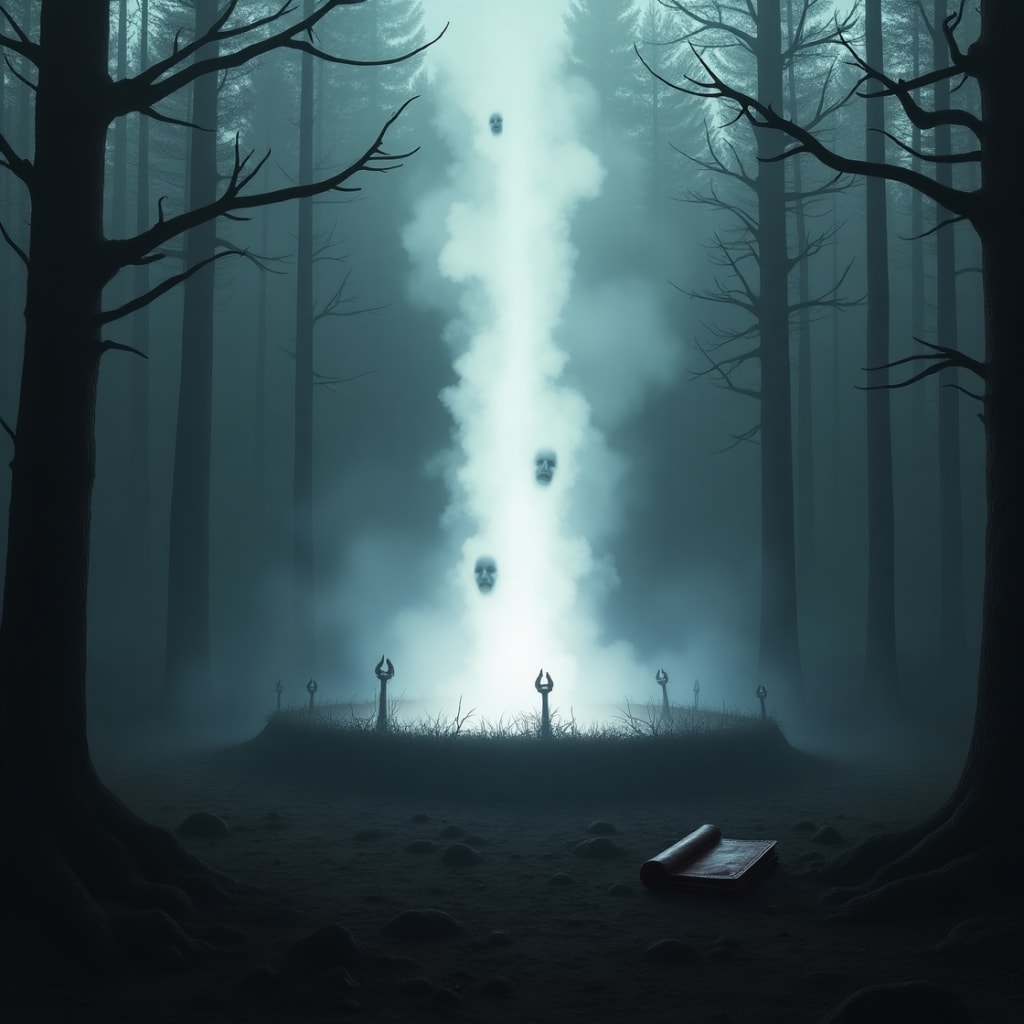
Foundations of houses sat buried under moss. A rusted bell tower leaned like it was whispering to the dirt. But at the village center stood a perfect circle of scorched earth — maybe fifty feet wide — where nothing grew. No trees. No grass. No birds dared cross it.
In the center of that circle was the Bone-Light.
It wasn’t fire. It wasn’t electricity.
It was a column of white light rising ten feet high, humming like an insect’s wings. And inside it — faint, shifting, screaming — were faces.
Dozens. Hundreds. Twisting in agony.
I should’ve run. But I stepped closer.
The humming grew louder, drilling into my teeth, my bones. My memories — my own name — began to slip like sand through fingers.
Then it spoke.
Not with words. With knowing.
It knew every secret I’d buried. It offered me visions — my dead brother alive, my childhood restored, the pain erased.
But then I heard Elsie’s voice — not from the light, but from the journal in my bag. It burned hot against my back.
“Don’t listen,” she had written. “It takes what it shows. The light doesn’t want worship. It wants mouths.”
Because the Bone-Light was not a god.
It was a wound in the world, a tear in the fabric of time and place. A gate — or maybe a throat — for something older. Something buried beneath nor hill before it was even a village.
And the people? They didn’t disappear.
They became the tongue.
Every prayer, every scream, every word spoken near the light fed it. Until nor hill itself became the last utterance of a dying mouth — frozen mid-sentence in a language too old to speak.
I turned and ran.
Branches clawed my face. The forest screamed in voices I knew — my mother, my lover, even myself. The light tried to pull my name from me, to burn it out of my mind. I bit my tongue to stay tethered.
I don’t remember how I got back. My phone was fried. My boots were missing. But I had the journal.
And in it, one final message:
“If you see the Bone-Light, do not speak. Do not wish. Do not write. For writing is remembering, and remembering feeds it.”
So why am I writing this?
Because someone has to know. Someone has to warn the next fool who stumbles into Norhill.
If you ever see a white light in the woods — one that hums like bees in your skull, one that shows you the life you almost had — don’t follow it.
Walk away.
Bite your tongue.
Forget your name if you must.
Just don’t speak.
Because when you do…
The Bone-Light listens.
And it never stops eating.
About the Creator
Wings of Time
I'm Wings of Time—a storyteller from Swat, Pakistan. I write immersive, researched tales of war, aviation, and history that bring the past roaring back to life
Keep reading
More stories from Wings of Time and writers in Horror and other communities.
Top 10 Spring Break Horror Movies
Spring Break is often associated with fun, sun, and relaxation, but in the world of horror films, it can also be a time of terror and chaos. College students and high school students are having a great time, unaware that the worst is yet to come.
By Ninfa Galeano4 days ago in Horror
Top tipple tricks
Been thinking a lot about drinking, lately. Not least because of a recent episode of over-indulgence and the inevitable after effects. Some readers may recall the earlier articles I wrote about beating the booze. Here I set out an experiment in techniques for cutting down on my alcohol intake. The experiment was successful, the techniques worked, and I have armed myself with an arsenal of weapons in the war against the demon drink. I have yet to fire the first round however. It's all a question of timing (perhaps procrastination).
By Raymond G. Taylor6 days ago in Psyche



Comments
There are no comments for this story
Be the first to respond and start the conversation.