
The Creeping Horror of Vietnam: When Soldiers Faced More Than Just the Enemy
Meet the Predator Scolopendra subspinipes

When we think of war, images of soldiers, weapons, and battles usually come to mind. But in Vietnam, the battlefield was far more complex. American troops weren’t just fighting the Viet Cong they were also fighting the land itself.
The jungle was as much an enemy as any armed soldier. Humid, dense, and alive with danger, it offered cover for ambushes but also harbored countless creatures that made every day a survival test. Leeches clung to the skin, mosquitoes carried malaria, snakes lay hidden in the underbrush, and spiders crawled into sleeping bags. The soldiers were foreign visitors in a hostile ecosystem, and nature did not welcome them kindly.
A Photograph That Froze Fear in Time
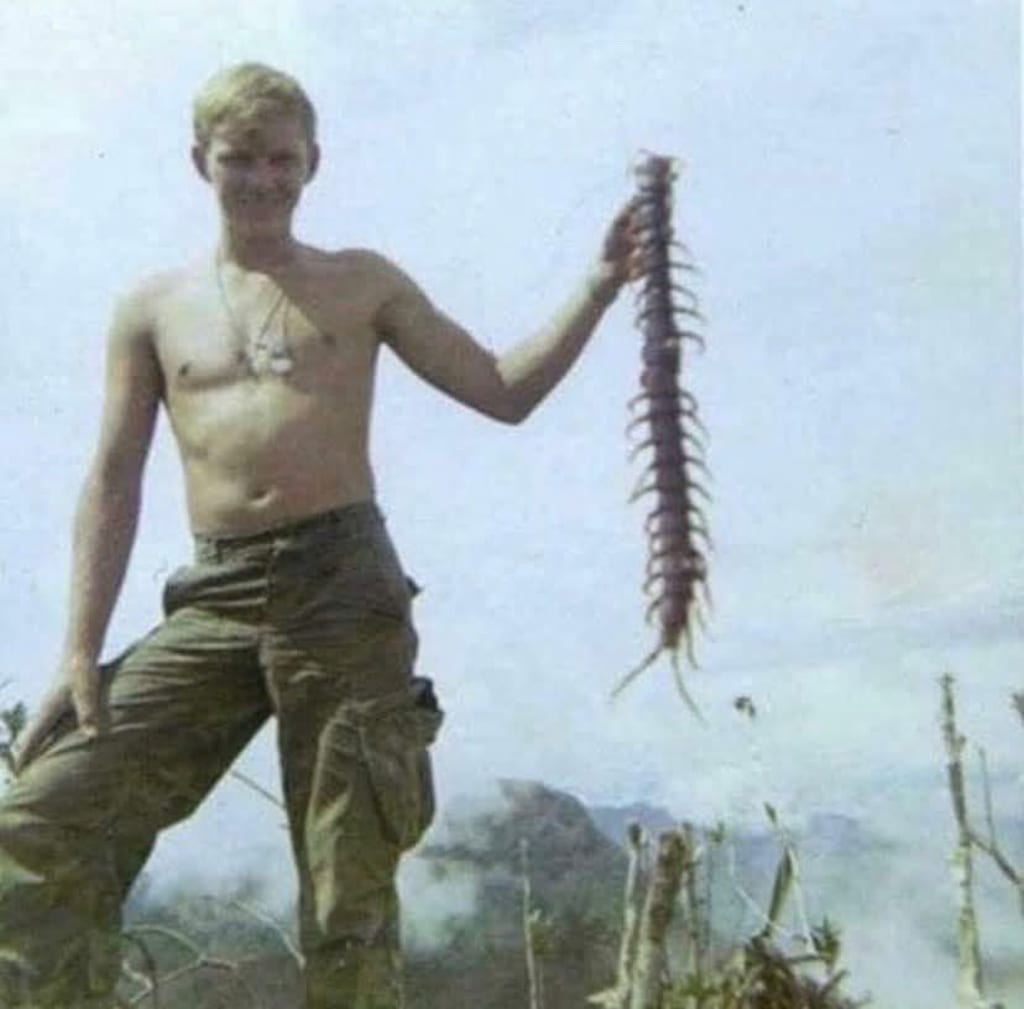
In 1967, one haunting photograph captured this reality in a single frame. An American soldier appeared to be holding a monstrous centipede aloft by a fishing line. The insect seemed impossibly large, dangling like a nightmare from his hand.
In truth, the centipede was closer to the camera than the soldier, creating the illusion of exaggerated size. But even without camera tricks, the creature was frightening enough. This was Scolopendra subspinipes, one of the largest centipedes in the world and a predator perfectly adapted to the jungles of Southeast Asia.
For the men serving in Vietnam, this wasn’t just a curiosity. It was a daily reminder that the jungle itself was watching, waiting, and striking when least expected.
Meet the Predator: Scolopendra subspinipes
Known to grow up to 12 inches (30 centimeters) long, the giant centipede is a relentless hunter. Its reddish brown armored body and dozens of writhing legs earned it a place in soldiers’ nightmares.
This creature’s menu ranged from insects and spiders to scorpions, small lizards, rodents, and even baby birds. Using venomous fangs, it would pierce its prey, injecting toxins that caused rapid paralysis. Once bitten, the victim was doomed. The centipede then wrapped its long body and countless legs around the struggling animal until it was still.
For soldiers, the idea of such a creature crawling into their boots, sleeping bags, or even helmets was enough to rob them of rest. In a war where fatigue already killed morale, the jungle’s predators pushed them closer to the breaking point.
Jungle Nights of Unease
Night in the Vietnamese jungle was the enemy’s greatest ally. Visibility dropped, the sounds of insects filled the air, and every movement in the shadows felt like a threat. Soldiers who already feared ambush now had another layer of anxiety creeping creatures that could strike at any moment.
Accounts from veterans often describe waking up to find snakes coiled near them, spiders crawling across their bodies, or leeches swollen with blood after hours of unnoticed feeding. The giant centipede, however, was in a class of its own. Its size, speed, and venom combined to make it one of the most feared jungle dwellers.
It wasn’t just physical danger it was psychological torture. Knowing that nature itself was against you wore down even the toughest fighters.
The Psychological Toll
War is not only about bullets and bombs it’s also about endurance. In Vietnam, endurance meant facing the unknown, whether from an enemy hidden in the trees or a venomous insect slipping into your clothing.
The giant centipede became a symbol of the uncontrollable. You could train for combat, study enemy tactics, and carry weapons but there was no preparation for a sudden sting in the dark. Soldiers learned to live in constant vigilance, a state that took a heavy toll on their minds.
By the time many returned home, they carried not only physical scars but memories of jungle horrors that few outside the war zone could ever understand.
More Than Bullets and Bombs
This single photograph from 1967 tells a story larger than itself. It shows that war is never just man against man. It is also man against nature against heat, disease, fear, and creatures beyond imagination.
For the men in Vietnam, survival wasn’t measured only by dodging bullets. It meant staying alive in a place where the jungle itself seemed intent on killing them. The giant centipede was one of many enemies, but it represented something deeper: the reminder that human beings are small in the face of nature’s raw power.
More than half a century later, the image still chills us, not because of the soldier, but because of the creature dangling in front of him. It stands as a stark reminder that war is never fought on one battlefield it is fought on every front where human beings test the limits of survival.
✨ Author’s Note:
This article is my own work, though I used AI for refining structure and flow. I was drawn to this story because it reveals the hidden horrors of war those that come not from human cruelty, but from the relentless force of nature.
About the Creator
Izhar Ullah
I’m Izhar Ullah, a digital creator and storyteller based in Dubai. I share stories on culture, lifestyle, and experiences, blending creativity with strategy to inspire, connect, and build positive online communities.
Keep reading
More stories from Izhar Ullah and writers in Horror and other communities.
The Lost Couple of the Chihuahua Desert: A Mystery That Refuses to Die
The Chihuahua Desert, one of the largest deserts in North America, stretches across northern Mexico and parts of the southwestern United States. With its blazing sun, endless stretches of sand, and towering cacti, it is both breathtaking and unforgiving. For centuries, this landscape has hidden stories of survival, loss, and mystery. But few are as unsettling as the disappearance of Ethan Morrison and Alice Peterson in March 1994 a case that still raises questions more than three decades later
By Izhar Ullah4 months ago in Horror
The Character Who Isn’t on Payroll
Posted to r/nosleep I work at Disneyland. I won’t say my department, but I’m close enough to characters that I see schedules, handoffs, rotations—the boring, logistical side of “magic.” Which is why this has been driving me insane.
By V-Ink Stories2 days ago in Horror


Comments
There are no comments for this story
Be the first to respond and start the conversation.