

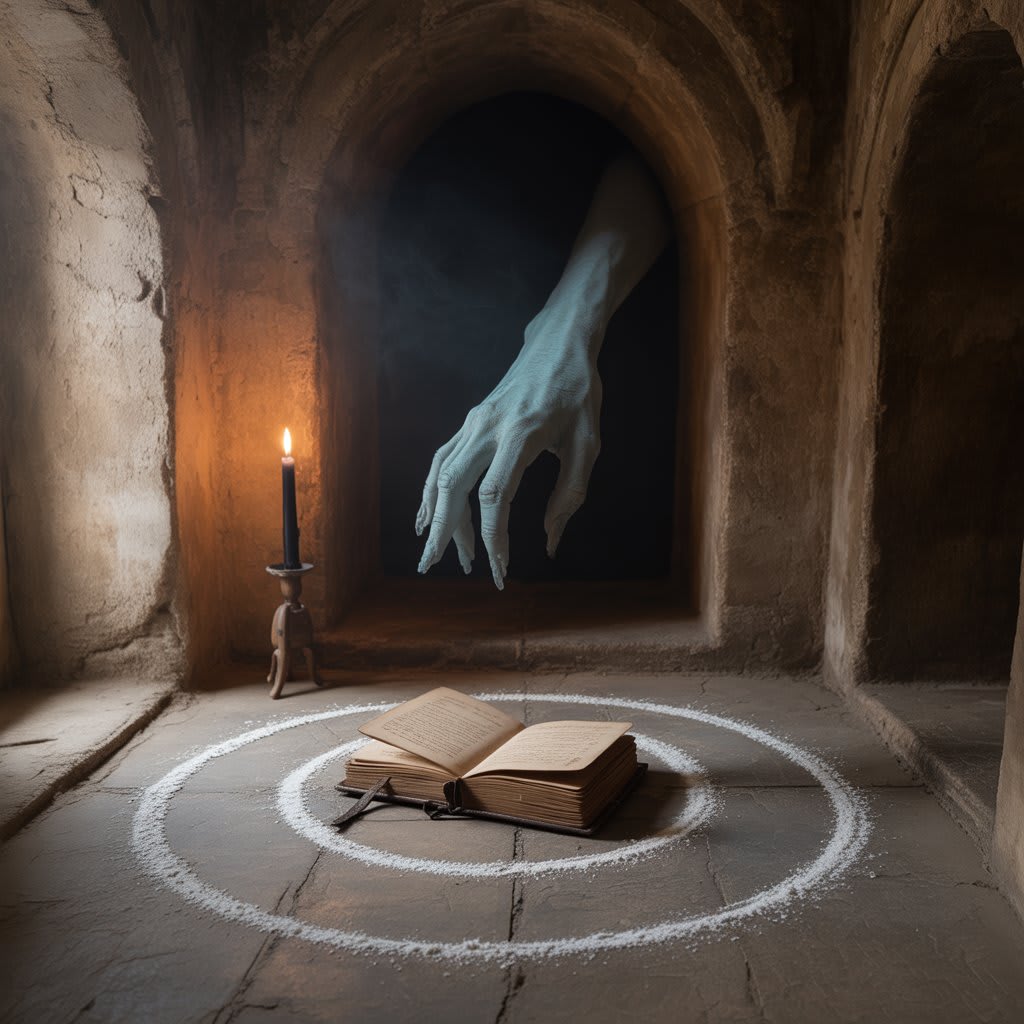
👹
The Merrick House wasn’t supposed to exist anymore.
It stood at the edge of Blackthorn Hollow in southern England, hidden behind skeletal trees and ivy so thick it almost swallowed the roof. The locals swore it should have collapsed years ago. They avoided it, crossing the street rather than walking past its gate. The older villagers remembered too well what had happened inside.
In 1923, the Merrick family—father, mother, two daughters—disappeared. Neighbors found the house unlocked, food left half-eaten on the table, the piano still playing faintly. But no one was inside. Only a smear of blood on the stairs. Police searched for months, but the family was never found. The house was boarded up, then abandoned, but somehow it never fell apart.
Almost a century later, Emma, a 27-year-old artist from London, bought it.
She wasn’t superstitious. To her, the stories were village gossip, nothing more. The house was cheap, too cheap, and as someone who wanted peace and quiet, it felt like a blessing.
“It has character,” she told her friends with a laugh.
They warned her not to. They told her the stories. She didn’t listen.☠️
The first week, nothing happened. She painted in the mornings, walked the hollow paths in the afternoons, and at night, she read by the fire. The house was drafty, but no more than she expected.
But then the sounds began.🤫
It started on the fourth night. She woke around 3 a.m. to something moving upstairs—heavy, slow, dragging footsteps. She froze, heart pounding, listening. They crossed the hallway above her bedroom, then stopped. She told herself it was the house settling.
The next night, she heard it again. Only this time, it came from inside her room. Breathing. Low, steady, right beside the bed. She turned on the lamp, but no one was there.
By the sixth night, the house had a rhythm. Knocks on the walls. Doors creaking open. The piano, untouched for decades, groaning a single note in the darkness.
She confided in Father Rowan, the old parish priest. His face went pale. “Leave it,” he told her. “That place isn’t empty.”
Emma laughed it off. “It’s just a house.”🎃
The priest shook his head. “No. It’s hunger.”
That night, the “hunger” came for her.👹
At 2:57 a.m., the piano started playing by itself, soft but deliberate. Emma, her heart hammering, went downstairs with her phone flashlight. The room was empty, yet the keys pressed themselves—three notes, repeating over and over. Her phone froze when she tried to record.
Then she noticed the mirror.
It was an old gilt-edged mirror in the parlor, one she had barely paid attention to before. But now, in the weak glow of her phone, something about it was wrong. Her reflection was delayed, moving just slightly after she did. And then—it smiled, though she did not.
Her phone clattered to the floor. She ran back upstairs, locked her door, and sat against it, trembling until dawn.
The following day, she decided to leave. She packed her bags, loaded her car, and turned the key in the ignition. Nothing. The engine wouldn’t start. She tried her phone, but it refused to power on. It was as if the house didn’t want her to leave.
For three days she was trapped there. She stopped sleeping, too afraid of what waited in the dark. She swore she could hear whispering voices in the walls. She swore she saw shapes moving in her peripheral vision. Every time she walked past the parlor, she covered the mirror with a blanket. But sometimes she found it uncovered again.
On the final night, she broke. She called the police from the village phone box after hiking there on foot. When officers arrived, they found her shaking, pale, and refusing to step back into the house.
One officer went in. He later reported the house felt “unnaturally cold” and claimed he heard faint piano music, though the instrument had no working strings. Another swore he saw the blanket over the mirror lift, though no wind was present.
Emma never returned. The house was sold again, boarded up again, left to rot—but still it stands.
The villagers say you can sometimes hear music drifting from it when the wind is still. They say Emma still wakes screaming, even years later, because she dreams of her reflection smiling at her, whispering through the glass:
“You never left.”😳
About the Creator
Essa khan
I write to turn emotions into echoes, weaving tales of love, loss, and beauty in life’s smallest details.
💫 Storyteller of heart and soul, finding meaning in fleeting moments and sharing words that comfort and inspire.
Nothing Felt Wrong at First — That’s What Made It Terrifying
Short introduction Come Closer is a psychological horror novel about possession, but not in the dramatic, spinning-head, holy-water kind of way. It’s quiet, modern, and very close to real life. The book follows a woman named Amanda as something slowly starts going wrong with her thoughts, her behavior, and her sense of self. It’s short, simple, and written in a very direct voice — which is exactly why it works.
By Rosalina Jane3 days ago in Horror


Comments
There are no comments for this story
Be the first to respond and start the conversation.