


Dr. Elena Vasiliev stood in the sterile glow of her laboratory, the hum of machinery a constant companion. The air was thick with the faint metallic tang of ozone, and the centerpiece of the room pulsed with a faint blue light: the Chrono Core, a compact nuclear fusion reactor no larger than a grapefruit, yet capable of bending the fabric of time itself. Years of sleepless nights, failed experiments, and relentless calculations had led to this moment. Tonight, she would test the device that could rewrite her life.
Elena adjusted her glasses, her dark hair pulled into a messy bun. At thirty-eight, she was a prodigy in theoretical physics, but her achievements came at a cost. Her mother, Sofia, had passed away two years ago, and her younger brother, Alex, had grown distant, consumed by his own struggles. Her partner, Clara, a painter with a laugh like sunlight, had stayed by her side, but Elena knew the long hours in the lab had strained their bond. The Chrono Core wasn’t just a scientific breakthrough—it was her chance to reclaim the moments she’d lost.
The device was elegant in its simplicity. By channeling the immense energy of controlled nuclear fusion, the Chrono Core could create a localized temporal field, a bubble that allowed the user to slip through time. The catch? It required precise calibration, and the energy demands were staggering. One misstep could trap her in a temporal void or worse. Elena checked the readings on her tablet: the core was stable, the coordinates set for a test jump—ten years into the past, to a summer evening when her family was whole.
She hesitated, glancing at a photo taped to the console: her, Clara, Sofia, and Alex, laughing at a picnic by Lake Tahoe. The memory was vivid—Sofia’s homemade borscht, Alex’s terrible guitar playing, Clara sketching the sunset. Elena’s heart ached. If this worked, she could see them again, not just as memories but as living, breathing people.
Taking a deep breath, she stepped into the temporal chamber, a glass cylinder lined with sensors. She clipped a portable Chrono Core module to her belt, its faint hum reassuring. The lab’s AI, nicknamed Chronos, ran final diagnostics. “All systems nominal, Dr. Vasiliev,” it intoned. “Temporal jump in T-minus ten seconds.”
Elena closed her eyes. “Here goes nothing.”
The world dissolved in a flash of blue light.
When Elena opened her eyes, she was no longer in the lab. She stood on a grassy hill overlooking Lake Tahoe, the water shimmering under a golden sunset. The air was warm, fragrant with pine and wildflowers. She touched her belt—the Chrono Core module was still there, its display showing a stable connection to the temporal field. She’d done it. She’d traveled ten years back.
Voices carried on the breeze. Elena turned and saw them: her family, just as she remembered. Sofia was setting out plates on a checkered blanket, her silver-streaked hair catching the light. Alex, barely twenty, strummed a guitar, wincing at a sour note. Clara sat cross-legged, sketching furiously, her auburn curls spilling over her shoulders. Elena’s throat tightened. They were so alive, so real.
She approached, her footsteps soft on the grass. Sofia looked up first, her face breaking into a smile. “Elena! There you are. I was about to send Alex to find you.”
Elena froze. They didn’t know she was from the future. To them, she was just their Elena, late as usual. She forced a smile, her scientist’s mind racing. “Sorry, got caught up with… work.”
Clara glanced over, her green eyes sparkling. “You and your equations. Come sit, genius. The borscht is getting cold.”
Elena joined them, sinking onto the blanket. The familiarity was overwhelming—Sofia’s gentle teasing, Alex’s exaggerated groans, Clara’s hand brushing hers as she passed a plate. She wanted to tell them everything: that she’d cracked time travel, that she missed them, that she was sorry for all the moments she’d let slip away. But she couldn’t. Altering the timeline was too risky. For now, she would simply be present.
They ate, laughed, and shared stories. Alex talked about his dream of becoming a musician, his eyes bright with ambition. Sofia recounted a childhood memory from her village in Ukraine, her voice warm with nostalgia. Clara showed Elena her sketch, a vibrant rendering of the lake. “For you,” she whispered, and Elena’s heart skipped.
As the sun dipped below the horizon, Alex pulled out his guitar again, playing a clumsy but earnest rendition of “Blackbird.” Sofia hummed along, and Clara leaned against Elena, her warmth grounding. Elena felt tears prick her eyes. This was what she’d come for—not just to see them, but to feel them, to remember what it meant to be whole.
The Chrono Core module beeped softly, a reminder that her temporal window was closing. The fusion core could only sustain the field for a few hours before needing to recharge. Reluctantly, Elena stood. “I need to… check something,” she said, her voice thick.
Clara frowned, sensing something off. “You okay, love?”
Elena nodded, forcing a smile. “I’ll be right back.”
She walked a short distance away, activating the module. The temporal field shimmered, and in an instant, she was back in the lab, the sterile light jarring after the warmth of the past. She sank into a chair, clutching the photo from the picnic. She’d done it—she’d seen them again. But it wasn’t enough. She wanted more.
Over the next weeks, Elena refined the Chrono Core, increasing its efficiency. Each jump drained her physically and emotionally, but she couldn’t stop. She visited her mother in 2010, helping her garden, memorizing the way her hands moved through the soil. She jumped to 2015, watching Clara’s first art gallery opening, cheering silently from the back. She even tracked down Alex in 2018, before his struggles with addiction began, sharing a coffee and listening to his dreams.
Each trip was a gift, but also a reminder of what she’d lost. Clara, in the present, noticed Elena’s exhaustion. “You’re pushing too hard,” she said one night, her voice soft but firm. “Whatever you’re working on, it’s eating you alive.”
Elena wanted to tell her—about the Chrono Core, the jumps, the moments she was stealing from the past. But how could she explain without sounding unhinged? Instead, she squeezed Clara’s hand. “I’m okay. I promise.”
But she wasn’t. The jumps were taking a toll. The Chrono Core’s radiation shielding was imperfect, and Elena’s bloodwork showed early signs of exposure. Chronos warned her that further jumps could be dangerous, but she ignored it. One more trip, she told herself. One more moment with them all.
She chose a date: Christmas 2013, a snowy evening at their family cabin. It was one of their last holidays together before Sofia’s diagnosis, before Alex’s spiral, before the cracks in her relationship with Clara began to show. Elena calibrated the Chrono Core, her hands trembling. This would be her final jump.
The cabin smelled of pine and cinnamon, the fireplace crackling. Sofia was in the kitchen, rolling dough for pierogies. Alex was untangling Christmas lights, swearing under his breath. Clara was decorating the tree, humming off-key. Elena materialized in the hallway, her arrival masked by the festive chaos. She slipped into the scene, claiming she’d been upstairs.
The evening unfolded like a dream. They cooked together, Sofia teaching Elena the perfect pierogi fold. They decorated the tree, Clara laughing as Alex got tinsel in his hair. After dinner, they played cards, Sofia’s sly cheating sparking mock outrage. Elena soaked in every detail—the creak of the floorboards, the flicker of the fire, the way Clara’s smile lit the room.
As midnight approached, Elena knew her time was up. The Chrono Core’s display flashed a warning: the fusion core was overheating, and the temporal field was unstable. She stepped outside, claiming she needed air. The snow fell softly, blanketing the world in silence. She activated the module, but instead of the usual smooth transition, the field flickered wildly.
Panic surged. The core was failing. If the field collapsed, she could be stranded—or worse, erased. She recalibrated frantically, her fingers numb in the cold. The field stabilized, but a new warning appeared: “Temporal Anchor Compromised.” She was being pulled back to the present, but something was wrong.
The world blurred, and Elena found herself not in the lab, but in a void—a gray, formless expanse. Time didn’t exist here, only an oppressive stillness. Her heart pounded. This was the temporal void she’d feared, a limbo where the Chrono Core’s energy couldn’t sustain her.
Then, a voice. “Elena.”
She turned, and there was Sofia, not as a memory but as a presence, her eyes kind and knowing. “Mama?” Elena whispered.
“You’ve been chasing us,” Sofia said softly. “But you can’t live in the past, my girl. It’s not where you belong.”
Clara appeared beside Sofia, then Alex, their faces gentle. “We’re still with you,” Clara said. “In every moment you carry forward.”
Tears streamed down Elena’s face. “I just wanted more time.”
“You have time,” Alex said. “With the people who love you now.”
The void began to fade, the Chrono Core’s display stabilizing. Elena felt a pull, and suddenly she was back in the lab, gasping, the module smoking in her hands. She collapsed, the photo of the Tahoe picnic fluttering to the floor.
Elena didn’t touch the Chrono Core again. The void had been a warning, and her family’s words—real or not—had struck deep. She dismantled the device, storing its components in a secure vault. The science was sound, but the cost was too high.
Instead, she turned to the present. She took Clara to Lake Tahoe, where they watched the sunset and talked until dawn. She reached out to Alex, now in recovery, and they started rebuilding their bond over coffee and bad guitar sessions. Sofia was gone, but Elena honored her by cooking her recipes, filling the house with the smells of home.
One evening, as Clara painted and Elena read by the fire, Clara looked up. “You’re different lately. Lighter.”
Elena smiled, touching the locket she now wore—a gift from Sofia, found in the cabin’s attic. “I’m learning to be here,” she said.
The Chrono Core had given her a gift, not just in the moments she’d stolen, but in the clarity it brought. Time wasn’t something to conquer—it was something to cherish, one fleeting, beautiful moment at a time.
About the Creator
"Scream 7" (2026): Running out of Fresh Screams
This is the seventh time we’ve had a Ghostface crisis. Scream 7 is the latest edition of the Scream franchise. Sydney Prescott and her family are under attack by another anonymous killer dressed in a Ghostface costume. While having issues with her daughter, Tatum, they run from the bloody murders, trying to determine who is behind it all.
By Marielle Sabbag9 days ago in Horror
Close encounter at the midnight hour.
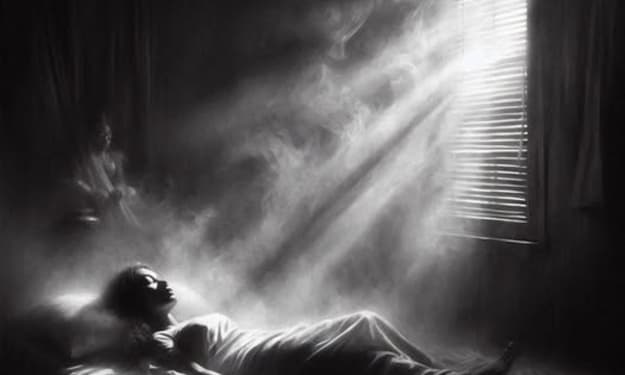
Close Encounters of the Midnight Hour It’s a quarter to 4, just a few hours before dawn. The room is dark; silence engulfs it. I lie in bed and fall asleep. In just a few hours, I will wake up and go through my morning routine. I’m not a morning person—just a bit tired from those sleepless nights.
By Rickles Pez3 days ago in Horror
Silken Chains
Silhouettes of the female form were given flesh and bone. Silken skin glistened under the spotlight. Dry ice rose around our Icons as they danced atop their podiums in the Square. Heralded for their beauty, their movements were slight, powerful, and sensual.
By Paul Stewart4 days ago in Fiction



Comments
There are no comments for this story
Be the first to respond and start the conversation.