
The Catacombs of Paris
The Catacombs of Paris: A Journey Through the City of the Dead

Introduction
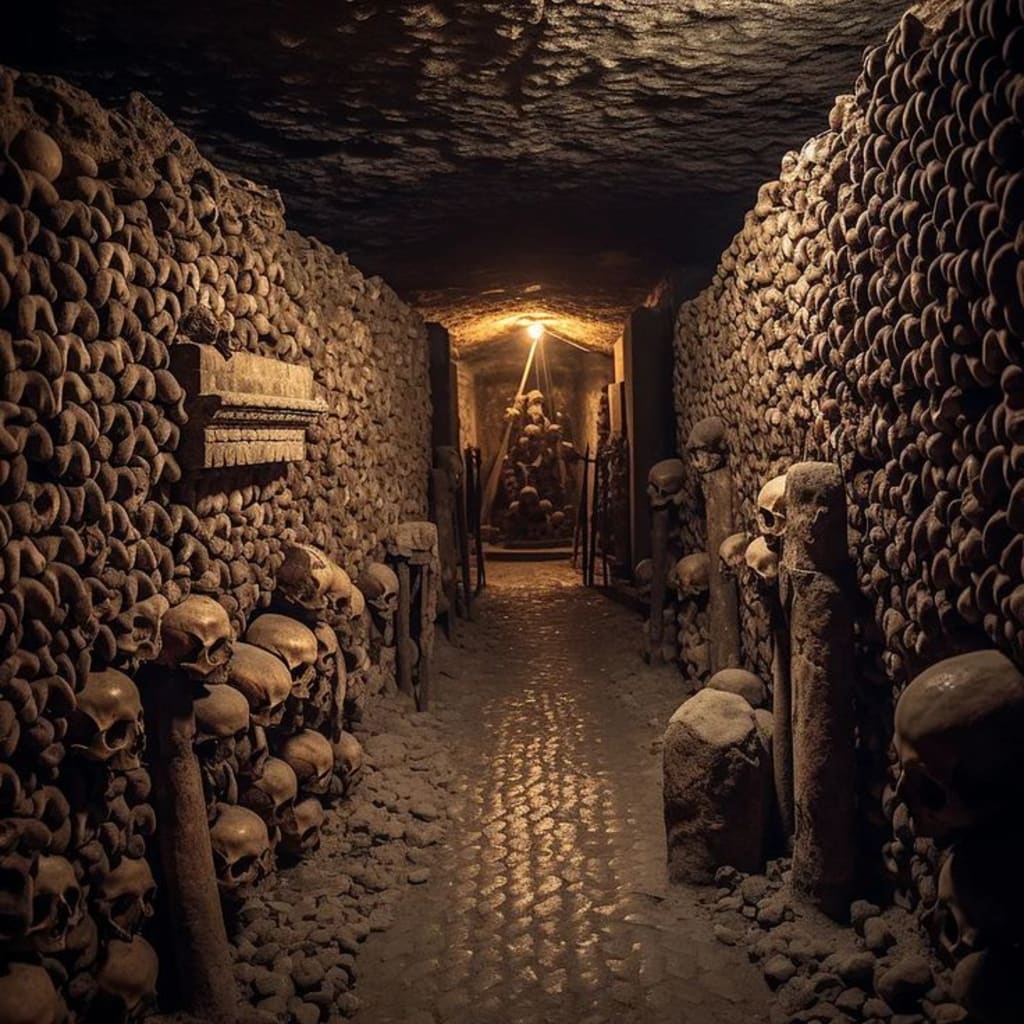
Beneath the bustling streets of Paris lies a hidden world of tunnels, crypts, and bones—the infamous Catacombs of Paris. This underground ossuary holds the remains of over six million people, making it one of the most macabre yet fascinating historical sites in the world. Originally limestone quarries, these subterranean passages were transformed into a massive burial ground in the late 18th century to address the city’s overflowing cemeteries.
Today, the Catacombs attract thousands of visitors who come to witness its eerie yet artistic displays of arranged skulls and bones. Beyond its tourist appeal, the Catacombs hold deep historical, cultural, and even political significance. This article explores the origins, history, legends, and modern-day relevance of the Paris Catacombs.
1. The Origins: From Quarries to Ossuary
A. The Ancient Quarries
Long before they became a burial site, the tunnels of the Catacombs were part of Paris’s vast limestone quarries. Since Roman times, builders extracted stone to construct the city’s iconic landmarks, including Notre-Dame Cathedral and the Louvre. By the 17th century, the underground network had expanded so much that parts of the city were at risk of collapsing.
B. The Cemetery Crisis
By the late 18th century, Paris faced a gruesome problem: its cemeteries were overflowing. The most notorious, the Cemetery of the Innocents, had been in use for nearly a millennium and was so overcrowded that decomposing bodies contaminated the air and water, spreading disease. Authorities needed a solution—and the abandoned quarries provided the perfect space.
C. The Creation of the Ossuary (1786)
In 1786, the French government began transferring bones from overcrowded cemeteries into the underground tunnels. The process continued for decades, with workers carefully stacking skulls and femurs into decorative patterns. The site was consecrated as the "Paris Municipal Ossuary" but later became known as the Catacombs, inspired by Rome’s underground burial sites.
2. Inside the Catacombs: A Maze of Bones
A. The Entrance and Layout
The public entrance to the Catacombs is located at 1 Avenue du Colonel Henri Rol-Tanguy, near the Denfert-Rochereau metro station. Visitors descend a narrow spiral staircase 20 meters (66 feet) underground before entering a dimly lit corridor filled with inscriptions and carvings.
The ossuary itself spans only 1.5 kilometers (0.9 miles) of the 300-kilometer (186-mile) tunnel network, but it is the most meticulously arranged section. Bones line the walls in intricate patterns, with plaques indicating the original cemeteries they came from.
B. Artistic Arrangements
One of the most striking features is the "Barrel of the Passion", a pillar made entirely of bones. Other sections feature skulls arranged in heart shapes or stacked in neat rows. These macabre designs were the work of quarry workers and later restorers who treated the bones with a strange mix of reverence and creativity.
C. Famous Inscriptions
Throughout the tunnels, visitors encounter solemn quotes about death, such as:
"Stop! This is the Empire of Death." (Above the entrance to the ossuary)
"Remember, man, that you are dust, and unto dust, you shall return."
These inscriptions serve as a memento mori—a reminder of mortality.
3. Legends and Mysteries of the Catacombs
A. The Phantoms of Paris
Given its grim history, the Catacombs are ripe with ghost stories. Some visitors claim to hear whispers or see shadowy figures. One famous legend tells of Philibert Aspairt, a doorkeeper who wandered into the Catacombs in 1793 and was found dead 11 years later—his body identified only by his keys.
B. Secret Resistance Meetings
During World War II, the French Resistance used the Catacombs as a hideout. The Nazis also built bunkers in some sections. Today, some walls still bear graffiti from both sides of the conflict.
C. The Underground "Cataphiles"
While only a small portion is open to the public, urban explorers (called "cataphiles") illegally navigate the forbidden tunnels. Some have discovered hidden chambers, underground art galleries, and even secret parties. Authorities regularly arrest trespassers, but the allure of the unknown keeps adventurers coming back.
4. The Catacombs in Modern Culture
A. Tourism and Preservation
Since opening to the public in 1809, the Catacombs have become one of Paris’s most unusual attractions. Due to preservation efforts, only 200 visitors per day are allowed inside to prevent humidity and CO₂ damage to the bones.
B. Books, Films, and Video Games
The Catacombs have inspired countless works of fiction, including:
"The Phantom of the Opera" (Gaston Leroux) – Features scenes in the underground tunnels.
"As Above, So Below" (2014) – A horror film set in the Catacombs.
"Assassin’s Creed Unity" – A video game that lets players explore a virtual version.
C. Scientific Research
The unique conditions of the Catacombs have made them a site for scientific study. Researchers examine the bones for insights into historical diseases, while geologists monitor the stability of the tunnels to prevent collapses.
5. Visiting the Catacombs: What to Know
A. Practical Information
Location: 1 Avenue du Colonel Henri Rol-Tanguy, 75014 Paris
Hours: 9:45 AM – 8:30 PM (Closed Mondays)
Tickets: €29 (advance booking recommended)
Accessibility: Not wheelchair-friendly (many stairs, narrow passages)
B. Tips for Visitors
Wear comfortable shoes (the path is uneven).
Bring a light jacket (temperature is ~14°C / 57°F).
Photography is allowed (no flash or tripods).
Respect the site—removing bones is illegal.
Conclusion:
The Catacombs of Paris are more than just a tourist attraction—they are a silent witness to centuries of history, from medieval plagues to wartime secrets. Walking through its dimly lit corridors, one cannot help but reflect on the fleeting nature of life. Whether you visit for history, art, or the thrill of the macabre, the Catacombs offer an unforgettable journey into the depths of Paris—both literally and metaphorically.
As the inscription at the entrance warns: "Stop! This is the Empire of Death." And indeed, within these walls, the past is always present.
If you would like any changes or additional details in a specific section?
Then please tell us in the comments.
About the Creator
Keep reading
More stories from Silas Blackwood and writers in Horror and other communities.
I Am Legend
I Am Legend: Richard Matheson’s Groundbreaking Vampire Apocalypse (1954) Introduction: Few novels have reshaped horror and science fiction as profoundly as Richard Matheson’s I Am Legend (1954). From The Last Man on Earth (1964) to I Am Legend (2007), starring Will Smith, this gripping tale of the last man on Earth fighting vampire-like creatures redefined post-apocalyptic fiction and influenced generations of writers. But beyond its pop culture legacy, I Am Legend is a psychological masterpiece, exploring loneliness, survival, and what it truly means to be "monstrous." In this in-depth look, we'll investigate: I Am Legend's themes and plot
By Silas Blackwood9 months ago in Horror
A More Human Vocal
When we launched Vocal nearly a decade ago, the world was a very different place. LLMs did not exist, and stories were created one at a time by people sitting down to write, revise, and share something personal. Many of our assumptions about publishing, trust, and participation were built for a world where effort and output were inseparable.
By Justin @ Vocal7 days ago in Resources




Comments
There are no comments for this story
Be the first to respond and start the conversation.