
The Candle Never Goes Out
Where Darkness Waits Patiently"
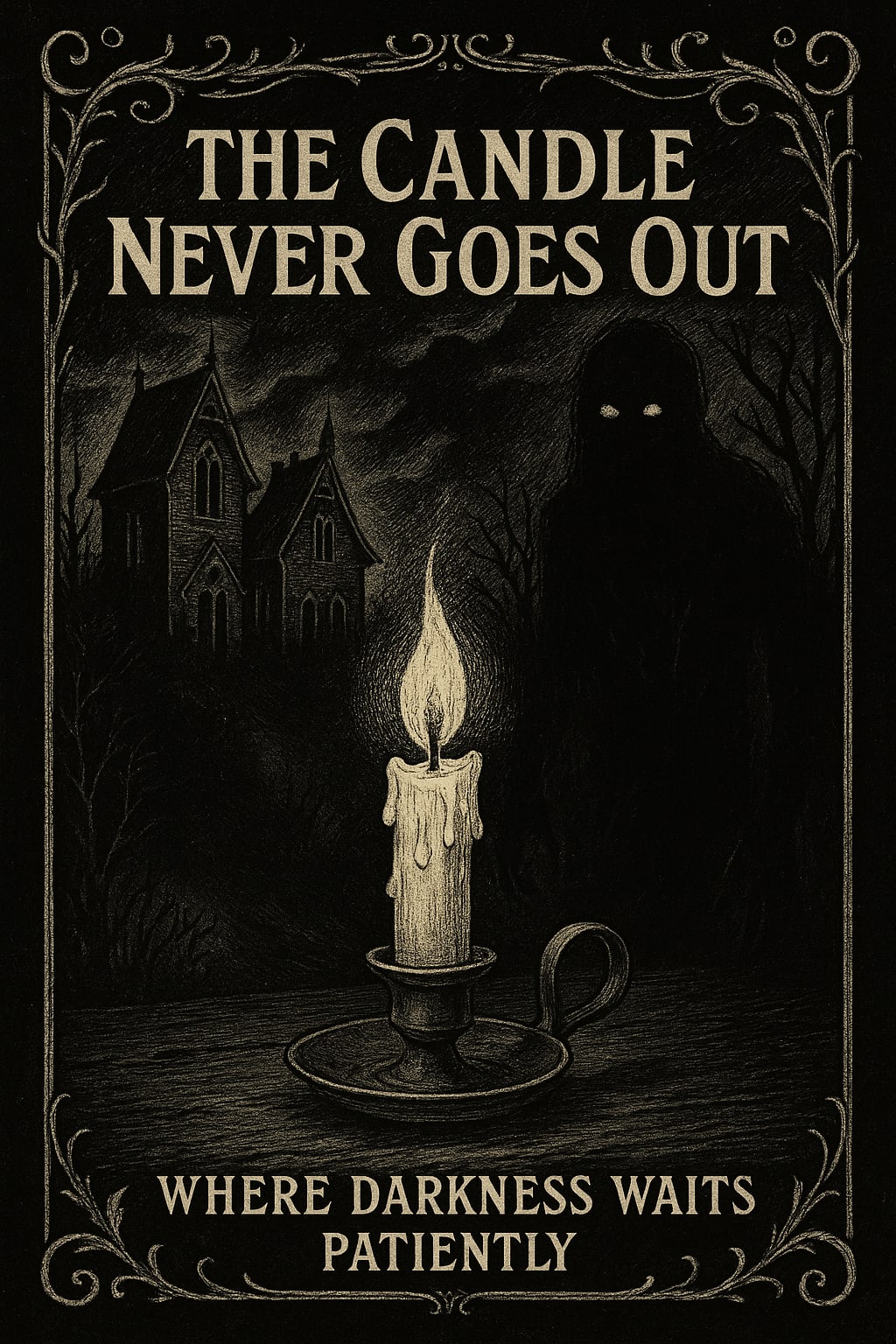
The house on Gallow’s Hill had long since rotted into local legend. Every child in the town of Merrow had heard the stories: how the original owners, the Braiths, vanished overnight in 1912; how the place resisted decay while everything around it crumbled. But one detail persisted in every telling: a candle in the attic window that never went out. Not once. Not during storms, not during snow, and not even after decades of abandonment.
When Lydia moved to Merrow for her research fellowship, she dismissed the stories as rural superstition. She was a doctoral candidate in folklore, after all—she knew the difference between tale and truth. That’s what she told herself when she first saw the house for real. It stood like a monument to defiance, the paint faded but intact, the windows grimy but unbroken.
And there it was: the candle.
It burned in the attic window, unmoving and unyielding, its flame frozen in a way that seemed unnatural, even from a distance. At night, Lydia watched it from her apartment window across the field. It never flickered. Not once.
Her advisor, Dr. Shale, had mentioned Gallow’s Hill in a half-joking tone during one of their phone calls. "If you want local lore, that place practically breathes it. But don’t go alone. Locals say it... watches."
Three weeks into her stay, curiosity turned to obsession. Lydia combed archives and church records, finding fragments of the Braith family: sermons from Reverend Alton Braith about spiritual light, newspaper clippings about a series of mysterious illnesses, and the final, cryptic journal entry from Margaret Braith: “The light must never fail, or he will walk again.”
"He," Lydia muttered aloud, sitting in the archive, the musty smell of paper making her nose itch. Who was he?
That night, Lydia made a choice.
She approached the house just before midnight. The grass had grown wild, brushing her thighs. The gate groaned open without resistance. The air thickened with every step, like she was walking through honey. She pushed the front door—it opened. Of course it did.
Inside, time had stopped. Furniture lay under sheets; wallpaper peeled in curls. And from above, a soft glow filtered through the ceiling cracks.
The attic door was at the end of a narrow hallway. She climbed the creaking stairs, each one protesting under her weight. When she reached the attic, the door was ajar.
The candle sat in the center of the room, on an iron candlestick atop a table scorched black. Its flame burned without heat, motion, or scent. Surrounding it were markings—circles etched into the wood, runes long forgotten. Lydia stepped inside, entranced.
The moment her foot crossed the threshold, the air shifted. Behind her, the door slammed shut. The flame sputtered—then pulsed like a heartbeat.
She stared, mesmerized, unable to move.
A whisper curled around her ear. “You shouldn't have come.”
Lydia turned—but no one was there. Shadows stretched across the floor though nothing cast them. She backed away, heart pounding, eyes locked on the candle.
And then she understood: the candle was not a beacon, but a prison.
Every second it burned, it held something back. Something old. Something waiting.
Something patient.
Suddenly, the flame flickered.
And in that instant, she saw it—him—in the reflection of the attic window. Not a man, but a shadow stitched into human shape, teeth like broken glass, eyes like empty graves.
The flame steadied.
The figure vanished.
Lydia dropped to her knees, breath ragged. She had almost freed it. She crawled to the table and steadied the candle. Beneath it was a note, faded and cracked:
“This light is a promise. As long as it burns, he cannot leave. Tend it, or all is ash.”
Now, she tends it.
Each night, she climbs the stairs to the attic and watches over the candle. Because now she knows what waits in the dark, in that sliver between flicker and fade.
And she knows one terrible truth:
The candle never goes out… because someone always makes sure it doesn’t.
About the Creator
Keep reading
More stories from Said Nawab and writers in Horror and other communities.
Love in Parentheses
It didn’t begin with fireworks or declarations. It started in parentheses—soft, subtle, quiet. You sat across from me in meetings, your words sharp, your tone direct. I admired you from a distance, tucked my feelings away behind polite nods and shared glances. We were professionals. Colleagues. Nothing more, and yet, everything more. Our connection didn’t live in the sentences we spoke. It breathed in the pauses, the side comments, the parentheses we placed around things we were afraid to say.
By Said Nawab9 months ago in Fiction
Killing him slowly
There’s an intruder in my house again. He stumbles through the door, wet carrier bags in hand. He’s bought me offerings. I show my appreciation, letting him caress my beautiful body. He wants to touch me. I rub myself against his legs. He sighs, dropping the bags. He can’t resist touching me. Running his hand slowly down my spine, I arch my back towards his caress, let out a low purr. It’s what we both need.
By N J Delmas5 days ago in Horror




Comments
There are no comments for this story
Be the first to respond and start the conversation.