
'The Babadook' - A Dark Metaphor
Exploring the Harshness of Parenthood & Grief

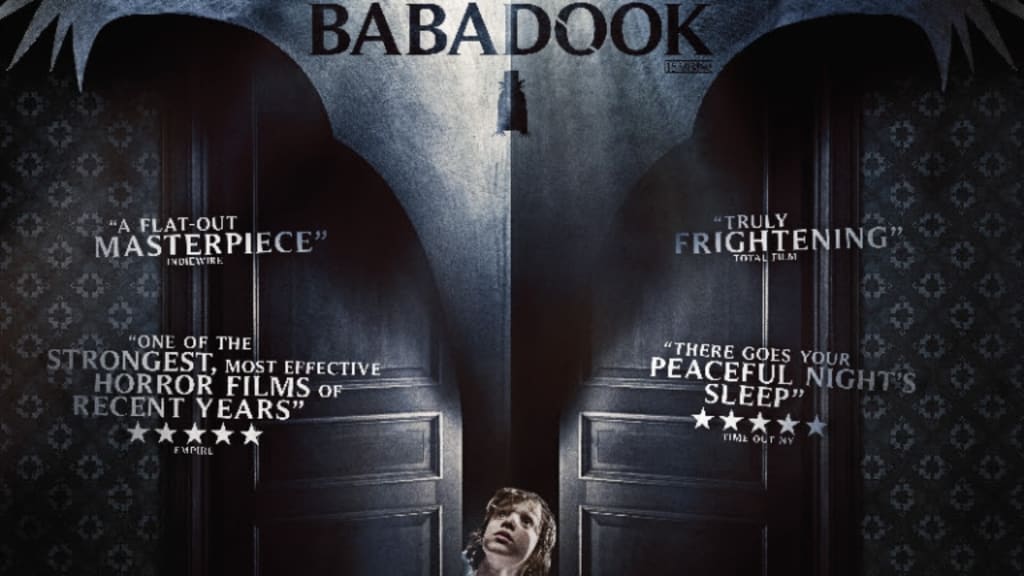
"With a horror movie, you're making a metaphor. You're making a personalized nightmare for the protagonist." Jordan Peele (writer & director of 'Get Out').
Synchronicity can be profound.
It's rare, but sometimes, you find the exact movie at exactly the right moment in your life. And what might ordinarily simply be a pleasurable experience, becomes an intense one. That film 'speaks' to you, resonates with what is happening in your life, and takes on a deeply significant meaning.
In fact, it's almost as if it had been made purely for you.
For me,'The Babadook' is one such film.
In her writing and directorial debut, Jenifer Kent, does not employ the typical horror tropes. There is no haunted house, no cartoon-like serial killer stalking nubile, sexually-promiscuous teenagers, and no ancient, malevolent curse to try and counter, and outrun.
Instead, more simply, we have an exhausted widow trying to raise her six-year old son.

And, from the moment we meet them, it's clear that neither Amelia or Samuel are coping particularly well.
Oskar, Amelia's husband, died in a car accident as he drove her to the hospital to give birth to Samuel. Already tired, and frayed, this experience has - understandably - also left Amelia bitter, and resentful as well. Not just at the world in general, but also towards her son.
Why should he have lived, when her soul-mate didn't?
And, when Samuel begins to display erratic behavior, tension between the two is ratcheted up.
Samuel's own fragile mental health has already been hinted at - like his mother, he's damaged.

But, when he starts to suffer from insomnia out of his fear of an imaginary monster he's become obsessed with, the cracks grow larger, deeper.
And when he later asks his mother to read him a pop-up, storybook called 'Mister Babadook', we begin to see just what it is he is so terrified of.
The book's titular character is a tall, pale-faced, man with talons for fingers who haunts his victims after they become aware of his existence. And Samuel is convinced that the fictional creature is not only real, but the very same entity that is now plaguing him.
Troubled by the book, Amelia destroys it. However, if she was hoping that would bring an end to the episode, it only heralds an escalation. Their home, which hadn't been a haven of loving calmness before, now seems even more hostile, as strange noises are heard, and doors and cupboards open by themselves. More worryingly, Amelia finds shards of glass in her food. All of which she believes her troubled son is responsible for.
But, the more strange events occur, the more Samuel remains adamant that the Babadook is behind them, the greater Amelia's frustrations grow.
A frustration that transforms into outright confusion when one morning, Amelia discovers the 'Mister Babadook' book reassembled on her front door step.
But, now, the story inside the book has changed.
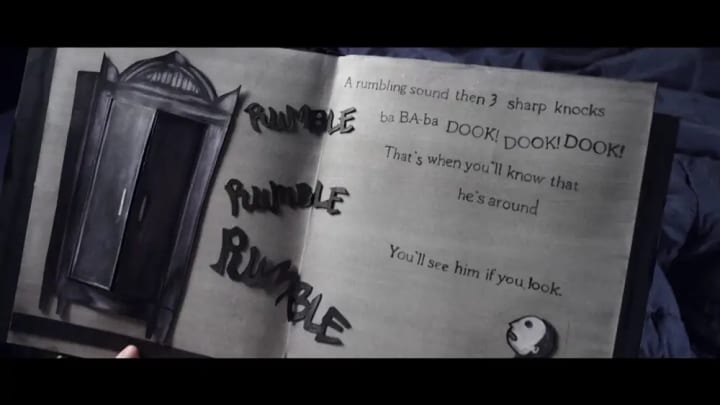
It no longer seems to be focused on Samuel, but on her.
New pages appear, showing her murdering both the family dog, and her own son. All accompanied with an ominous waning: The more she continues to deny the creature's existence, the stronger his powers will become.
Amelia's mental state disintegrates, as she is unable to distinguish between what is real, and what is the product of her fevered, unraveling mind. We know things are building, steadily reaching a climax, and we're hoping - praying - that they won't mirror what's depicted in the unsettling book.
Up to this point in the movie, it's a slow-burn. The tension between Amelia and her son is prickly, and uncomfortable, evoking early-Polanski at his best. And, the funereal atmosphere of dread, punctured with the occasional jump-shock, is reminiscent of 'Halloween' - no small praise. As well as being a wonderful writer, Kent is an accomplished director - there's no doubting the technical craftsmanship on view.
But, it's in the final third of the film where she is bravest, directly addressing the metaphor at the heart of the film, and managing to deliver a climax that is both terrifying, but resolutely fulfilling.
Amelia sees a vision, an hallucination, of Oskar. He tells her that he can return to life if she brings their son to him. She knows that this is all a creation of the Babadook, and - although initially tempted - she refuses. In return the Babadook possess her, and what we feared might happen does - she tries to kill her son.
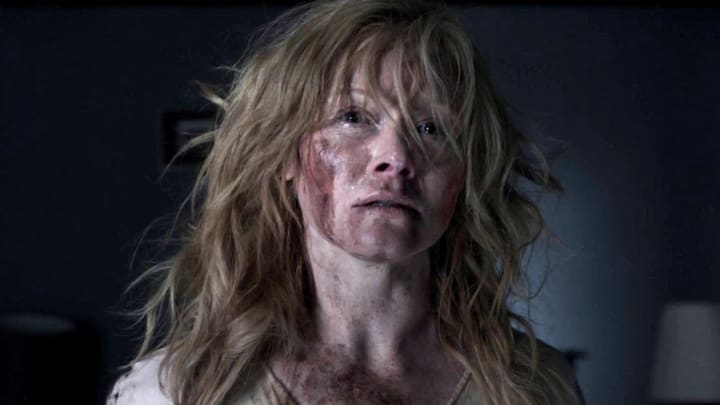
However, Samuel has been preparing for this encounter for a long time now - he's been living with the Babadook for ages. Through ingenuity, and love, he saves himself and his mother.
But, we've still got the standard reversal to come - the monster, seemingly vanquished, resurfaces, and always returns for one last try. And the Babadook does.
He forces Amelia to re-watch a vision of her husband's death. Making her relive that vile trauma over and over again. However, instead of crumbling, or trying to avoid re-watching the creature's malevolent manifestations, she watches. And...
... She becomes furious.
Instead of repressing the emotion of her husband's death, she allows herself to feel it, to vent it. Having spent the entire film 'locked in' by that tragedy, unable to face it, she finally does.
And the Babadook is powerless.
His strength derives from fear, from repression, and projected blame: By 'opening' herself up, Amelia takes away all of the creature's power.
The film ends with the Babadook not destroyed, but chained up in Amelia and Samuel's basement. And where he is cared for, and looked after, as if the family pet. Even then, he still tries to exert control over Amelia, but - instead of becoming angry, or denying its existence - she simply calms it down, as if placating an angry puppy. She then returns to her son, and their attempts to re-build their lives.
Earlier in the film, Samuel had told his mother, "you can't get rid of the Babadook." And you can't. Just as is the case in all truly great horror, the Babadook is, obviously a metaphor.
Most baldly, one for grief: The more you deny it, repress it, the more powerful it will become. The only way out is through - and the moment Amelia faces up to the tragedies she's endured, is the moment she can begin to slowly take away the power they have in her sub-conscious, and finally move on.
Seeing the film not after my divorce was finalized, and whilst I was still denying the effect it had had on me, was a sobering experience: I had become Amelia. Denial, and repression, had led to depression; I was carrying my own Babadook inside me. Exorcising him required me to same the same thing as Amelia had; to face him, directly.
He's still there, but nowadays I have the power to placate him as well.
But the Babadook has a double-metaphorical meaning; parenthood.
In an interview, Kent stated she wanted to not only tell a story about facing up to the darkness within ourselves, and of the "fear of going mad", but also wanted to explore parenting from a "real perspective."

"I'm not saying we all want to go and kill our kids, but a lot of women struggle. And it is a very taboo subject, to say that motherhood is anything but a perfect experience for women."
I too was a 'homemaker', and stayed at home, and looked after my children until they both began full-time school. It was the single greatest experience of my life, and I would not swap a single second of it.
But, it was also the single hardest thing I have ever done, and will ever probably do.
It was by wonderful but also lonely, terrifying, and full of moments when you know - just know - you're struggling to stay emotionally afloat. Moments when you feel as if you're failing at the single thing you shouldn't be failing at; being a parent.
And I've never found a better metaphor for it than this disturbing, brilliant, and scary film. It taps into fears that we hold on a deep, primal level. Fears are that taboo, and so rarely directly addressed. And that only makes it even scarier.
The monsters in 'The Babadook' are both imagined, and - worst of all - real. It's a supreme achievement, and is now - firmly - my favorite horror film.
So, do yourself a big favor, and willingly invite the Babadook into your home.
You'll be terrified by the experience, but you won't regret his brief stay.
----------------------------------------------------------------------------------------
If you've liked what you've read, please check out the rest of work my on Vocal.
You can also find me on Elephant Journal and The Mighty.
If you've really liked what you've read, please share with your friends on social media.
If you've really, really liked what you've read, a small tip would be greatly appreciated.
Thank you!
About the Creator
Christopher Donovan
Hi!
Film, theatre, mental health, sport, politics, music, travel, and the occasional short story... it's a varied mix!
Tips greatly appreciated!!
Thank you!!
Keep reading
More stories from Christopher Donovan and writers in Horror and other communities.
My Composite Halloween Costume: A Smorgasbord of Terror
Given that 2020 has been so, so strange, I've decided that this year's Halloween costume needs to be a bit special. It's not been a normal year by anyone's standards, and 2020 deserves a costume that reflects that.
By Christopher Donovan5 years ago in Horror
I wanted to title this something different, but worried that my chosen title might cause problems entering the United States in the future so this is the new title. It's the greatest title. No one has ever written a title better than this. (All titles unrelated to content).
Let me be honest. I am finding this difficult. Now, I like a challenge, a stretch, a bit of an obstacle course. “Write about the decline of the British Empire in the form of a narrative poem in which your protagonist is an artichoke” I read, and flex my fingers. “Write a haiku to evoke the sensation of sibilance using only the first half of the alphabet.” “Well”, I think to myself, “this should be fun.” But “write about a system that isn’t working”? A system that isn’t working? Now? In 2026? ONE system? My favourite system that isn’t working? The sexiest system that isn’t working? The one giving me the most angst day to day? The one giving me the most existential dread? I am, as I say, finding this difficult. I will own that I have contemplated writing a thousand words on why the steady “all on” setting on my fairy lights is the EIGHTH of seven options which must be sequentially activated to get there, because that is a system that some fool came up with and it definitely doesn’t work, and now who is paying the price, eh? But how can I write about my fairy lights when…. When…. When….
By Hannah Moore3 days ago in Humans


Comments
There are no comments for this story
Be the first to respond and start the conversation.