
The 2:17 Arrival
Deep beneath the city, the past is right on schedule.


The city of Oak haven was built on a foundation of secrets, but its deepest one lay exactly one hundred and twenty feet beneath the pavement of Foundry Street.
Every night, at precisely 2:17 AM, the residents of the towering Bayside Apartments would stir. It wasn’t a noise that woke them, but a vibration—a subtle, rhythmic tremor that traveled up through the steel girders of their building like a shiver up a spine. Dogs would whine five minutes before it started; cats would stare intently at the floorboards. The tenants called it the "Foundry Heartbeat." Most dismissed it as settling sediment or distant industrial machinery.
Leo Vance knew better. Leo was an urban speleologist—a fancy term for a guy who liked crawling into forgotten sewers and boarded-up basements. He was a historian of the dark, obsessed with the city’s circulatory system that had long since stopped flowing.
The source of the heartbeat was the legendary "Line A." In the post-war boom of the late 1940s, Oak haven had constructed a marvel of underground transit. Line A was its crown jewel, running polished chrome trains with cushioned seats. But on October 14, 1974, a massive geological shift—later blamed on hasty construction protocols—caused the ceiling of the central tunnel to completely shear off. The collapse crushed Station 7, the Foundry Street stop. The official report stated the line was empty at the time. The tunnels were sealed with thousands of tons of concrete, entombing the failure forever.
Yet, the rumors persisted in the urban exploration community. Grainy audio recordings circulated on dark web forums, capturing the distinct, heavy-gauge rumble of a 1940s R-Type subway car screeching to a halt, recorded near the sealed blast doors deep in the system.
Leo had spent three years mapping a route. The direct way was impossible, blocked by government-grade concrete. But water, Leo knew, always found a way. He had discovered a storm drain runoff in the forgotten sub-basement of a defunct textile mill that intersected with an older, prohibition-era smuggling tunnel. If his calculations were correct, that tunnel ran parallel to the collapsed section of Line A, separated only by a few feet of fractured shale.
At 1:00 AM, Leo lowered himself into the intake grate near the docks. The air instantly changed, thickening with the smells of ancient oil, wet rust, and the mineral tang of deep earth. He clicked on his high-lumen headlamp, cutting a cone of white light through the suffocating darkness.
The journey was grueling. He waded through waist-deep sludge and squeezed through gaps in crumbling brickwork that snagged his jacket. The deeper he went, the quieter the city above became, replaced by the rhythmic dripping of water echoing in vast, cavernous spaces.
By 1:55 AM, he reached the breach. It was a jagged fissure in the rock wall, barely wide enough for a human chest. The air rushing through it was different—drier, colder, and smelling faintly of ozone.
Leo pushed his pack through first, then exhaled fully, forcing his ribcage flat to shimmy through the gap. He tumbled out onto hard concrete on the other side.
He stood up and gasped. He wasn't in a collapsed ruin. He was standing on the platform of Station 7.
It was impossibly preserved. The tiled walls, gleaming white with emerald trim, were free of the grime that coated the rest of the city’s underground. Advertising posters, pristine and colorful, touted products from a bygone era: "Smoke Lucky Strikes!" and "Buy War Bonds!" A large, analog clock hung from the ceiling, its second hand ticking smoothly.
It read 2:12 AM.
The air here was deathly still. No rats skittered in the tracks; no water dripped. It felt like stepping into a photograph. Leo walked toward the edge of the platform, his heart hammering against his ribs, louder than the city’s heartbeat above. He looked down the tunnel into the oppressive blackness. According to history, fifty yards down that track was an impenetrable wall of fallen bedrock.
At 2:15 AM, the atmosphere shifted. The air pressure dropped so suddenly Leo’s ears popped. The fine layer of dust on the platform floor began to dance.
Then, the sound began.
It wasn't the high-pitched whine of a modern electric train. It was a deep, throaty roar, a churning of heavy gears and steel wheels grinding against iron rails. The ground shook violently. Leo had to grab a support pillar to stay upright. The vibration was intense, rattling his teeth.
At 2:16 AM, two beams of golden incandescent light pierced the darkness of the tunnel.
Leo held his breath. The roar became deafening, a physical force pushing against him.
At precisely 2:17 AM, the Phantom of Line A arrived.
It was magnificent and terrifying. A gleaming silver R-Type car, looking as if it had just rolled off the assembly line in 1948, screeched to a halt in front of him. The brakes hissed with a cloud of white steam that smelled faintly of burnt copper.
The car was brightly lit from within. Through the crystal-clear windows, Leo saw them.
The passengers.
There were perhaps twenty people aboard. Men in fedoras and trench coats, women in tailored wool suits with intricate hats. They were seated, holding newspapers or staring straight ahead. They were frozen, like wax figures in a museum display, trapped in the second before disaster.
With a pneumatic whoosh, the center doors slid open directly in front of Leo.
The invitation was clear. The warm light from inside spilled onto the cold platform. An overwhelming urge washed over Leo—the desire to step across the threshold, to join this impossible tableau, to know what lay beyond the collapse. He took one step toward the open doors.
His eyes fell upon a newspaper held by the frozen figure nearest the door. The headline, crisp and black, screamed: FOUNDRY STREET COLLAPSE: HUNDREDS FEAR... The headline cut off where the paper was folded.
The date on the paper was October 15, 1974. The day after the collapse.
Ice flooded Leo’s veins. This wasn't a replay of the past. This was a prison of a potential future that never happened.
The conductor, a stern man in a uniform cap standing at the end of the car, slowly turned his head. His eyes, devoid of pupils, locked onto Leo. He raised a gloved hand and beckoned stiffly.
The rumble intensified into a shriek of tortured metal. The reality of the station began to flicker. The pristine tiles showed cracks; the air filled with choking dust. The illusion was failing under the weight of the approaching moment of destruction.
"No," Leo whispered, stumbling backward.
The conductor’s expression didn't change, but the doors slammed shut with the force of a guillotine.
The train didn't depart normally. It accelerated instantly, a blur of silver light plunging not toward the next station, but straight into the solid rock face at the end of the platform.
There was no impact sound. The train simply dissolved into the stone, followed by a horrific, psychic scream that tore through Leo’s mind—the collective terror of souls trapped in an endless loop of their final moment.
The resulting shockwave threw Leo across the platform. The station lights blew out, plunging him into total darkness save for his sputtering headlamp. Rock dust rained down. The real collapse, the echo of 1974, was threatening to bury the area again.
Leo didn't remember scrambling back through the fissure. He only remembered the agonizing squeeze, the tear of his clothes, and the desperate crawl through the sludge-filled tunnels as the earth groaned around him.
He burst out of the storm drain intake near the docks just as the city clocks struck 3:00 AM. He lay on the cold asphalt, gasping for air, covered in fifty years of muck.
Above him, the Bayside Apartments were quiet. The residents had rolled over and gone back to sleep, the nightly tremor having passed. They would wake up and go to work, never knowing that beneath their feet, at 2:17 AM, the past was still desperately, violently trying to reach a future that had already been buried. Leo knew he would never go back, but every night, when he felt that subtle vibration in the floorboards, he would see the conductor’s empty eyes beckoning him for a ride on the line to nowhere.
About the Creator
Waqar Ahmad
I have been a professional freelancer and computer science degree holder since 2007. I have been working as a content and article writer for more than 10 years. Providing the best content with better research is my aim.
Keep reading
More stories from Waqar Ahmad and writers in Horror and other communities.
Whispers Beyond the Glass
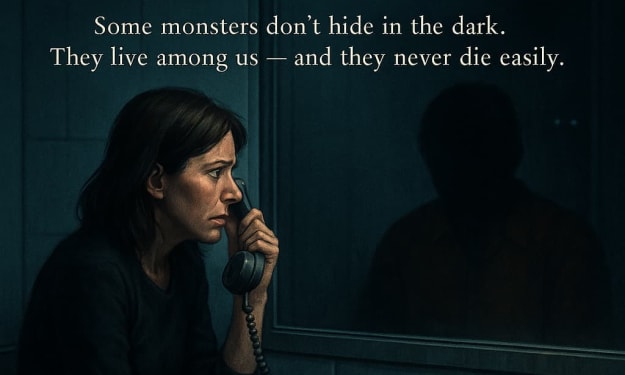
The visitation room was freezing. It was a plain, empty place where thick glass separated visitors from inmates. If you wanted to talk to someone inside, you had to use an old gray telephone. There was no other way to connect. No hugs, no handshakes. Only cold plastic and glass between you.
By Waqar Ahmad10 months ago in Horror
Scream 7 Review (Spoiler-Free): Is the New Ghostface Movie Worth Watching?
The newest entry in the Scream franchise brings us back to Neve Campbell as Sidney Prescott — now living under the name Sidney Evans. She’s trying to live a quiet life in a small town with her daughter, Tatum.
By Bella Andersonabout 4 hours ago in Horror
Flower Bloom 369
FLOWER Bloom 2/25/26 Wednesday By Mariann Carroll Karen had been with Tony for 7 years. Tony started acting strangely after her surgery. He would mow the lawn in the rain and be on his cellphone. He started pushing Karen away. Tony came clean about seeing someone. Karen moved out two months later. Karen moved in with a friend. She felt betrayed.
By Mariann Carroll3 days ago in Fiction



Comments
There are no comments for this story
Be the first to respond and start the conversation.