

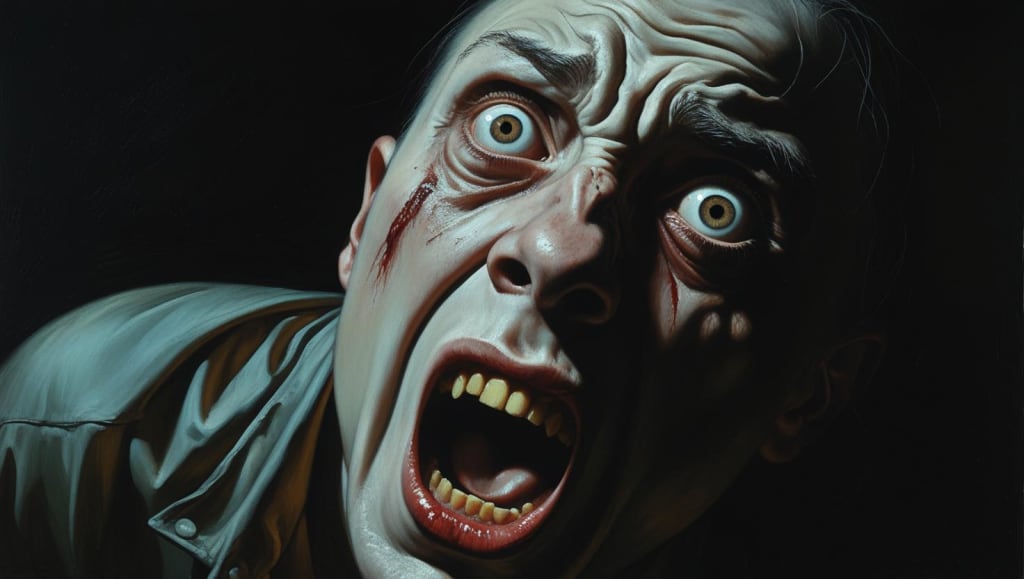
The wind whispered of ancient things in the scorched soil of northern Iraq. Father Lankester Merrin, an elderly Jesuit priest with eyes that had seen too much, brushed sand from a stone carving — a face with a twisted grin and wings folded like secrets. The demon Pazuzu. He’d met it before. And it had not forgotten him.
That night, the dogs fought savagely under a blood-orange sky. Bells tolled though no hand had rung them. And in a dream — or perhaps a memory — Merrin stood face to face with the statue in the desert wind, feeling the weight of a darkness that was rising once more.
Thousands of miles away in Georgetown, the air was still. The MacNeil home sat among leafy streets and tall windows, rented for the duration of actress Chris MacNeil’s latest film. Her daughter, Regan — twelve, curious, and lonely — had found an old Ouija board in the basement. She asked it playful questions, her fingers barely brushing the planchette.
“Captain Howdy,” the entity called itself.
What began as a game soon took on a strange edge. Regan began speaking to the board without touching it. Then, speaking like the board — in voices that weren’t hers.
At first, it was small things. Objects moved. Regan claimed the bed shook at night. Chris laughed it off as a child’s imagination, her mind worn thin from the divorce and her father’s absence.
But then came the screaming. The contortions. The violent outbursts. Regan's body bent in impossible ways, and her sweet voice was drowned out by guttural curses and demonic snarls. She spat at doctors. She lashed out at friends. And still, no test could explain what was happening to her.
One evening, the film's director, Burke Dennings, was found dead at the bottom of the stairs — his head turned completely backward.
Holy Trinity Church had also been desecrated. Statues were defaced, altars smashed. Detective Kinderman, drawn by the strange death and the church incidents, began circling. He suspected Father Damien Karras, a Jesuit priest and psychiatrist struggling with grief after the death of his mother. But Karras was a man sinking in his own crisis of faith, not one causing harm.
It was to Karras that Chris MacNeil finally turned — not out of belief, but desperation. A woman of science and reason, she could no longer deny what was in front of her: her daughter was not sick. Not in any human sense.
Karras met Regan. Or rather, he met something that wore her like a costume.
The thing inside her mocked him. Spoke in his mother’s voice. Revealed secrets it should not have known. But still, he hesitated. Psychiatry had answers, surely. Medication. Trauma. Delusion.
Until the room turned cold. Until the words appeared on Regan’s skin like rising steam. Until the furniture moved without touch and the voice inside her claimed it was Legion.
Permission was granted. The Church sent for Merrin.
Old, pale, trembling — but resolute — Father Merrin returned. With Karras at his side, the exorcism began.
For days, the two men faced the unrelenting evil. The demon twisted truth and memory, dredging guilt from Karras’s heart and mocking Merrin’s failing health. Regan’s body convulsed. Her voice changed. The walls bled. And yet the priests endured.
Until one morning, Karras returned from a brief rest to find Merrin collapsed. Heart failure.
The battle had taken him.
And now, Karras stood alone.
The thing inside Regan grinned. “You’re all alone now, Father,” it hissed.
But Karras — broken, angry, and alive with something he hadn’t felt in years — shouted a demand:
“Take me! Leave her!”
The demon lunged.
In a final act of sacrifice, Karras seized control of his body long enough to hurl himself through the window. He fell to the steps below, his body broken — but the demon gone.
As he lay dying, another priest rushed to him. Karras could no longer speak, but he clutched the priest’s hand as the words of absolution were whispered in his ear.
And with that… he was free.
Weeks later, Regan woke with no memory of the ordeal. Her mother held her tighter than ever. The house stood empty now. The film was forgotten. But something had changed.
Evil had passed through this place.
But so had love. And sacrifice. And faith.
Moral:
Even when all reason fails, the heart — and the soul — may still carry us through the darkness.
About the Creator
King MA
I write stories where memory lingers, silence speaks, and the past refuses to stay buried.
🅼🅸🅳🅽🅸🅶🅷🆃 🆂🅽🅰🅲🅺🆂
"It's 10 in Tuscon! We all know what that means... It's Time for Midnight Snacks with your man, Gerald Gee! Ready to spend the night together? Me too! I'm full of snacks and can't wait to regurgitate them all back into your hungry ears. Crack a brew! Pop some corn! Anything to get ready for one hell of a show where the talk maybe cheap but the words cut deep...
By Lamar Wiggins3 days ago in Fiction


Comments
There are no comments for this story
Be the first to respond and start the conversation.