
Soft Walls of the Room
A story of forgetting, remembering, and the dangerous in-between

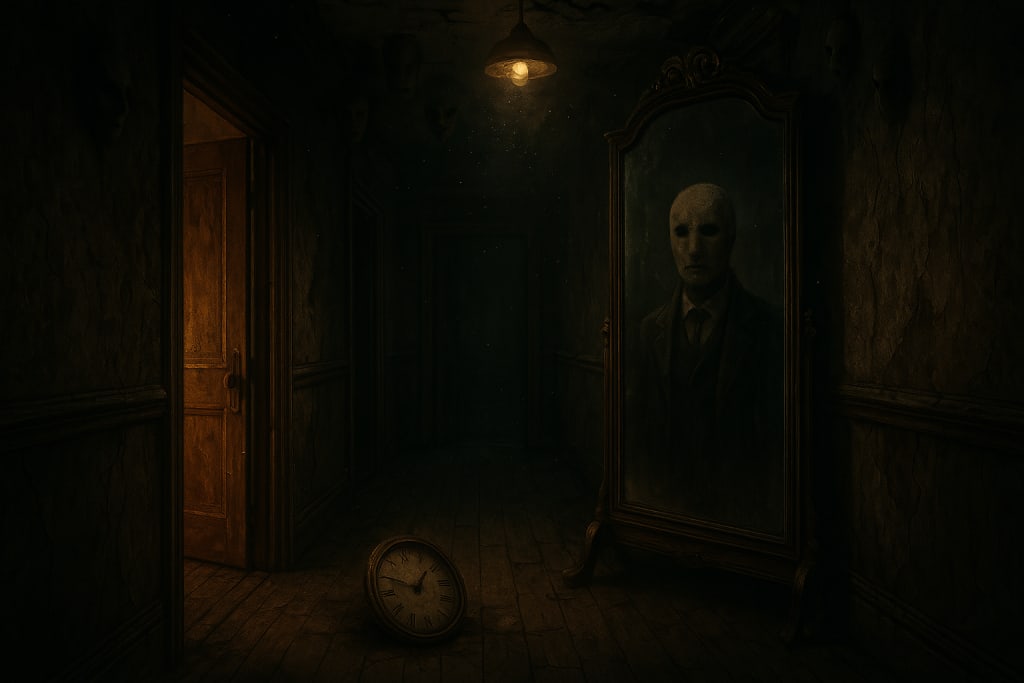
There are rumors that I assaulted a man using a clock as a weapon.
I don’t remember doing it, of course — that’s the first thing I told the nurse. The detective. The woman with the kind voice and cold eyes. They all nodded like it was a bedtime story they'd heard too many times before.
Apparently, I hit him with a brass clock. “Seven times,” the nurse said, while checking my blood pressure. “You must’ve really hated that man’s punctuality.”
I laughed. "Why she didn’t?" I pondered.
They assigned me to a house for the “recovery of memory and self.” Which is a fancy way of saying they dumped me in a creaky old building with ghosts made of paperwork and therapists who hide their judgment in spiral notebooks.
The house is mine, that's what they actually say. Technically. Legally. The deed has my name and everything. But I don’t recall ever buying it, or even visiting it. I can’t decide if that’s the amnesia or if I’m just really bad at real estate.
Either way, I’m told to stay here until “clarity returns.” Clarity, I’ve noticed, is just a more expensive word for guilt.
The first night, I find a locked drawer in the kitchen, and a note inside the oven that says, "You’re not who you think you are. But don’t worry. Nobody is."
I’d think it was a prank — if I had friends. Or memories. Or a working oven.
At night, I hear the stairs creak on their own. But only downward. Something’s always descending. And I don’t know what’s worse — the fact that I hear it… or the fact that it sounds like it’s wearing my shoes.
There’s a mirror at the end of the hall. It’s cracked, of course. Like all good metaphors. But what’s peculiar is that every time I pass it, my reflection is a split-second behind me. Not slow. Not fast. Just… delayed. Like it’s trying to decide if it agrees with me before copying.
I asked the social worker if mirrors can lie. She said, “Only if you expect them to tell the truth.”
That was the first intelligent thing anyone’s said to me since the clock incident.
On the third night, the dreams begin. In them, I’m always walking into the same room — gray walls, yellow chair, a man at the desk. He has no face, just a shadow where features should be. But he speaks.
“You are not a liar,” he says, “You’re just very creative with your facts.”
Then he offers me a mask. White. Porcelain. Grinning.
I always take it. Always.
Eventually, I find the basement.
I don’t mean I discovered a door and opened it. I mean one day the floor gave way, and I landed on the steps.
It’s not a basement so much as a museum of things I never bought. Paintings of people who look vaguely familiar. A ledger with names — none of them mine, but all in my handwriting. A dusty photo of me as a child, hugging a man whose face has been scratched out with what looks like a fork.
At the far end: a door. Wooden. Humble. Whispering.
I open it, expecting a jump scare. Instead, I find… comfort.
A room lined with masks. Hundreds of them. Maybe thousands. Each labeled with names and sins. I see “Thomas – Arrogance,” “Eliza – Compliance,” “Daniel – Ambition.”
And then I see mine: “Arthur – Forgetting.”
The mask is soft. Velvet. A little wet.
I don’t scream. That’s the strangest part. I don’t run. Don’t cry. Don’t question. I just put it on.
The next morning, the sun is shining and my memory is back.
Or so I claim.
Now I know where the knife was hidden. Now I know why the clock was my weapon of choice. Now I remember the man I struck — he wasn’t trying to hurt me. He just knew the truth.
And that is, in the end, the worst crime a man can commit in polite society.
Truth, after all, is vulgar. Ugly. Uncomfortable. We dress it in nice suits and call it "nuance." We smother it in kindness and call it "perspective." But truth, raw and bleeding, is offensive. And offensive people get hit with clocks.
The final twist comes not with a scream, but a whisper.
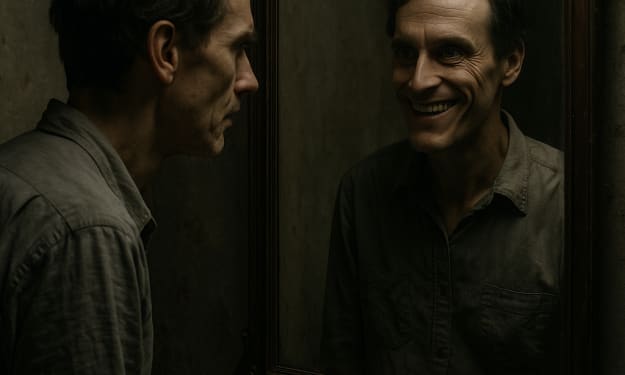
I’m in the mirror again. Only this time, my reflection smiles first. I don’t.
“You’ve become very good at pretending,” it says.
“I’ve had practice,” I reply.
Outside, a knock at the door. Another man arrives — nervous, confused. A file under his arm. A look of doubt in his eyes.
I step into the hallway. The house breathes. The masks tremble with anticipation.
I reach under the couch for the clock.
That isn't something I need to remember. That it was a psychotic break. Repressed trauma. Dissociative identity.
And I’ll nod along. Who am I to challenge the experts?
But here’s the truth — just between us:
Sometimes it’s easier to be a monster than a memory.
About the Creator
Muhammad Abdullah
Crafting stories that ignite minds, stir souls, and challenge the ordinary. From timeless morals to chilling horror—every word has a purpose. Follow for tales that stay with you long after the last line.
Keep reading
More stories from Muhammad Abdullah and writers in Horror and other communities.
"Scream 7" (2026): Running out of Fresh Screams
This is the seventh time we’ve had a Ghostface crisis. Scream 7 is the latest edition of the Scream franchise. Sydney Prescott and her family are under attack by another anonymous killer dressed in a Ghostface costume. While having issues with her daughter, Tatum, they run from the bloody murders, trying to determine who is behind it all.
By Marielle Sabbag8 days ago in Horror
A More Human Vocal
When we launched Vocal nearly a decade ago, the world was a very different place. LLMs did not exist, and stories were created one at a time by people sitting down to write, revise, and share something personal. Many of our assumptions about publishing, trust, and participation were built for a world where effort and output were inseparable.
By Justin @ Vocal4 days ago in Resources



Comments
There are no comments for this story
Be the first to respond and start the conversation.