
Seven Legendary and Creepy Cryptids That Will Keep You Awake At Night
Animals that you surely did not know of their existence and that you will be surprised to learn.


What are cryptics?
Which cryptids do you know?
Which ones do you think could be real?
Which is your favorite cryptid?
The other day when I got home from work I didn't know if:
a) Swiping through Netflix while eating junk food
b) Gorge me on Haagen Daz ice cream while swiping through guys on Tinder
c)Sneaking into bed reading a 50 Shades of Grey marathon until I fall asleep
I don't know how she ends up on YouTube watching videos of seemingly supernatural animal species with similar characteristics to animals unrelated to any known species from the fossil record to modern times.
These beings are the focus of cryptozoology, or "occult animal studies," a pseudoscience and subculture that seeks to prove the existence of extinct, mythological, and folkloric animals.
Here is a list of the ones that caught my attention the most:
1. Skunk ape
The skunk ape, Skunk ape, also known as the swamp ape, stink ape, Florida bigfoot, Myakka ape, and Myakka skunk ape, is a hominid cryptid said to inhabit the states of Florida, North Carolina, and Arkansas.
However, reports from Florida are more common.
It obtains its name because of its appearance and unpleasant odor.
According to the U.S. National Park Service, the skunk ape does not exist.
The Skunk Ape is a cryptid that supposedly inhabits the swampy areas of the Everglades in Florida, where it has got seen as far north as Tallahassee and Dade County.
It believes that the Skunk Ape could weigh over two hundred kilos and measure between 2 and 2.20 meters tall, leading several cryptozoologists to speculate that it may be part of the same species or even be a subspecies of the famous Bigfoot.
It has black fur and bright red eyes, unusual for most primates because most primates lack a tapetum lucidum, a layer of tissue behind the retina that reflects light.
Reports of the skunk monkey were widespread in the 1960s and 1970s.
In 1974, reported sightings of a large, foul-smelling, hairy, monkey-like creature running upright on two legs in suburban neighborhoods of Dade County, Florida.
Skeptical researcher Joe Nickell has written that some of the reports may represent sightings of the black bear (Ursus americanus) and other sightings are likely hoaxes or wildlife identification errors.
The Myakka Photographs
Twenty-six years later, in the fall of 2000, police in Sarasota County, Florida, received a letter from an anonymous woman.
With the letter were two enclosed photographs of what the woman said was an escaped orangutan that had been stealing apples from her back porch for three nights.
Later found these photos near the Myakka River. After the images got released to the public, cryptic enthusiasts dubbed the creature in the photograph the "Myakka Skunk Monkey."
The images have become known to Bigfoot enthusiasts as the "skunk monkey photos."
Loren Coleman is the lead researcher of the photographs, having helped locate the two pictures at an "Eckerd Photo Lab at Fruitville and Tuttle Roads" in Sarasota, Florida.
Chester Moore, Jr., took photographs in Sarasota County near the Myakka River.
Most Skunk monkey sightings, like Bigfoot sightings, can be dismissed as black bear sightings.
That is because a black bear can stand up, making it look like another animal entirely.
Bears are also known to scavenge in garbage cans, explaining the odor so closely associated with this creature.
Experts suggest that if this population exists, Skunk Apes must be nomadic and foraging, so they prowl the outskirts of cities and towns in search of food.
There is even a report of one of these apes running along I-75 in broad daylight, and they have got seen in parks, forest preserves, and suburbs.
There are also known incidents of hunters' and hikers' camps destroyed, but Skunk Apes or another large mammal in the Everglades is unknown.
In the Everglades, it is not rare to find populations of escaped animals, as the rock python is known to have become an invasive species; and there is evidence indicating the existence of a group of chimpanzees that roam the swamps.
It would not be unreasonable to believe that a small population of orangutans might exist in the Everglades, especially after an analysis of the photograph by Loren Coleman, an authority in the world of cryptozoology.
2. Dobhar-chu
The Dobhar-chu (hound of the waters) is a little-known but fascinating creature of Irish folklore, which in recent times cryptozoology tries to usurp.
About his name, we have to point out that his name has also translated as "king of the otters" and Chú/cú is a reference to "hound," while in modern Gaelic water is "uisce" and "dobhar" is almost in disuse.
Another name for this creature is "cobarcu," anglicized as "doyarchu "dhuragoo." And dobarchú is one of the modern Irish words for the otter.
There is little information about this creature, but it has usually described as a large dog or otter, half dog half fish, whose fur may be completely white except for the ears and some dark black stripes on its torso.
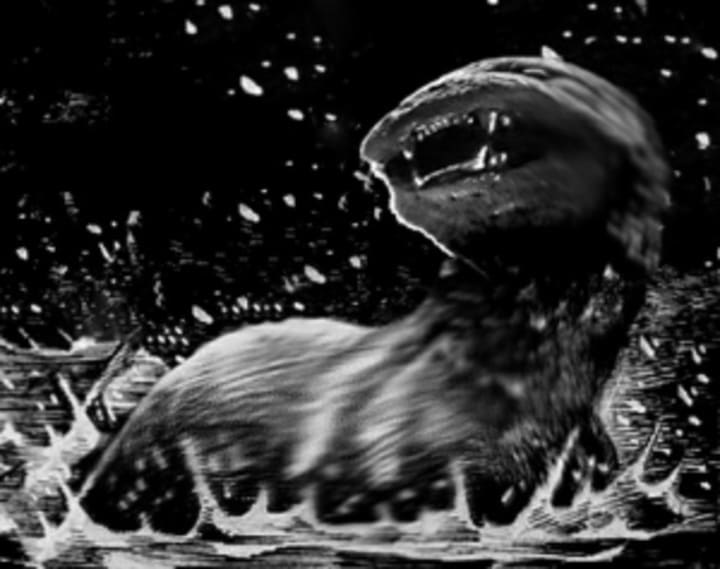
It seems that they do not need to sleep, and their environment is wetlands, where sightings occur, and they kill humans and horses.
One tradition says they can only kill them by wounding them with a silver bullet, although whoever has injured them in some versions also perishes within 24 hours, we will see that there are more ways to finish them off.
It also claimed that a one-inch strip of dobhar-chu skin could protect horses from injury, humans receiving bullet wounds, and even a ship colliding with rocks.
One of the best-known stories about the water hound is on a 17th-century gravestone in a cemetery in Cornwall, Glenade, County Leitrim, where it is described and refers to a woman named Gráinne who went to clean clothes in Loch Glenade and heard screaming by her husband.
He found her mangled with the Dobhar-chú over her remains when he arrived.
Gráinne's husband, named Terence McGloughan, managed to kill the hound by stabbing it through the heart.
Then, as the dobhar-chu perished, he let out a hiss that made his mate jump out of the water in search of revenge, although the widower managed to kill him as well after a long and bloody battle, some sources say with the help of his brother.
Another less-repeated story says that in 1684 a man was taking a walk by Mask Lake in Norfolk while being spied by a dobhar-chu, which emerged from the water, caught the man's elbow in its jaws, and dragged him into the lake.
The human saved his life by stabbing his assailant with a knife, after which the lake water was dyed red.
The arrival of modernity has not put an end to sightings of water hounds.
In 1968 there were several in the Achill Islands, and in 2003 Irish artist Sean Corcoran and his wife claimed to have seen one on Mey Island in Connemara, County Galway.
They described it as a dark creature but with orange fins instead of legs, which made a frightening screeching sound and could swim fast.
In the face of these recent sightings, cryptozoologists have tried to sell the water hound as one of their mysterious monsters.
A theory published a few years ago in the Irish press suggested that the myth may be related to the remains of a giant river otter, Siamogale melilutra, which lived in the Miocene and was the size of a wolf.
However, this does not make much sense, as the Siamogale melilutra remains have been found in China's Yunnan province, not in Ireland.
In short, the Dobhar-chú is a unique creature of Irish folklore.
It resembles mostly a giant otter (although it resembles a dog, a fish, or even a crocodile) that legends depict as very dangerous.
Nevertheless, recent alleged sightings have made it a commodity for cryptozoologists.
3. The Loveland Frogman
The Loveland Frogman is what it sounds like: a humanoid frog.
The creature got spotted swimming in Ohio's Little Miami River in 1955.
Then, in March 1972, police officers in Loveland, Ohio, sprinkled it on 2 different opportunities.
The first officer described a three- to 4-foot-tall creature weighing 60 pounds with tanned skin and a face like a frog.
The second officer even shot the beast.
In 2016, the Loveland Frogman was allegedly seen again by 2 persons gaming Pokemon Go.
One of them sent a video by email of the creature to local news outlets, saying quote,
"We saw a vast frogman near the water.
Not in the game Pokemon Go); this was a real giant frog.
I took some pictures and a video because I had never seen that great.
Then the thing got up and walked on its back legs.
"He added, "I swear on my grandmother's grave that this is the truth."
However, after that article came out, the second officer of the 1972 sighting came forward and labeled it a hoax, claiming that the creature he had seen and shot was an iguana with a missing tail.
One blogger could duplicate what the Pokemon Go player had captured in his video using a small frog statue with light-up eyes.
4. Thunderbird
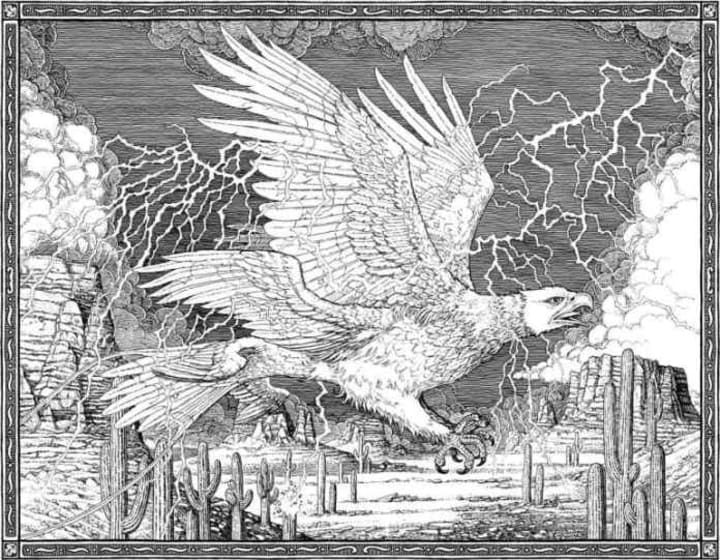
The Thunderbird is a fabled creature in the history of many indigenous peoples of North America.
It is considered a "supernatural" being, a bird of power and strength.
Therefore, it is essential and richly depicted in art, amulets, songs, and oral histories in many Pacific Northwest Coast cultures.
In addition, it got found in legends among the peoples of the southwestern United States and the Great Plains.
It calls a thunderbird because the beating of its enormous wings causes thunder when it flaps them in the wind.
As a result, the wind stirs and rainfalls.
Across many indigenous cultures of North America, the Thunderbird has much in common. It describes as a large bird, capable of creating storms and thunder as it flies.
Its flapping gathers clouds, the sound formed by flapping its wings; lightning is the flashing light from its eyes when it blinks.
On masks, it is depicted as many-colored, with a large sun in its center and often teeth in its beak.
Native Americans believed that the giant Thunderbird could shoot lightning from its eyes.
In all North American tribal mythologies, the Thunderbird is intelligent, powerful, and full of anger.
All agree that one must get out of its way to avoid the angrThThunderbird.
The Thunderbird resided on a mountaintop and was the servant of the Great Spirit.
The Thunderbird only flew to carry messages from one spirit to another. In addition to controlling the rains.
That is why it is a sacred bird, for it moves among the gods and higher energies.
The Thunderbird has the power to adopt the human form simply by tilting its beak and remaining as a mask, and its feathers remain as a blanket, looking like a native.
There are stories of thunderbirds marrying beautiful natives, and some families proudly count him as an ancestor.
(In the Vancouver area, these mythological lineages are typical).
Thunderbird is a bird of power; shamans invoke it to provoke rains in times of drought and obtain incredible passion and energy in times of battles.
Obtaining courage, strength, health, and a lot of energy are the magical properties of the Thunderbird.
5. The Beast of Exmoor
The legendary Beast of Exmoor is said to roam the moors and hills of western England, killing hundreds of sheep and stalking reckless travelers.
Reports concerning this creature began to emerge in 1970, although the first witness to have seen it firsthand was Eric Ley, a South Molton farmer.
The latter told authorities that he had lost 100 sheep in three months due to attacks by the beast tearing the throats of his livestock.
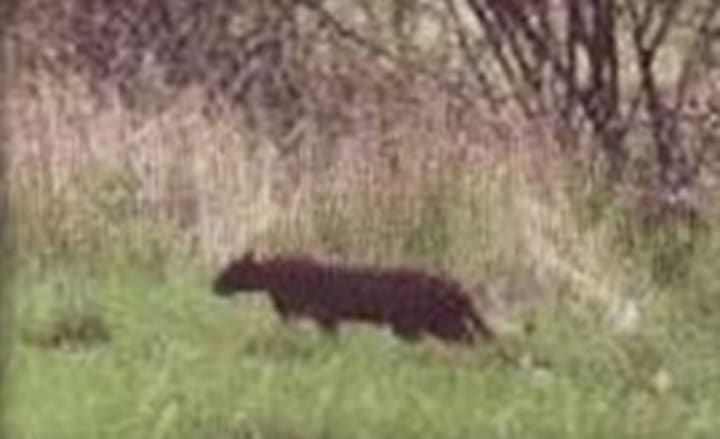
The consternation was such that the Daily Express newspaper rewarded anyone who captured the creature.
The most obtained were very distant photographs of the alleged beast, showing the image of a vast cougar or panther.
The beast has not got accurately described, but its form got believed to be predominantly feline.
It runs at surprising speed and can leap fences over two meters high.
The story goes that during five months in 1987 it killed some 200 farm animals in the village of Exmoor.
But naturalist Trevor Beer, author of Trevor Beer's Wildlife of North Devon, says it must not be a mythical creature, but some big cat that only kills for food.
He even thinks there is more than one "Exmoor beast," although he clarifies that they are harmless.
Trevor Beer assures that the closest hypothesis to reality is related to one or several felines that escaped from circuses and got lost in the Exmoor area.
In his words:
"I believe that over the years, some big cats have escaped from circuses, as well as some exotic domestic animals," he says. At present, we have a breeding population of wild cats in the British Isles".
In the 1990s, sightings of the supposed beast and its attacks disappeared.
6. The Ahool
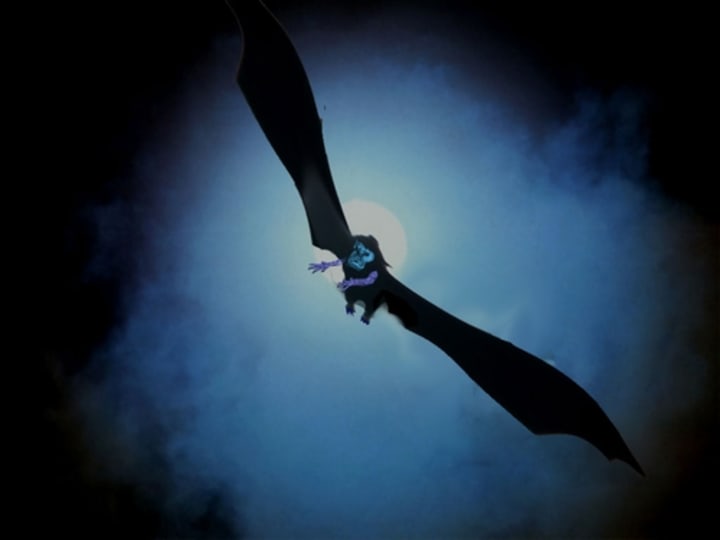
The Ahool is a giant bat-like creature that a scientist discovered in the jungles of Java in Indonesia in 1925.
It is named after its call and is said to be twice as large as the excellent flying fox bat, which, with a 5-foot wingspan, is among the giant bats in the world.
Some have said the creature could be a pterosaur; others believe it could be an owl.
Bonus
7. The Bunyip
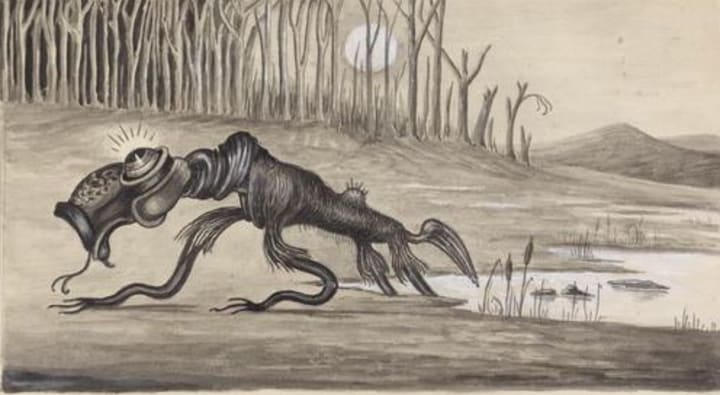
According to Australian indigenous folklore, the Bunyip is a creature found in the lakes and swamps of Australia that likes to eat people, especially women and children.
Descriptions of the Bunyip are all over the place, but many describe it as being similar to a seal. In addition, it supposedly lays its eggs in platypus nests.
Sources:
About the Creator
Rocio Becerra
I live in a house next to a river in the middle of the forest. I like horror stories whose main objective is to entertain, and my favorite writer is Stephen King. However, my passion is writing crime fiction.
Keep reading
More stories from Rocio Becerra and writers in Horror and other communities.
Worth the Wait: Puerto Viejo, Costa Rica
Beach bumming in a small Caribbean beach town sounded like a perfect way to end our 6-month trip through Mexico and Central America. Or so we thought. The foul, fishy stench of rotten seaweed hit our nostrils as we stepped from the cramped bus and looked out at a rather depressing, empty, and underwhelming black sand beach. It was pouring with rain, and we had to quickly fish out our ponchos. We thought, this couldn’t be it, could it?
By Sh*t Happens - Lost Girl Travel6 days ago in Wander




Comments
There are no comments for this story
Be the first to respond and start the conversation.