
Psycho: The Godfather of Slashers
A horror-lover's look at the icon.

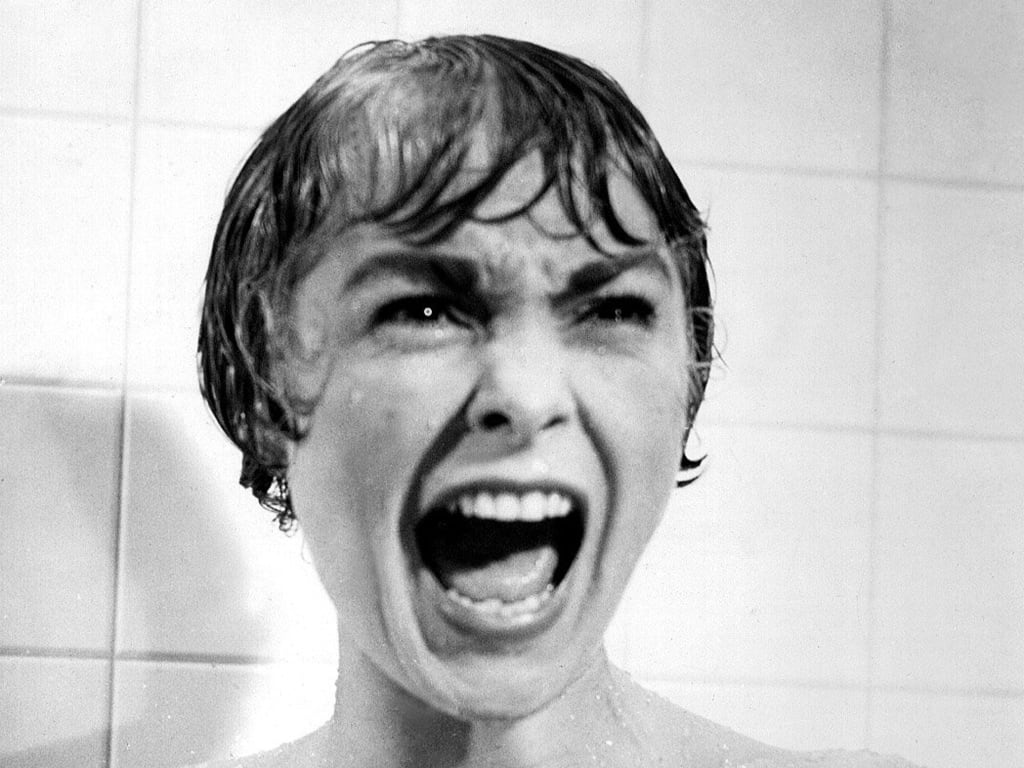
They say you never forget your first. My parents used to tell this story about a night when I was around three or four years old, they left me and my brother with a baby-sitter so they could go to a church function. A potluck, a night without the kids, probably a few riveting rounds of bingo. Apparently, as the tale goes, this lovely and sweet teen from our little baptist church thought it would be a great idea to let me watch "Psycho" with her. Everything seemed fine until the next morning, when I started running around the house with a play knife from my Fisher Price kitchen making the infamous nose that accompanied that scene. Ree! Ree! Ree! My parents called up the babysitter, she admitted everything. They were less than thrilled. While I don’t remember this, I do remember how profoundly important "Psycho" always seemed to be in the world of horror and media in general. All its iterations, homages, and impacts. I went to a film camp, a Christian film camp, in my teens and even they could not help but use the movie in references for framing, camera angles, storytelling. My local Red Robin had a blown up still of Marion Leigh’s final moments, that terrified shrieking visage, hanging outside the bathrooms. Framed in gold. Classy.
While the 1980s saw the rise of icons like Michael Myers, Jason Voorhees, and Freddy Krueger, to truly understand the depth of the genre’s origins we need to look back further. The 1970s saw the release of films such as "The Town That Dreaded Sundown" or the original "Black Christmas", known to many as "Silent Night, Evil Night". Films that helped turn the modern slasher into a mainstream standard. However, it is an undeniable fact that to many, Hitchcock’s "Psycho" is the godfather of the modern slasher film. It is still the standard. Untouched, unrivaled, and consistently imitated. And it is still terrifying. It opened the minds of the typical citizen to the concept that your friendly neighborhood quiet guy may not be all he appears. That your safe havens; bedrooms, kitchens, showers, could be just as dangerous as a war zone. That a common household item could spell your end. That a shower curtain is the most anxiety inducing object you’ll ever own.
You’d be hard pressed to find anyone who isn’t familiar with Alfred Hitchcock’s "Psycho". The shower scene. The mother reveal. That sick, sly grin on Norman Bates' face. Film buffs of any kind are always standing at the ready to throw in any tidbit of knowledge of the film into a conversation to make themselves sound credible. It is iconic, a seminal piece of cinematography thrust into the minds of moviegoers during a transitional period of American history, when counterculture was on the rise and people hungered for more than what was traditionally given to them. New ideas blossomed and average everyday folk were no longer content with the things that were labeled as good. Normal. They wanted change. Music evolved, adapted. Cinema took daring leaps forward. It was the perfect time to introduce the world to the concept of the slasher film, and while many shouted out in disgust at the horrific things being showcased upon the silver screen, the intrigue and fascination of this concept drew critics and moviegoers alike back to the seats to witness the soon-to-be masterpiece on the big screen. There is a reason that, in 1992, the Library of Congress deemed the film "culturally, historically, or aesthetically significant”. Imagine that.
Before "Psycho" was let loose on cinemas on June 16th, 1960, the horror genre consisted almost entirely of monster movies, a few supernatural flicks here and there but nothing too notable unless you’re truly an avid fan of the genre and cinema as a whole. I can almost guarantee you've never seen 1959's "A Bucket of Blood". Hitchcock's name brought people to the theater. The controversy brought them back. It pushed the boundaries, literally and figuratively, of how fear could be stretched in the still young medium of film. It unleashed an idea that few dared to contemplate in that age of American history, a country still trying to recover and find itself post-war. A country with rose-colored glasses and glitzed up marketing to reassure you that life is good. When the idea that the life you were being sold in the newspapers, the idyllic picket fence, could still house darkness inside it startled people. It was unheard of. The monster in the movie was man! An inescapable force that stood every which way you looked. On the bus, your morning walk, your office, just across the way of that idyllic picket fence. "Psycho" shifted the concept of terror on the silver screen so far that it was inevitable for the genre to not obsess over it.
Take any iconic horror film of the last few decades and you’ll find a tried and true checklist of tropes that are guaranteed to cause audiences to shriek. A bone-chilling score. Tense, close camera angles. The use of slow building tension. Endings that leave you in disbelief. These can all be traced back to "Psycho", even in minute ways. It’s a legendary film, one that anyone from casual viewers to hardcore horror junkies can find stressful and thrilling. It’s been years since I’ve seen it but it still makes me jump when I hear a noise somewhere in my apartment while I’m in the shower. It left an impact.
The slow, ambient build of Marion bathing, the lack of score in the background creates an uneasy feeling. Amplified by the door opening behind her, the slow push toward the shower curtain as the silhouetted figure becomes clearer. The jarring moment when the curtain is ripped back, the knife is raised, that legendary shriek is let loose, and the slow zoom out from her lifeless gaze has stuck with me for years. When I binge movies during the spooky season I can find little nods to the OG in unlikely places. The shocking death in "Alien Covenant", where the Xenomorph skewers the couple through the shower curtain. The incredible use of ambient sound during the super 8 segments in "Sinister". Mike Flanagan’s criminally underrated "Hush", using its dark setting to throw discomforting shapes in the background while our heroine is blissfully unaware of the danger.
While the standard for cinema has evolved, and will continue to do so - the effects have gotten sharper, death scenes have gotten bolder, directors are allowed to get away with more extremes - it is always a good idea to stop and take a moment to appreciate and revisit the one who helped pave the way for one of the world’s most known and ever changing genres. "Psycho" will always be one of the most influential films ever created, not just in the horror community. Its legacy will continue to help shape the way our villians are presented as long as cinema continues to be an integral part of humanity. It was, in all reality, my first horror film. It paved a path for a lifetime of admiration and excitement for horror and slow-burn movies. It’s effects are long lasting, its scares are hard-hitting, and its legacy is undeniable. So, let us raise a glass to the godfather of slashers and make sure to add the classic to our binge-lists this Halloween season.
About the Creator
Alycia "Al" Davidson
I am an author who has been writing creatively since the age of ten. My first novel was published at fifteen and I am currently drafting a space opera. I love creative and unique horror.
disturbancesbyalycia.weebly.com
Keep reading
More stories from Alycia "Al" Davidson and writers in Horror and other communities.
The House on Marlow Lane
There stands a house on Marlow Lane. In this house lives a deafening sense of silence. It’s tucked away so tightly amongst the great oaken trees it was built within that no sound, nor wind, nor creature of earth or sky dare to trespass. The wind chimes on the porch no longer sing, the wooden floors no longer creak, and the grandfather clock on the second floor landing sits quietly alone. Forever frozen at 3:03pm. The house has never seen a murder, nor was it born on sacred ground. No curse was ever laid on the clay below, no ritual ever desecrated its heart. Opposite of this fact, no children have ever laughed in its homely halls, no Christmas gatherings were ever made into memory in its grand living room. For you see, the house died long ago, breathing life no more and never again.
By Alycia "Al" Davidson4 years ago in Horror
OBLIT
This is me. My name is Oblit. It's odd, isn't it? I live on an island. Well, at least I think I do. I haven't seen anyone else in a long time, so I assume I do. I live inside a little house - it's quaint. A five-windowed bungalow, built on a street with only half-constructed houses all around. The lights don't light up at night - and the various concrete and plaster walls that decorate the plain green field only serve as props to my living. I live inside 1557 Rangolin Street. One front door, one back. A modest little backyard with benches and various plants sprouting from scattered pots. Two sets of gardening tools, one for me, one in case I forgot the other.
By Albert Xiong3 days ago in Horror


Comments
There are no comments for this story
Be the first to respond and start the conversation.