
Psycho (1960)
A Mother's Day Review of the Kitsch Classic

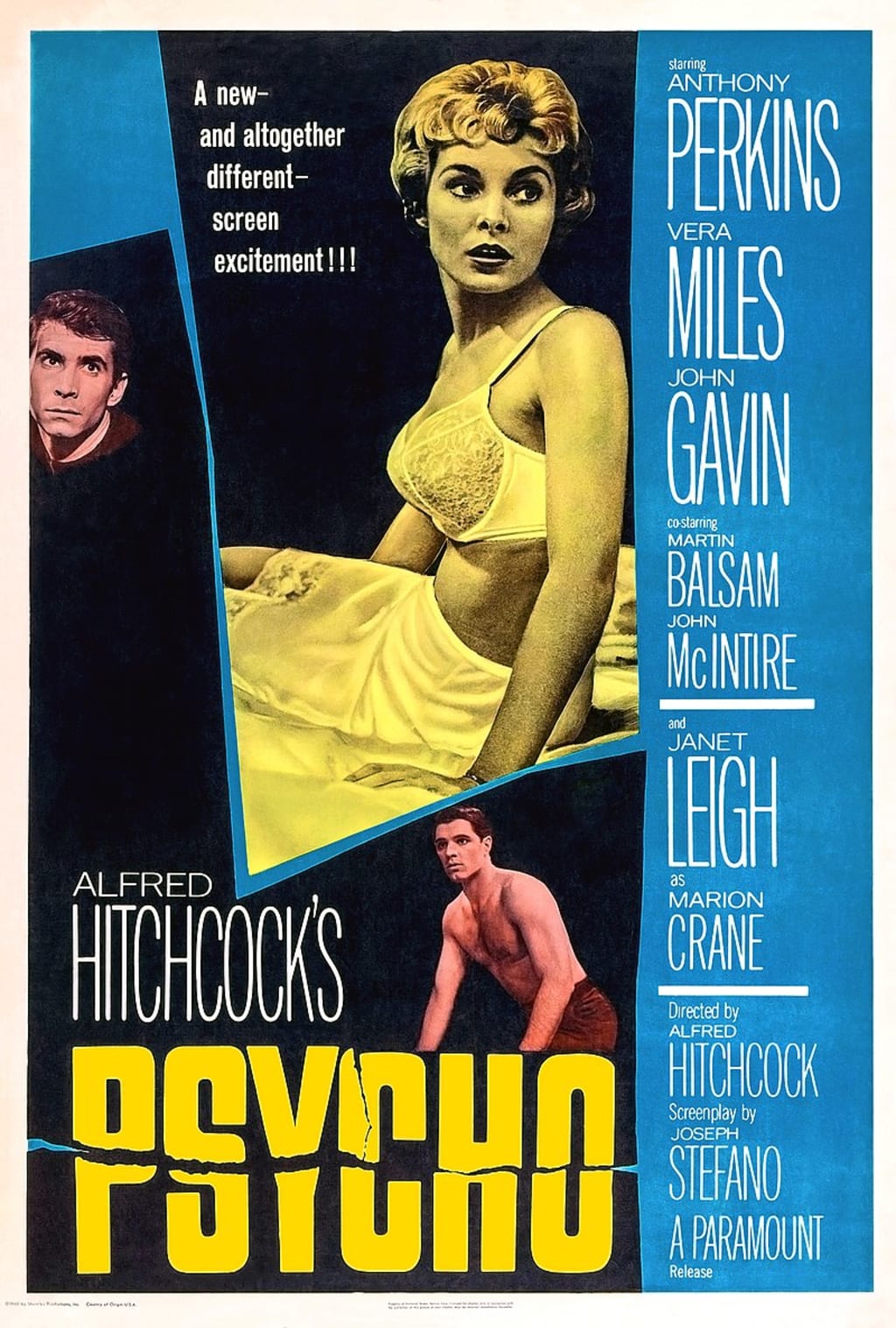
Psycho, Hitchcock's paen to "mother love" (in the literal sense) is a movie so engrained in the collective cinematic unconscious it hardly needs anything more said about it. Right? Am I right?
That being said (and all matters of grammar and spelling aside), I want to say something about it. because it's just such a goldurn good if somewhat sanitized take on the Ed Gein story, that, since I am a confirmed Gein-O-File, I feel I have to finally step up to the plate. (Which, in this case, just like in that old EC Comics story from Tales From the Crypt, is probably a human heart. Ed, when not wearing his heart on his sleeve, kept one in a saucepan. Or was that Jack the Ripper? I can't remember right off hand.)
Psycho was written by H.P. Lovecraft's protege and penpal, a youthful Robert Bloch, Hitch liked the novel, liked the story of Mr. Ed, and turned the two of them into what was originally going to be a two-part episode of his "Alfred Hitchcock Presents" television show, but was, perhaps, a tad too extreme for that. Lucky us.
I don't need to tell you the movie begins with a film noir beginning of a camera coming in on a hot, dirty, 1960 Phoenix from above, then peeping into the window of a hotel room boudoir wherein Marion Crane (Janet Leigh, whose daughter Jamie Lee Curtis, went on to star in another horror, mad slasher blockbuster Halloween, in 1978), and her lover Sam Loomis (John Gavin), who owns a hardware store, is broke, ruggedly handsome, and complaining of his ex-wife and her alimony payments.
Marion says she'll "lick the stamps." It's not the most intellectually fathomless line she ever delivered. But anyway.
Marion goes back to work, where a sleazy Phoenix millionaire (Frank Albertson) who wears a cowboy hat and must have trained hard to be that obnoxious, waves a huge ham fist of dollars in front of her for, his "little sweetheart's wedding." 40 GRAND.
The Boss (Vaughn Taylor) of whatever this firm or whatever is a 1957 guy who looks like he stepped out of a bad "Twilight Zone" episode, and tells Marion to go bank that wad, it "makes him nervous." The Millionaire was just, after all, trying to "buy off unhappiness," in this case, his daughter's, and if that wad of cash should disappear, well...
It does so. With Marion in tow. She drives, the camera dead in her face, the highway bluescreened behind her, thoughts of her thievery and what they all must be saying about her back at the office resounding in her head. She drives from Phoenix to Farevale (Sp?) California, and to her date with death.
She stops at the Bates Motel, a seedy rundown little dive trying to "hide from itself away," and meets the caretaker Norman, who lives with Mama in a huge, Victorian Charles Addams house behind the place. It's raining, they eat together, and Marion, who seems thoughtful, emotionally distant, cold, burdened, guilty, notes that old Norman--Anthony Perkins in a role he made iconic, as a shy, awkward, nebbish; a good-looking, lean young man who is the exact opposite of the repellent necrophiliac dwarf his character was based on--is a little cracked, his Mama (whom she has heard yelling at him when he went up to the house) berating him, Augusta Gein style, over those whorish women and their whorish ways. And the "cheap, disgusting fantasies of young men, that disgust me." Or some such.
Later, Norman watches the delectable Marion strip down to brassiere and slip, black, through the infamous peephole in the parlor. He gets turned on HARD. Marion decides to shower--she's feeling a little grimy, what with being a fugitive and all. As we ALL already know, this was her LAST MISTAKE.
A silhouette behind the curtain. The shower curtain pulled back. The high screech of the stringed instruments scraping over the fretboards. The jump cut of the terror-stricken face. The tall, obviously mannish figure in a dress and wig. That phallic, killing blade plunging into the bare midriff. The swirling blood going down the drain.
A solitary dead eye that looks upon nothing. The camera pulls back. "Oh God, Mother! Blood! Blood!"
Norman cleans up Mama's little messes. He puts Marion, poor, dead dear Marion, in the trunk of her car. He drives it into a swamp.
Next, a private detective("Arbogast", played by the iconic old television actor Martin Balsam), Sam in the Hardware store, and Marion's sister Lila (Vera Miles) enter the picture. Lila is hunting for Marion and assumed Sam had her hidden out, but was doing no such thing and was clueless. The detective, Arbogast, comes on like something from a noir pulp novel by Chandler and goes out to Bates Motel and interviews the nervous Norman, who gets the nellies, but then Arbogast hangs around too long (to interview "the Mother" ya' understand?), and goes up a staircase at the Old House with the bottom of it bluescreened, dream-like, behind him. The bewigged cross-dresser whom we see from yet another view as if looking down with what Genet would have called "angels farting on the ceiling" comes out to screeching chamber music and stabs Arbogast to death, causing him to plummet backward.
Sam and Lila go looking for Arbogast, aware something is fishy in that the private dick wanted to interview a woman the JOP assures them "has been dead for ten years. The only case of murder-suicide in Farevale history." They both meet Norman, and Sam puts on the old intimidation racket while Lila sneaks up to the house, and the rest is cinema history and we already know what happens.
In the end, some psyche played by the guy that played Vincenzo in later years in "Kolchak: The Night Stalker" (Simon Oakland) comes on and yaks about split personalities, Norman, his Mother-lovin' fixation, etc. But, at this point, it's just a "mopping-up operation" (as the real killers call the killing that goes on after an invasion when the "enemy combatants" have been mostly put down, but there are a few pockets of resistance left).
Psycho is a stark, brutal, and macabre little picture, one that made Hitchcock the legend he became. All performances are perfect, excellent, to the point: the desperations of damned souls all trapped in their prisons of the self, all moving to ward their inexorable troubling ends. It's based on the crimes of Ed Gein, although Ed was not the sanitized, handsome young man that Anthony Perkins was. He was an ugly, vaguely Elmer Fudd-like schizophrenic who lived in filthy squalor (he only kept sainted Mother Augusta's room clean), and had lips on a drawstring, heads on the bedposts, human face masks, vulvas in a box--you get the picture.
Psycho is the sanitized dream variant of that true, macabre piece of Americana. But, for all that, the dream is still dark, and the view is troubling, and Ed is relieved, at least by his cinematic stand-in, of carrying the additional burden of being born with a face "only a mother could love."
Ciao.
About the Creator
Tom Baker
Author of Haunted Indianapolis, Indiana Ghost Folklore, Midwest Maniacs, Midwest UFOs and Beyond, Scary Urban Legends, 50 Famous Fables and Folk Tales, and Notorious Crimes of the Upper Midwest.: http://tombakerbooks.weebly.com
The Animatronics Don’t Power Down Anymore
I’m 17 and I work closing shifts at Chuck E. Cheese. If you’ve never closed one before, let me explain something real quick: the place does not go quiet after the last family leaves. The lights dim, the arcade hums, and everything smells like grease and sanitizer. You hear noises that don’t belong to anyone anymore.
By V-Ink Storiesabout 15 hours ago in Horror


Comments (1)
I was not aware of the true life origins of Psycho. Great review.