

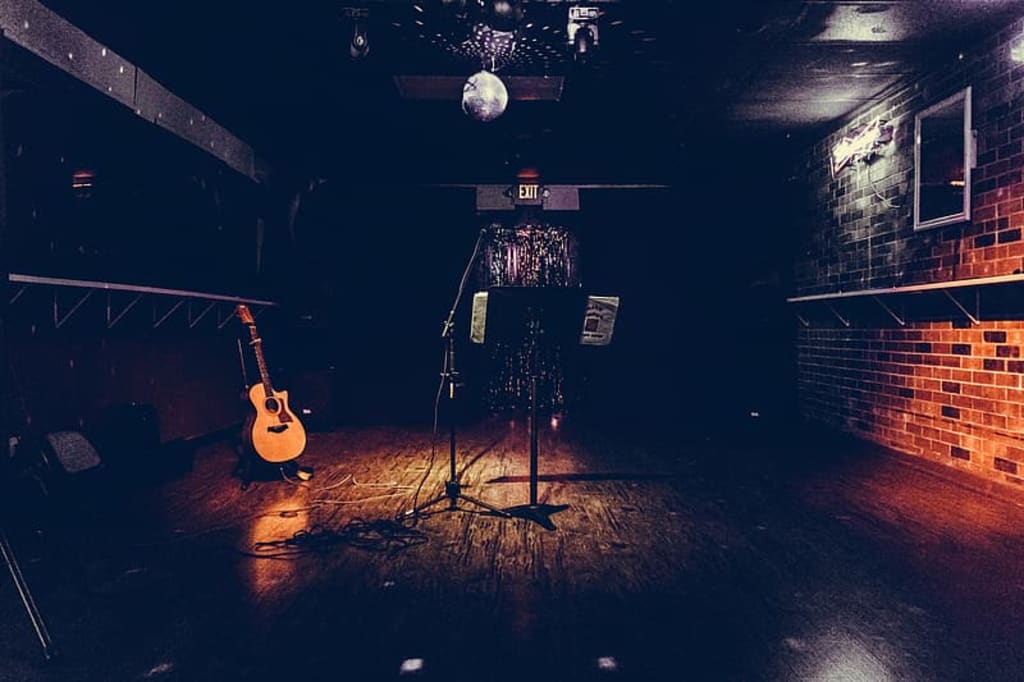
After my mother had my grandmother admitted to Senior Haven -- the best nursing home in the county, she claimed -- my father chose to pour all of his time and energy into finishing the renovations on the plantation home. There were nights that he would not come home until the middle of the night. He’d stumble into my bedroom and kiss my forehead, his breath masked in cheap whiskey. My father was always drinking, but never had the evidence been so clear than in the months after Grandma was admitted.
We’d lived in a tiny run-down trailer in the woods since my parents got together, and it bothered my mother so much that my father spent as much time working on that plantation home as he did when our own trailer was so awful. The floor was sunken in places where the wood beneath had given in, and the wallpaper was yellowing and peeling from the drywall.
My father promised that all of his hard work would pay off, and the summer after my Grandma Helen passed, it finally did. Although my Uncle Martin, the eldest of the three brothers, had been promised the plantation home in my Grandmother’s will, he was a hot-shot attorney out of Kansas City and didn’t have a use for it right away. He had agreed to let our family stay in the home until my father was able to find one of his own with the money that Grandma had left him in the will.
“Your uncle Martin is a lot of things,” my father told me, “but greedy is not one of them.”
We continued to stay in the house, but the house did not appreciate us. After Grandma left, the walls and floor of the house creaked and moaned at all hours of the night. The beautiful china that lined her kitchen walls on wooden shelves would come crashing down at least once a week, even when no one was home. The windows in the attic flew open and permitted the howling wind to echo throughout the house. It was as if the house was throwing a tantrum at the absence of its owner.
Every night after school, I helped my mother pack up the boxes of things that we had been storing in Grandma Helen’s house. Most of the things that we had brought (the clothes, furniture, toys, and other things) were stored in the attic. There was only one piece of furniture that remained on the ground floor of the house -- the cumbersome, plastic-wrapped sofa that my father insisted that he would not haul up the stairs, despite my grandmother protesting how it “clashed” with her set.
“It’s only temporary, Mom,” he argued.
“One way or the other it will be. I promise you that,” she snapped.
Once my grandmother had passed away, my mother was less discriminate about the decor that she would pack. I remember a particularly tacky vase with salmon pink roses and golden ribbons that she had squirreled away in our box of living room objects.
“Mom, I don’t think that’s ours.”
“It is now, Skylar.”
I gave her the most judgmental look I could muster -- the kind of withering, guilt-inducing look of judgement that only a kindergartner is able to give. My mother huffed in rebuttal.
“Well, she doesn’t have much use for it now, does she? Besides, your uncle doesn’t strike me as the floral type, to be honest.” She pointed to a janky cardboard box to my left. “Make sure and grab that box on your way out the door.”
I looked down at the box and scoffed. Mom folded her arms and I thew mine up in the air with a beleaguered “fine, woman!” She left the room, and I inspected the box. It was filled with books. I pulled one from the top of the pile: Secrets of Our Honeysuckle Nights.
After a few months of living in the plantation home, my parents settled on a new home for us. It had been recently renovated, and my father insisted that it was “a million times” better than the plantation home. I’d grown to love the nooks and crannies of Grandma’s house. There was an eerie stillness that settled over the bedrooms as the time since Grandma’s death slipped further and further away. It was that unnatural quiet which fascinated me. Some of the rooms still had furniture in it that Mom hadn’t pilfered -- ornate chairs and chests made of solid wood that would have been nightmarish to move. Creepy dolls and rocking horses that hadn’t been touched in decades collected dust in the room that I stayed in. Mom told me I could move them to a different room or throw them out, but I didn’t want to touch them.
“Suit yourself,” Mom huffed. “There’s no way I’d be caught dead sleeping in a room with Liverpool Lindsey over there, but that’s just me.” She gestured towards one doll in particular with a Union Jack vest, a tiny parasol, and a teacup. One of his eyes had been plucked from his porcelain skull, and the other was obscured by a soiled monocle. He was one of the more unsettling dolls in the room, definitely. But that’s why I liked him -- he was the most likely doll to scare off the real threats in the house; the entities that tugged at the corners of my bed sheets in the middle of the night, the whispers in the dark when everyone else had long since fallen asleep, and the shadows that danced across the ceiling in the dim nightlight beside my bed.
For all the frightening parts of the plantation house, it was never boring. Between pouring over the trinkets and antiques in each room to decide what to pack and the creaking and aching of the house as it settled into the final throws of another quarter century passed, the house was alive in ways that no other house could have been. Saying goodbye to that racist monument meant moving on past a chapter of my young life -- the only life I’d ever known.
As our last nights in the old house grew closer, I felt the sadness creeping in. The energy of the room grew colder in spite of the summer heat -- the darker corners of each room growing darker still. It was as if the house was being pulled from existence while I still stood in it -- or maybe my memories have faded in the years since those final days. Either way, I couldn’t help but cry one late night when Dad came to check on me. Dad had always worked late, and the construction on the new house only made his returns later and later.
Dad owned a local bar and grill near the highway called “The Right Folk.” It was another relic of our generational past that had been passed down through the family line. The building had once been a butcher shop, but my father had no interest in the meat business. Unlike the other men in his family, my father was not a hunter or a farmer -- he was an artist. He re-branded the butcher shop as a tavern, and after he’d built up a good reputation for the place in the community, he was able to support our family comfortably off of it. It wasn’t much, but it allowed him to do his two favorite things in the whole world -- drink, and play music.
He came into my room that night from the bar and sat on the edge of the bed beside me. He placed his giant, calloused hand on my forehead. He smiled softly at me, his lips barely visible behind the scraggly brown beard. He saw my tear-soaked face and furrowed his brow in thought for a moment. Inspiration struck, and his soft brown eyes lit up.
“We can get cable at the new place,” Dad told me.
I sniffled, considering the development. I thought for a moment before my tiny voice squeaked out, “Nickelodeon?”
“I don’t really know what that means, but probably,” he laughed.
I wiped my nose on my sleeve. “I can work with that.”
Every week or so during the time that he was working on the house, he would call me over to the kitchen table. In the beginning, he rolled out the blueprints he had designed with a friend named Rex to guide their renovations and showed me all the different rooms that Rex had sketched out. Under the dim kitchen light, he pointed to each room and explained the specifics of the electrical and plumbing, the furniture and windows -- with special attention given to the room that would eventually be mine.
Dad had described the layout as some “hippie” nonsense when he first found the place. To hear him describe it, the house was one big room with strings of wooden beads serving as the only barrier of privacy between each room. He said that as many as twenty people would come and go from the house since it was built -- staying just long enough to wear out their welcome on the drugs and sex that the owners had promised.
“How do you know all that,” my mother asked the first night Dad had brought it up at the dinner table.
“Same way every other person found out about the place -- they reached out to me. I was playing a gig at Tawnya’s place -- the one down the road from Mom’s -- and they reached out to me after my set to ask if I wanted to take my show on the road down in the Ozarks and shack up with them for a few nights.”
“A couple strangers thought you’d be interested in drugs and sex at their place? How the hell did they get that idea?”
My father was not a man who was prone to any extremes of emotion. He never got angry around me, and he never cried. He on occasion would express mild annoyance or some content joy, but it was his steady nature that was so appealing to ordinary folks. Despite my mother’s prying, my father remained cool. He closed his eyes and took a measured breath.
“Well,” my mother prodded impatiently. “what did you say to them?”
“I told them to get back to me when they were looking to sell the place. It just so happened that they were. It seemed like they were just as eager deep down to leave all this free love bullshit behind them, too. Offered the place for dirt cheap just to get rid of it -- that’s how I was able to make that down payment with the money Mom left us.”
Mom was lost in intense thought for a moment, then shrugged. “Just scrub the place really well before we move in. God only knows what’s in that carpet.”
-----------------------------------------------------------------------------------------
Once they started renovations on the house, Dad would bring home cheap Polaroids of the progress. During the last few weeks of progress, he did not bring home any pictures. He claimed that he wanted it to be a surprise, but I knew that he was really too busy.
As my excitement about the new house grew, my fondness for the old plantation home faded. The creaks and groans of the floorboards were no longer charming -- they only annoyed me. I couldn’t wait to be out of that house, and I could sense that my parents felt the same way.
After a few more days and long, drunken nights, my father completed work on the new house. My father and his two brothers, Uncle Martin and Uncle Jeffrey, hauled the entire contents of our trailer (plus the new-found decor courtesy of Grandma Helen) down the winding Ozark back-roads to our new home. I bounced up and down in my seat, unable to contain my excitement about our new home.
I couldn’t hardly eat on the morning of our big move. All of the heavy furniture and boxes of kitchenware, books, and trinkets had already been moved to the new place -- my father took a box or two with him each time he left to work on the house. My Uncle Martin drove down from Kansas City, picking up my Uncle Jeffrey along the way in Jefferson City, to help my father with the last of the construction on the new house, and they were there that morning to help pack up the rest of our stuff. Our remaining clothes and blankets were shoved in plastic trash bags and tossed in the back of Dad’s beat-up Chevy pick-up the night before, and by 6 AM, we were on the road. I could hardly keep my eyes open, but my mind was racing.
The new place was quite a drive from the flat fields that surrounded the plantation home. The harvest season had come and gone, leaving the fields barren and dry. As we headed down the highway, the open sky slowly gave way to high cliffs and towering trees. The road became much more narrow and twisted, and the smell of cow dung and farmland gave way to the dewy, rain-soaked air of the Ozarks. After what seemed like hours of winding tree-covered roads later, we reached the house. I cried out with joy at the sight of it. My uncle Jeffrey, who sat beside me in the tiny backseat of the truck and on the opposite side from Martin, placed his thick, hairy arm around my shoulders and laughed, squeezing me tight.
“Are you kidding me, John?” My mother turned to my father in the front seat of the truck and scowled at him.
“What now?”
“There’s no way that we could have afforded this place! How much did you spend ‘fixing up’ the place?”
My father pulled into the arching gravel driveway that led up to the house. He slammed on the brakes at the door and sighed heavily.
“Can we not do this right now,” he asked wearily.
“He already built it, Debbie. It’s not like you can just --”
“Shut the hell up, Martin,” my mother snapped. “Honestly, John. There’s a whole other floor to this house now!”
“Hun, please… there was an attic, and we just expanded it a little.”
“Lighten up, Deb,” Uncle Martin muttered. “Jesus Christ…”
“You have no idea what it’s like for us, Martin. Helen just hands you her house on a silver platter and it’s like it doesn’t even matter to you. You knew what that house would have meant to us.”
“Where’s this coming from,” Martin laughed. “We all knew she’d leave it to me. I knew it, Jeffrey knew it, the others knew it, and John knew it too. Hell Debbie, I even let ya’ll stay in it while you were getting this fine piece of work done. I didn’t have to do that, you know. I could have sold the old shithole right from under ya’ll, but I didn’t.”
“Oh, how merciful of you, Martin. How thoughtful of you to let us stay in the house that you swindled out of your senile old lady. Gloria a Dios!”
“That’s enough!” John roared. My father never raised his voice, but the power of it startled me and I began to cry. Uncle Jeffrey squeezed me tighter, and I buried my face into his side. I couldn’t see him, but I could hear my father’s sigh. “I don’t want to fight about Mom. She did what she thought was right. And Debbie, I didn’t tell you how much the house cost to fix because I knew it would worry you. But there’s nothing to worry about.”
I pulled my head from my uncle’s side and looked at my father. The warmth that I recognized in him returned to his voice and to his cheeks. He reached out his hand and placed it over my mother’s. She recoiled a bit, but she didn’t pull her hand away from him.
“I’m sorry. I just --”
“It’s okay, Deb. I know you’re scared. But this is our home. I wanted to give my family nothing but the best, and this,” he gestured to the house, “is what the best I can give looks like.”
“It’s beautiful,” I said feebly.
“It sure is,” my uncle Jeffrey cheered. “The princess has spoken!”
“I think it’s about time we let her royal highness see her wing of the castle, don’t you,” Uncle Martin added. He nodded towards my father, giving him the permission to continue speaking with my mother. My father thanked him. Uncle Martin unbuckled me from my child’s seat and we walked, hand-in-hand with Uncle Jeffrey, down the gravel driveway and onto the front porch.
“It’s still a bit of a work-in-progress, fellas!” my father called from the truck.
If I’m being completely honest, I don’t remember much else from that first night we were there. I remember the smell of lumber from the construction, and I remember the feeling of the scratchy carpet that covered the staircase and the halls. I remember making a game of tumbling down the set of beige carpet-covered stairs that led to my bedroom in the attic. Once at the bottom of the stairs, I would sprawl out like a dead person, stick out my tongue, laugh to myself, and crawl back up the steps on my hands and knees like a lanky cat.
For the rest of the night, the family worked to start unpacking boxes and moving their contents to the different rooms in the house. The men rearranged the larger furniture by hand and dollies while my mother weaved around them with boxes of trinkets and items that she’d hoarded from her mother-in-law. Whatever conversation my parents had in the truck after I left, it seemed to have lifted her spirits. She was nearly floating on air as she moved through the new house.
My father had sold The Right Folk when we moved to new ownership, but within a few days, he had found a new place to play his music and unwind every Friday and Saturday night. After a few years, he got popular enough that other bar owners were asking him to come play shows in their bars. There were a few nights that he would take me with him. The bar he frequented the most was run by an athletic blond woman named Cheryl. Cheryl didn’t have any children of her own, and so she would treat me like her own when I would come by. I remember that she had a small bowl of Snickers that she left on a shelf in her tiny office for me any time that I came to one of Dad’s shows. We would walk into the back room, behind the bar and the kitchen, criss-crossing between boxes and staff to make it back to her office.
There was one time in particular that I remember walking back to her office and meeting her best friend, a short grey-haired woman named Donna. Donna was not as child-friendly as Cheryl, but she let me take my Snickers and minded her business, so she was alright by me. She was not alright by my mother though, and when I told her about Donna, she told me that she wouldn’t allow me to go to the bar with my father anymore.
“The bar is no place for a little girl,” she said. “Especially not with women like Cheryl and her ‘gal-pal’ Donna running the place.” My mother used her fingers as air quotations when she said “gal-pal,” and although I could sense her judgement and her disgust, it didn’t stop me from using that term with all of my female friends for the rest of the third grade. There was something about the nickname that was fun for me. It’s a good thing she saved “carpet-munchers” for my high school years, because that would have been a very uncomfortable trip to the principal’s office.
It was those nights at the bar where my father and I would really connect. He always had to show up to the club at least one hour early -- he had to have a buzz in order to perform. He’d sip on whatever draft beer the bartender recommended and strum on his guitar on whatever the bar considered to be the stage -- some places were more generous with their definition of what a stage was than others. After I had guilted the bar owner out of whatever snacks and treats they had lying around, I would approach the stage where my father would sit. He’d look down at me, grin, and call me on stage with a bend of his index finger.
Being on that stage with him was like a whole different dimension. Every bar looked so different from up there -- the lights hit the leather of the stools and the silhouettes of the people in a way that felt alien. I told my father about that thought one of the times we sat together, and he just chuckled and said, “well how d’you think God feels up there in the clouds, kiddo? He created the whole world and you know what? I bet he does look on down and think to himself ‘ya’ll really made a mess of things while I was gone.’”
I didn’t get it then, but I do now -- still isn’t funny, but at least I get it.
Every night that we were there, Dad would teach me about some folk singer. My mother always thought it was one of those things that was cute when I was younger, but that I would grow out of it someday. My father, on the other hand, insisted that “folk music is our music.” And it was true. For years I went to his shows -- at least a dozen a year -- and shared in his love of folk music.
“You remember the Campbell song I taught ya?” he asked one night during the summer before I started high school.
“Joe Campbell?”
“Joe? Hell no, I’m talking Glen. Glen Campbell.”
I shifted nervously on my bar stool.
“Don’t worry about it, kid. It’ll come to ya.” He leaned in really close and I could smell the sickly-sweet scent of whiskey on his breath. He whispered to me, “when you hear it, I want you to come up and sing it with me tonight, Sky.”
I didn’t know what to say. I’d been visiting his shows and watching from the crowd for over a year, and never once had he asked me to sing with him in front of the crowd. My cheeks grew warm and he wrapped one arm around me tight. He used his sizable belly to erupt in a deep, full laugh.
“Don’t worry, sweetheart -- you’re a natural! You’ll do great.”
Even as a kid, I never wanted to be in the spotlight. While some people feel all of the eyes of the crowd on them and they feel excitement, all of those eyes on me creates a burning sensation that starts in my stomach and radiates to the rest of my body. I’d never really experienced that feeling so intensely before and I instantly rejected it. Even still, I knew that it meant something to my father to have his daughter on stage with him, so I decided to endure it.
I racked my brain to try and think of Glen Campbell.
Is that the guy that sounds like an elf?
The one with the deep deep voice like a bullfrog?
Is he the one that sings that song ..the song with the… the ba-dum-da-da-dum?
My father sang a few songs at the beginning of his set that were definitely NOT what I thought Glen Campbell would be. Willie Nelson was one of my father’s favorite singers, but that was not an opinion that we shared. I knew Simon and Garfunkel, Neil Diamond, Cat Stevens … and then I saw him reach from behind his stool and grab his banjo. My father had only just recently started to learn the banjo, and there was only one song that he could play by heart. He strummed the opening lick and the couple dozen people in the crowd cheered for him. His eyes locked with mine and he started to sing:
Hey… Little one….
So far from home…
And so alone.
He nodded his head towards me, calling me onstage as his fingers continued to strum.
Hey… little one…
I hopped off the stool, a tall drop for my tiny legs.
I’m just li-ike you.
I’m lonely, too.
I knew the song by this point, and I started to chime in. The room grew dark around me and the bar crowd faded from view.
The road of life is a long, long road--
A shadow extends from the stool I was sitting in -- long and eldritch.
When you walk alone
Then I found you.
And I found a lo-ove,
This can’t be right … I don’t remember the shadows… I would have remembered those… Why is it so hard to remember this moment?
A love I’ve never known.
The blinding lights. I can hear my father sobbing beside me … or maybe it’s my mother. The sounds are muffled in my memory. A crash -- sudden and fierce like lightening.
A love I’ve never known.
I feel a sharp tug across my chest -- a shadowy finger grasping around my torso. I can’t catch my breath to sing. But no, that can’t be right. It was a seat belt! I know it was.
Hey, hey, hey, hey little one.
Why am I remembering this now? It was later that night, not now. I’m not ready to tell you now. There’s so much about my father that I --
Don’t go away.
My father, hanging from the driver’s seat, with only the seat belt holding him in place. The blood, rushing to my head.
Tell me you’ll stay.
The bar crowd has moved away as the shadows recede and my father, in tears beside me and my mother in the crowd, continues to strum on. I can hear the distant nagging of my mother. His voice is only a whisper now.
Hey, hey hey little one.
I’m just like you.
I’m so lonely, too.
And then nothing.
My father is gone and I’m all alone. I can’t see anything anymore. It’s all black. Why can’t I remember that night… before the crash … before he left me forever…
About the Creator
ZCH
Hello and thank you for stopping by my profile! I am a writer, educator, and friend from Missouri. My debut novel, Open Mind, is now available right here on Vocal!
Contact:
Email -- [email protected]
Instagram -- zhunn09
OBLIT
This is me. My name is Oblit. It's odd, isn't it? I live on an island. Well, at least I think I do. I haven't seen anyone else in a long time, so I assume I do. I live inside a little house - it's quaint. A five-windowed bungalow, built on a street with only half-constructed houses all around. The lights don't light up at night - and the various concrete and plaster walls that decorate the plain green field only serve as props to my living. I live inside 1557 Rangolin Street. One front door, one back. A modest little backyard with benches and various plants sprouting from scattered pots. Two sets of gardening tools, one for me, one in case I forgot the other.
By Albert Xiong7 days ago in Horror


Comments
There are no comments for this story
Be the first to respond and start the conversation.