
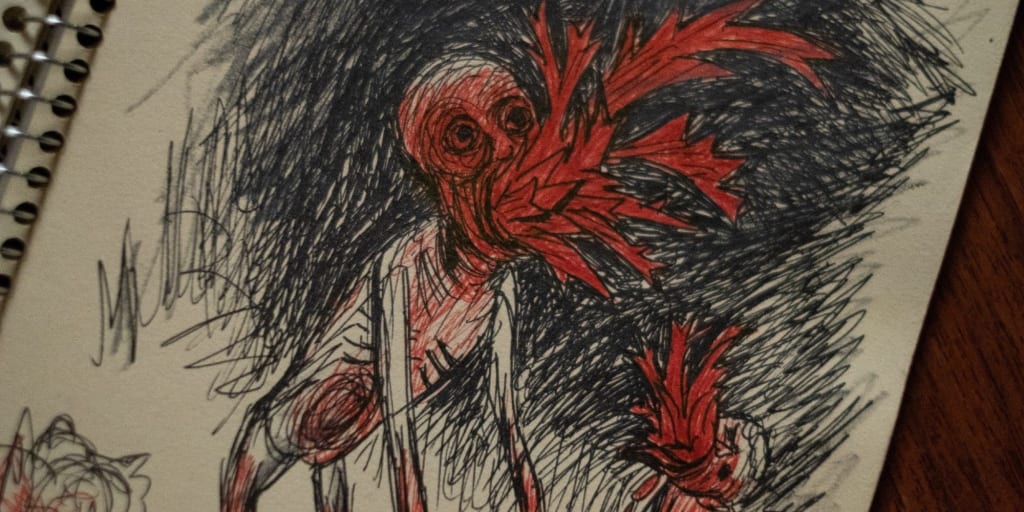
Be aware of the possibility of a large flesh-eating giant when venturing into the woods of the Mid-West and North East. This terrifying figure is a member of Native American folklore, specifically Algonquin-speaking tribes. There are many different descriptions associated with this gruesome monster, but most agree that is a large (15ft tall) malevolent organism that feeds on human flesh.
Basil H. Johnson describes the monster as:
“The Wendigo was gaunt to the point of emaciation, its desiccated skin pulled tightly over its bones. With its bones pushing out against its skin, its complexion the ash-gray of death, and its eyes pushed back deep into their sockets, the Wendigo looked like a gaunt skeleton recently disinterred from the grave. What lips it had were tattered and bloody ... Unclean and suffering from suppuration of the flesh, the Wendigo gave off a strange and eerie odor of decay and decomposition, of death and corruption.”
The word Wendigo means “the evil spirit that devours mankind”.
Definitely not something you’d want to meet on your nice easy hike with your dog Sparky. There probably would be no more you, and no more Sparky either. So let’s keep all the Sparkys’ in the country safe by learning a little more about the Wendigo.
Wendigos are reportedly created when a human resorts to cannibalism, whether it be as a last resort or a personal choice. There is also the thought that Wendigos were once humans who were so greedy in their life, that they were possessed by the spirit of the Wendigo.
Wendigos are apparently master hunters, and at times they are said to turn invisible. They are also said to know their territory extremely well and can catch their prey very quickly. Apparently, they can control the weather with black magic. They are able to mimic voices, which lures in victims who believe they are responding to a friend or family member.
However, no matter how much the Wendigo eats, it will never be full. The more it consumes, the bigger and hungrier it gets. The human soul within the Wendigo is completely taken over by the insane hunger. It can still starve to death though, which is good news for us.
The Wendigo was also used as a metaphor in Native American society as representing anything that was driven by greed or an insatiable need for power. It also served as a warning for Algonquin tribes during harsh winters. The stories attempted to dissuade the practice of cannibalism when there was food scarcity, especially since Native American societies viewed it as one of the worst crimes a person could commit.
Even if this mythical being is not real, there is still a direct effect caused by its terrifying presence.
The Wendigo Psychosis.
Wendigo psychosis is characterized by the intense need to eat human flesh and the fear of becoming a cannibal. Funnily enough, it occurs mainly in areas where Wendigo myths are prevalent. Heavy winter snows that trap people frequently cause the onset of the mental disorder, as people begin to starve.
For example, a Native American named Swift Runner was afflicted in the winter of 1878. His oldest son died, and though there were supplies available a short way away, he chose to kill his entire family and eat them. He later claimed that the Wendigo infiltrated his mind and forced him to kill his wife, as he was no longer in control of his body. The ‘Wendigo’ then made his son kill his other son, and while eating his child, he strangled his infant to death. He was later caught and hanged for his crimes.
Another Native American, Jack Fiddler, was a killer of Wendigos. However, it was reported that he himself was afflicted by the evil spirits and was arrested for murder in 1907. These murders were attributed to his intense hunger for human flesh. He killed himself before he could face trial.
Overall, anything having to do with the Wendigo is a nasty and gruesome business. Luckily, or hopefully, it doesn’t actually exist.
Hopefully.
About the Creator
Jude Vain
this isnt real
Getting Serious About Comedy (Part I)
If I were asked to remark on my life and the childhood that paved some road leading me to this point, I would have to say something about all the funny people who surrounded me for the last 26,872 days (and counting). Somewhere along that road, I became a big fan of laughter and the comedy that spawns it – and, I mean not only my own laughter, but the laughter of others, some of which I have actually been responsible for inducing.
By John Oliver Smith7 days ago in Humor



Comments
There are no comments for this story
Be the first to respond and start the conversation.