
My Son Keeps Pointing at a Room That Isn’t in Our House
He says that’s where I used to leave him
He says that’s where I used to leave him
By Anees Ul Ameen
My son learned how to point before he learned how to talk.
At first, it was harmless. Cute, even. He’d stretch out his tiny finger toward the window when birds landed outside, or toward the kitchen when he smelled food.
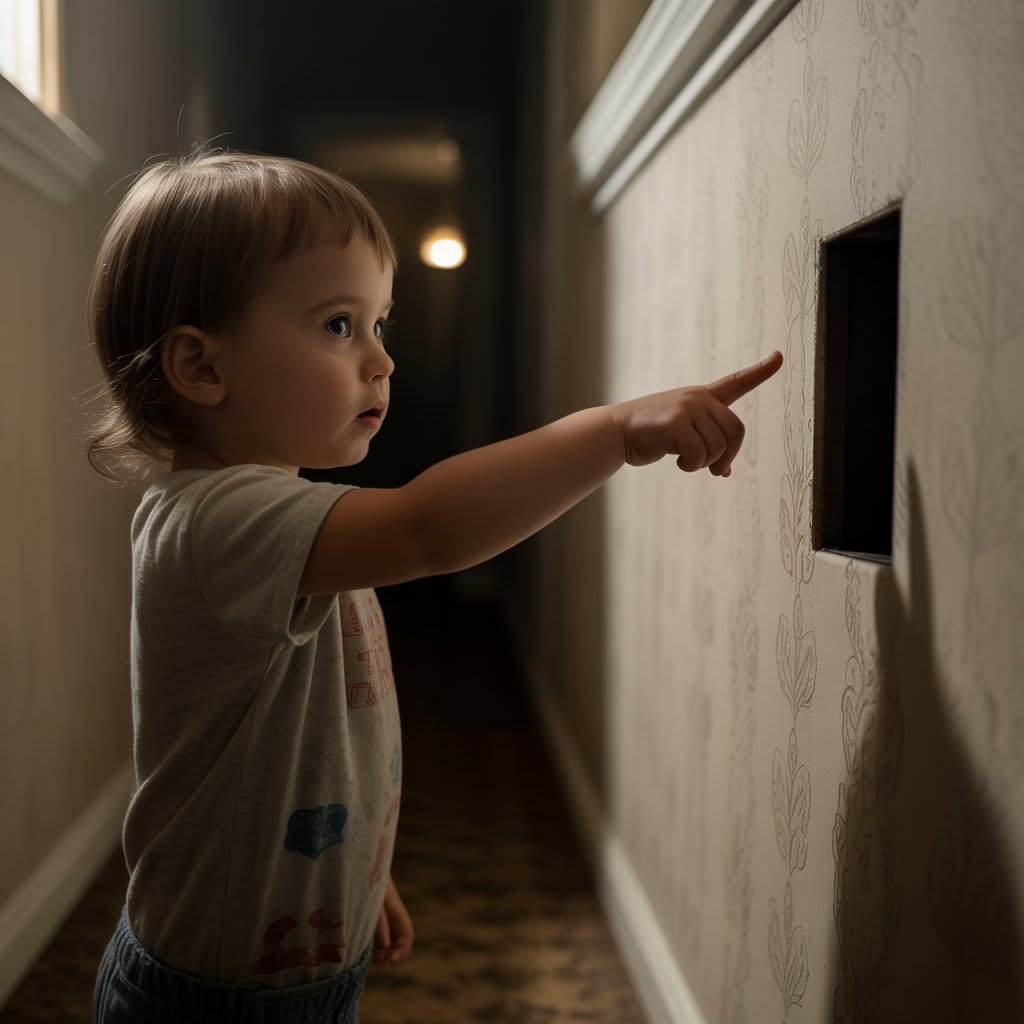
Then one night, he pointed at the hallway.
“There,” he said.
The hallway was empty.
“What’s there?” I asked, smiling.
He frowned. “The room.”
We didn’t have an extra room.
After that, it became routine.
Every evening, just before bedtime, he would stand in the living room and point down the hallway, his small hand trembling slightly.
“That’s where you go,” he said one night.
“Where I go?” I repeated.
He nodded. “When you’re tired of me.”
I laughed too quickly and pulled him into a hug. Kids imagine things. They absorb words, tones, fragments of adult conversations and turn them into stories.
That’s what I told myself.
But the pointing never stopped.
One afternoon, I was folding laundry when he wandered in, dragging his blanket behind him.
“You forgot to lock it,” he said.
“Lock what?”
He pointed again.
The air in the hallway felt colder suddenly, heavier, like the pressure before a storm.
“The room,” he said. “The dark one.”
That night, I checked the house.
Every door. Every closet. Every corner.
Nothing.
Still, I found myself standing at the end of the hallway, staring at the wall where my son always pointed. I pressed my palm against it.
It felt wrong.
Not hollow. Not solid.
Waiting.
The dreams started soon after.
I dreamed of standing in a narrow room with no windows, the walls too close, the air thick with the sound of crying. A child’s cry. Hoarse and exhausted.
In the dream, I stood outside the door.
Listening.
Telling myself I’d open it soon.
“You stayed longer this time,” my son said at breakfast.
My coffee cup froze halfway to my lips.
“What do you mean?”
He swung his legs under the table, cheerful. “In the room. You stayed longer.”
I felt sick.
“I don’t go anywhere,” I said. “I’m always here.”
He tilted his head. “That’s not true,” he said gently. “You promised you wouldn’t forget again.”
I searched the house records that afternoon.
The original blueprint showed something strange.
A small room marked in the hallway.
No label. No purpose.
In the updated plans, it was gone—absorbed into the wall, removed during renovation.
Sealed.
That night, my son stood in the hallway again.
But this time, he wasn’t pointing.
He was knocking.
Three slow taps against the wall.
“Open it,” he whispered. “I don’t like being alone.”
My legs wouldn’t move.
“There’s no room,” I said, my voice breaking. “There’s nothing there.”
He turned to look at me.
His eyes were too old.
“That’s what you said before,” he replied. “That’s why I cried.”
The wall cracked.
Just a thin line, running from floor to ceiling.
From inside, something breathed.
The smell hit me next—stale air, old fear, the unmistakable scent of a place that had been used and forgotten.
I remembered everything.
The sleepless nights.
The frustration.
The soundproofing.
The lies I told myself about “just a few minutes.”
Minutes that stretched.
Days.
I fell to my knees.
“I’m sorry,” I sobbed. “I didn’t know it would stay.”
My son smiled.
“That’s okay,” he said. “You’re here now.”
The crack widened.
A door appeared.
And behind it—
Silence.
Waiting.
They found the room two days later.
Empty.
My son hasn’t pointed since.
But sometimes, when the house is quiet, I hear knocking from inside the walls.
Three slow taps.
And a voice that sounds like mine, asking to be let out.
— Written by Anees Ul Ameen
Author’s Note:
This story was written with the assistance of AI and carefully edited, revised, and finalized by Anees Ul Ameen
About the Creator
Top 10 Spring Break Horror Movies
Spring Break is often associated with fun, sun, and relaxation, but in the world of horror films, it can also be a time of terror and chaos. College students and high school students are having a great time, unaware that the worst is yet to come.
By Ninfa Galeano4 days ago in Horror
Top tipple tricks
Been thinking a lot about drinking, lately. Not least because of a recent episode of over-indulgence and the inevitable after effects. Some readers may recall the earlier articles I wrote about beating the booze. Here I set out an experiment in techniques for cutting down on my alcohol intake. The experiment was successful, the techniques worked, and I have armed myself with an arsenal of weapons in the war against the demon drink. I have yet to fire the first round however. It's all a question of timing (perhaps procrastination).
By Raymond G. Taylor7 days ago in Psyche



Comments
There are no comments for this story
Be the first to respond and start the conversation.