

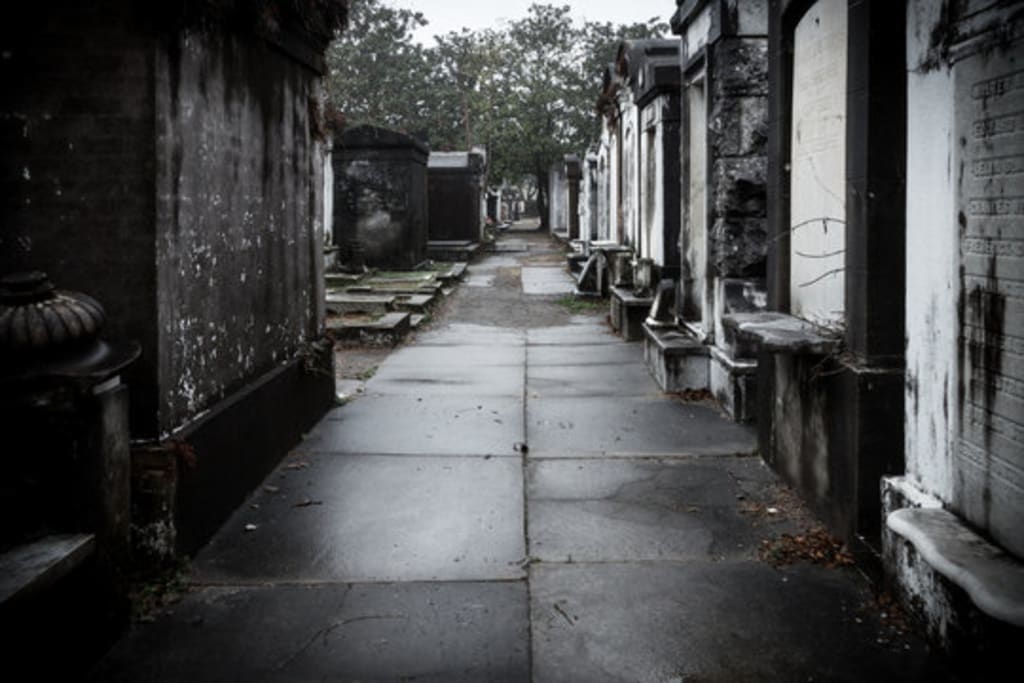
I have a thing about going to cemeteries when I don’t have to, especially in a place like New Orleans. But this day it is necessary. Even so, I don’t like it. It seems to be part of the human instinct that cemeteries are a bad place. No one told us these stories when we were children, we came up with them by ourselves.
I don’t remember who I heard it from, that thing in the cemeteries. It’s something that stands behind, and when you walk it stays behind out of your sight. Behind the pillars of the fence, behind the statues and mausoleums and hills of dirt. Most of all behind the walls that occasionally surround the cemeteries in the nicer areas. They probably tower behind those walls, with no one inside to see them except for the unburied corpses in the rows of standing tombs that make up the famous mausoleums of New Orleans.
In the majority of cemeteries, there is just a fence, and when I used to walk by on my way back from school I would pass the towering marble and concrete boxes and figures, knowing that something long and shadowy was standing behind them. One time I ran past. I remember hearing that you could catch a glimpse of them if you ran. Don’t ever run in a cemetery: I ran with my eyes closed, knowing that if I opened I might catch a glimpse of the side of one of them, and if I saw them they would come to get me.
I knew, as I ran, that they were there, sliding back behind the crosses and tombs, and they knew I was running. To this day, I believe the only thing that saved me was the high black fence in between the rows of empty houses and my unsafe walk back home.
So if there was any other way to do this, I tried it. I tried sage and rituals, I tried praying and moving, but the whole problem of my life is centered here, in New Orleans, in this epicenter of three cemeteries cut open by a road and a trolley line.
I am ten years older than I was on that day, but the weather is the same. It’s always the same in New Orleans: at the beginning of winter the clouds begin to accumulate in the sky and coat the city in a rigid foam, and as the land begins to heat, the air bubbles up through the valley like a pot. Then as the scorch of summer supplants the steeping ferment, a roaring and a flashing begins that has only been found in ancient depictions of Sheol: the heavens themselves weep and gnash in response to some primal enmity with the land it presides over.
It is the same gray in the sky, the same edges and orbiting of tornado clouds, and a constant, but distant flashing of angry strobing sky, flickering second by second like it is blinking. The sound of a train rolling across the sky, leaving. The swirling waters of the gulf, inverted above us. And rain falls on our land, land the ocean continually demands to soak up into itself through any means necessary. That’s why we bury our dead above ground, so they don’t wash away.
So I keep my head down, I don’t look up because I know what is there. I don’t look through the fence as I pass by the cemetery I walked by so many times before. I park by what is now a coffee shop at the edge of the fence, The Witch’s Brew.
They sell candles and incense on one side, and on the other, tea and coffee. I get an iced coffee and drink it outside, but don’t sit down. The chairs are all shaped like brass hands to go with the voodoo theme of the coffee shop. I just stand with my back to the cemetery like I am smoking a cigar with a firing squad to my back. Here, minutes before I die, there is no one but the company of the hands.
The thunder reminds me that this was all my fault. The big one was all my fault. It was three days after, in August, and I was ten years old. Katrina hit New Orleans, and I knew it was because of me. That day coming home, when I ran. Out of the thin line between my pinkie and my ring finger, I saw them.
Ever since that day I haven’t been able to live normally, I didn’t finish school, I don’t get along with my family or anybody. It’s haunted me, truly, like a bad dream in the early morning. I was running and saw a black line, just one of their arms, maybe, their tall long arm. He pulled it back instantly, but I knew they were after me. I got brutally sick that day, and then three days after, Katrina happened. That week lives in infamy in the minds of everyone in New Orleans. Still, ten years later, Katrina is a household name used daily. It’s a crazy aunt that has ruined everyone’s family. And I can’t stand being the cause of the storms any longer.
They’re incessant, the rain clouds and light shows telling me that there will be more, unless I go back and fix what I did. It was just a childhood story, but that day it became real with an ethereal black edge that cut my life in two, and the storm that shouted, you saw us.
I go slowly today, turning into the pedestrian entrance to the cemetery, stepping slowly like a bride down the aisle. The walkway is gravel, and it cuts all the way through the field with stone above-ground coffins on either side all the way down to the very other edge, where stands a giant black marble wall.
Some of the mausoleums and crypt lids were dirty and grayed by one hundred years of storm and wind, whereas those accompanied by an engraved inscription of “Perpetual Care” shine with their white marble and stone. This great marble wall, however, bears the decay of these forgotten graves.
As I step over the cracking bricks of dirt and masonry, my eyes dart from mausoleum to mausoleum, scanning up and down for tendrils of whisper hands sliding away from vision, but there is only the dry sand of air.
I near the middle of the cemetery, seeing no fleeting figures I knew that all of them were behind me, instead outlining marble and stone, the shadows are behind my back as the clouds above thicken, and the wind picks up around me, and everywhere is dark.
There is no one outside. People have learned to seek shelter in those altars they built to live in, those houses, like mausoleums they hide in. In the city of New Orleans, some are clean, some are dirty, but all are an affront to the angry sky, and all are laid bare before the huffing of the sea.
And like a monument to this wall of water, this wall around the basin of New Orleans, the black walls encapsulate the deeper level of the cemetery, which I walk around the massive, open portcullis, and enter. This inner sanctum wrapped in the arms of those marble walls is massive, and yet on the other side, the city goes on as if there are not a thousand buried men and women there.
In fact, the road from one side of the cemetery to the other hardly seems long, which must be some confusing geometrical coincidence; where the cemetery appears to be a square, it must really be asymmetrical: spilling out in skewed shapes in ways the walls would never reveal.
From inside, it is a giant circle. She is locked in, her only escape a small unhitched gate from the top wall to the bottom. She descends the steps, down into the subterranean level, down below the usual hole New Orleans sleeps in, far under the sea already, she descends. This circle, this basin, walled in by black marble, lies beneath the abysmal. These mausoleums are greater, more jagged and magnificent, and trepidatiously sunken, sitting deep in the earth, challenging the stars to submerge them in blood.
There is no garden, no decoration. There are no white mausoleums here: just the old high marble gate above her, leading down a road of rain-stained concrete, down steps and steps, and a statue of a great deer. And it begins to rain.
It begins to rain with ferocity, the ferocity of all those behind her, as the gate behind her disappears, and she is fully walled in. She reaches the center of the lower level, like the bottom of a bowl, and the wind swirls around her, and the rain hits her face with vengeance.
She could not possibly apologize for all those people in the city. All those people who built houses and shops on cursed ground, on ground where no man was supposed to tread. They were building their mausoleums; graves they will be stuck in until their bodies fall off of them.
The ground beneath her starts to soften, and water starts to rise to her feet. She can see the water falling down the black marble, down into the basin. The sea has wrought its vengeance on me for coming to life here, for living here, and every day it fights against me and the city to look again like itself—a dead swamp.
That is the will of the sea: The buildings will fall, the people will float. Anyone who lives in the city will tell you. And I am the first of them all, because I saw the sea. I looked them in the eye and they saw me. That is why this is personal.
The rain will always come, the storm will build and build as humanity expands, build so wide and swirling that it destroys them all. But my torture is reserved particularly to those who run in a cemetery, even as a child, even though I was very afraid; I should not have tempted death. We all should not have tempted the ocean by coming here, by looking into the eye of that great cloud of death.
I hope the rains aren’t as bad after this. I hope the gray sea above us is happy for a little while, with my sacrifice. I wish I could feel honor with this, but I only feel the cold water crawling up my stomach. And as the dirt and water rise they swim under the surface, I feel them skitting below my feet like a ribbon, circling the courtyard, squeezing tighter in toward me, toward the center.
The ground starts falling: The whole time I was standing on fleshy mud. The water reaches the bronze deer as the tops of the mausoleums disappear.
The mud falls down and my head falls under the water, and it’s dark, and I am floating. And the skittering of the dark things follows me under the surface. And as the lightning strikes in the courtyard, I can see all the bodies float up and look at me with yellow eyes. None of us should have come here, the sea will destroy us all. And I am dragged down.
About the Creator
Noah Thomas
writing at storiesbynoahthomas.com
Keep reading
More stories from Noah Thomas and writers in Horror and other communities.
Uninfected
The dark is quiet without the roar of zombies from all around, and the screams of humans that wandered in for undiscovered food. The mall, everything, used to be paradise. All the cars on the roads stopped, the lights went off, and there was only the dull hum of hunger.
By Noah Thomas5 years ago in Horror


Comments
There are no comments for this story
Be the first to respond and start the conversation.