
Monster Mash
If you are a fan of classic monster movies and literature, then the gothic soap opera “Dark Shadows” is for you!

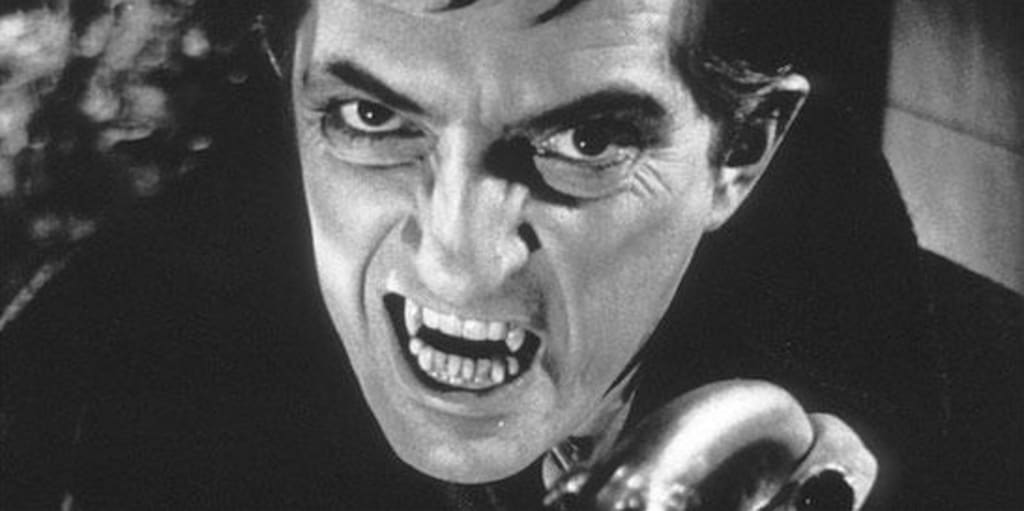

When I tell people about “Dark Shadows”, the gothic soap opera that aired on ABC television between 1966 and 1971, I typically get one of two reactions: “Are you talking about that weird Johnny Depp vampire movie that wasn’t very good?” or “Are you seriously recommending me a black and white, 50-year-old horror soap opera?”.
Regarding the first question, the answer is no, I don’t mean the 2012 movie of the same title starring Johnny Depp and directed by Tim Burton – although that movie is a loosely based reboot of the show. As for the second question, the answer is yes, I am seriously recommending a 50-year-old horror show, although only the first 295 episodes are in black and white. The other 930 episodes, mind you, are in color.
Before you quit reading this post based on the previous answer, just hear me out for a second. If you are a fan of classic monster movies and literature, then you need to check out “Dark Shadows”. From witches and vampires to werewolves, zombies, and even Frankenstein’s monster, this show has everything. If sci-fi and fantasy are your bread and butter, then this show has got you covered. Throughout its run, “Dark Shadows” dealt with reincarnation, elder gods, time travel, parallel universes, mad scientists… and this is just the beginning!
Personally, this show is also very important to me. It took me around 5 years to finish watching it in its entirety, which I finally did 2 years ago. It is crazy to think how much my life changed since then. When I began watching “Dark Shadows”, I was an undergrad Engineering student in Brazil having a bit of a crisis of conscience. I didn’t like my course or the several internships that I had, and I didn’t know what to do about my future. Since then, I continued my studies with a master’s in Computer Science, which I loved; became a mobile app developer; and I am currently pursuing my Ph.D. in Canada, focusing on health informatics! Plus, I began to write sci-fi and fantasy stories (some of which are published right here on Vocal; if you are interested, please check them out on my profile), which was always a dream of mine that I never had the courage to pursue until now.
The reason that I mention this is to stress how much “Dark Shadows” means to me. It is almost as if I can measure stages of my life according to where I was in the episode count of “Dark Shadows”, and looking back to the person I was when I started this adventure to the person I became after finishing it is amazing. “Dark Shadows” is my own personal time capsule, capturing moments in my life; it was with me in the best of times and in the worst of times. I know that the episode count is huge and that most people wouldn’t want to dedicate this much time and energy to a show in the first place. However, if you are a fan of sci-fi, horror, and fantasy I urge you to reconsider.
In this review, I will take you on a journey chronicling the beginnings of my obsession with this strange and fantastic piece of television, providing an overview of its many characters and plotlines, detailing how the show went from almost being canceled to a ratings phenomenon, and exploring its surprisingly long life almost 50 years after cancellation. There will be minor spoilers ahead for major arcs of the show, but believe me, I will only be scratching the surface.

The first time I heard about “Dark Shadows” was in 2012. A film news website that I followed announced that director Tim Burton was teaming up with his usual collaborator, actor Johnny Depp, for a movie called “Dark Shadows”, based on a sixties soap opera that was a huge phenomenon in the United States – although it was never exhibited in my home country of Brazil.
Being a huge fan of vampire movies and the creative team behind the production, I was very excited for the film. The final product, however, was a mixed bag. While I think it is an interesting take on the vampire subgenre, it definitely has problems. More importantly, the movie was not a good adaptation of the tv show at all, leading most fans to hate it.
The core of “Dark Shadows”, both the show and movie, concerns a character named Barnabas Collins, played by Jonathan Frid on the little screen and by Johnny Depp on the big one. After losing his love and being imprisoned for over a century, Barnabas wakes up in the “modern-day” (1967 in the tv show, 1972 in the movie) and, pretending to be a long-lost cousin, starts living with his relatives, the rich Collins family from Collinsport, Maine. The movie deals with this situation very comically: a large part of the plot focuses on Barnabas dealing with changes in society, such as asking for horses instead of a car. While the movie’s humor is pretty funny at times, it does not represent the tone of the original show. I will give the movie this, though: it made me interested in learning more about the original series, and I am glad that I did.
Unlike the goofy, comedic tone of the cinematic version, the show took itself very seriously. Its creator, a television producer named Dan Curtis, made sure that “Dark Shadows” wasn’t just a silly soap opera for kids; since the beginning “Dark Shadows” played out as a gothic romance, and a very good one at that. Despite the crude special effects of the time, limited budget, and time constraints, Curtis took the material very seriously and gave weight and heart to its storylines.
Curtis was a huge fan of classical gothic and horror literature, although he was reluctant to create a full-on horror show. His original idea was more inspired by “Jane Eyre” than “Dracula” after he had a dream of a mysterious woman arriving at a foggy train station. This image led to the initial version of “Dark Shadows”, which didn’t have any supernatural creatures but instead focused on the mystery of a young woman named Victoria Winters (Alexandra Moltke). In the best “Jane Eyre” fashion, Victoria is hired to be a governess for the Collins family in the Collinwood mansion, located in the town of Collinsport. Every early episode opens with the narration “My name is Victoria Winters…” followed by a brief recap of previous events. This opening is truly eerie and sets the gothic tone well from early on.
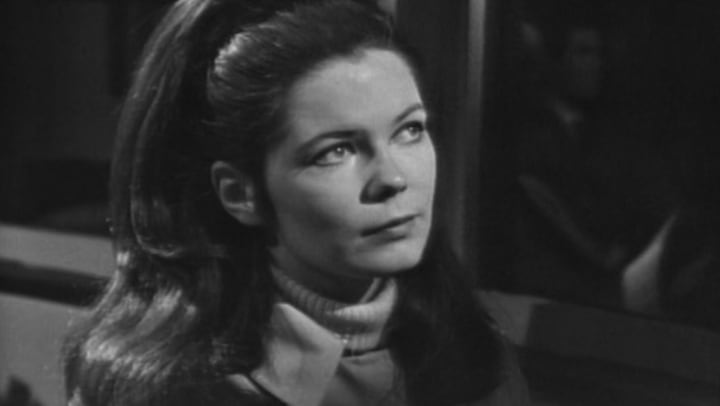
The Collins family is originally comprised of the matriarch Elizabeth Collins (played by popular classic film actress Joan Bennet); her daughter Carolyn Stoddard (Nancy Barrett); Elizabeth’s alcoholic, ne’er-do-well brother Roger Collins (Louis Edmonds); and Roger’s son, 14-year-old David Collins (David Henesy). The first arc of the show deals with Victoria getting to know the family members and some of the local Collinsport residents, including waitress Maggie Evans (Kathryn Leigh Scott), who plays a huge part in later episodes along with her father Sam Evans (David Ford).
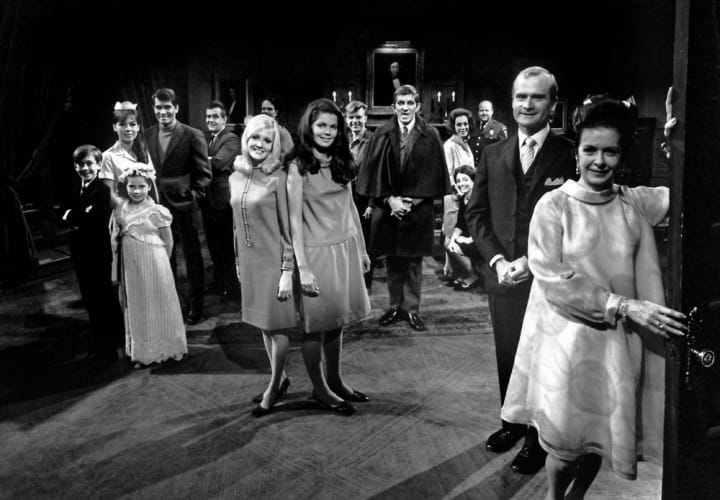
Meanwhile, spooky events start to happen as a mysterious man from Roger’s past, Burke Devlin (played in the first arcs by Mitchell Ryan, and then by Anthony George), arrives in Collinsport at the same moment as Victoria with a personal vendetta against the Collinses. For her part, Victoria begins to suspect that the mysterious family are her long-lost relatives.
The most surprising part about these first episodes is how effective they are in building mysteries, especially with a murder plot introduced around episode 50. Despite the gothic settings, including the creepy interior of the Collinwood mansion, the show didn’t feature any explicitly supernatural occurrences until episode 70 when a painting comes to life and the ghost of Josette DuPres comes out of it. This scene is so well made that I couldn’t believe how good the special effects were. The low-resolution black and white image also contribute to a feeling of uneasiness, like you are watching something that shouldn’t be seen (you can check it for yourself in the video below). It is truly impressive what they achieved, especially with the limited resources of the time.
After the introduction of Josette’s ghost, the show dips into more supernatural territory for its next storyline as we see the return of David’s mother, Laura Collins (Diana Millay), in episode 123. Laura is a phoenix, a mythological creature that every 100 years must burn alive with her offspring, to be reborn again in the next cycle. Needless to say, this is not your typical soap opera drama.
I love these early episodes of Dark Shadows. The mysteries around Burke Devlin’s past with Roger Collins, and a murder that shakes the entire town, are interesting and fun to watch. Unfortunately, the plot of Victoria Winters’ parentage ends up being largely forgotten, but the phoenix arc is very well made and has a surprising amount of character development for Roger and David Collins. Roger, at the beginning of the show, is an absentee father who couldn’t care less about David. During the show, and especially in this arc, he starts to grow into a (mostly) decent and honorable man that is ready to take on responsibility for his son.
Despite the high-quality of the initial arcs, ratings were low, and the show was about to be canceled. Dan Curtis always wanted to do a vampire picture (and directed, in fact, a “Dracula” tv movie starring Jack Palance; it is a very well-made movie that is worth the watch), and since the show was about to be canceled anyway, decided to introduce a vampire as the villain of the next arc.
And so, in episode 211, a character named Willie Loomis (John Karlen) accidentally discovers a secret passage in the Collins family mausoleum. Inside it, a secret room with a chained coffin at its center. Believing that lost jewels are inside the coffin, Willie opens it and looks in horror as hands come out and grab him by the neck! In the next episode, a stranger in a dark cape and carrying a silver wolf-head cane arrives at Collinwood, claiming to be a distant cousin from England. His name: Barnabas Collins.
Barnabas’ initial scenes are truly chilling and memorable. You can see it for yourself in the video below.

Initially, the plan was for Barnabas to appear in only a few episodes, kidnapping and hypnotizing Maggie Evans to make her believe she was his long-lost fiancée Josette. However, Barnabas was such a popular character that the writers decided to keep him on the show. He not only survived this arc but went on to become the de facto main character of the series. The introduction of Barnabas Collins, coupled with a time slot change, made the show a hit with teenagers, who ran home from school to watch it every day.
The next storyline saw the introduction of Julia Hoffman (played by Oscar-nominated actress Grayson Hall, in ), a doctor that treated Maggie Evans’ amnesia after she escaped from Barnabas. Finding out the vampire’s secret, Julia tried to cure Barnabas of his curse; initially blackmailing Barnabas into letting her treat him, Barnabas and Julia eventually became close friends. Willie Loomis, who turned into Barnabas’s slave after being bitten (any similarities with Reinfield from “Dracula” are definitely on purpose, as the writers were inspired by this and other literary classics – more on this later), also became an ally and friend of the vampire, guarding his coffin during the day.
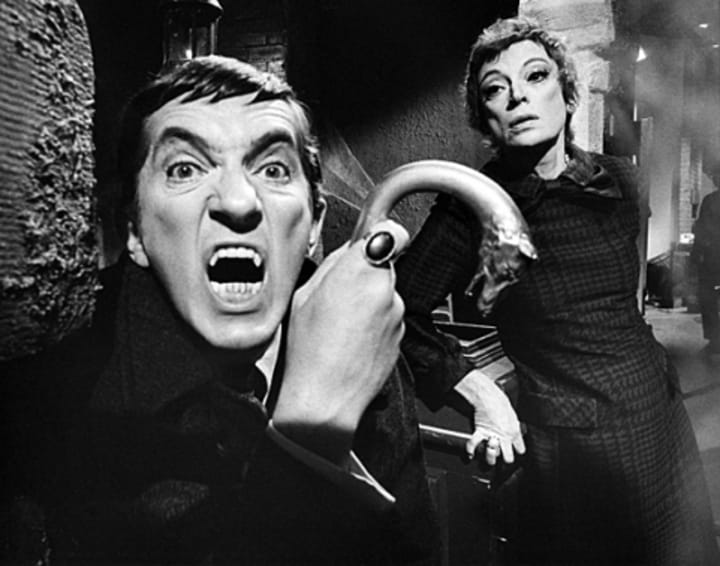
Barnabas himself became an anti-hero of sorts and protector of the Collins family. The character was somewhat of an innovation for the time: while vampires had been typically portrayed as evil creatures of the night, Barnabas was genuinely repentant of his actions. He didn’t enjoy draining blood from his victims and hated what he had become. His main motivation throughout the show was to get rid of his curse and live a normal, mortal life. Barnabas was one of the first sympathetic vampires ever portrayed, resembling more of the conflicted nature of a Hamlet than the violent bloodlust of a Dracula. Jonathan Frid was an experienced Shakespearean actor before taking the role of Barnabas and brought complexity and nuance to the character; when Barnabas curses his existence as a vampire, we genuinely feel sorry for and root for him. It is not an understatement to say that, without “Dark Shadows”, we wouldn’t have had recent works such as “Bram Stoker’s Dracula”, “Interview with a Vampire” and even “Twilight”.
It is truly impressive what Dan Curtis and his team were able to accomplish with this show. Taken at face value, “Dark Shadows” is very goofy, especially by today’s standards. Actors could not re-shoot scenes due to tight filming schedules and, since producers thought no one was going to re-watch the show anyway, many goofs were left in the show. It is very common to see cameras and microphones at the edge of the screen, and actors constantly forgetting their lines. With a low budget and little technical resources, it’s not hard to imagine how silly the whole enterprise might have looked. Curtis, however, respected the material and the actors played their parts with everything they got. The entire team enjoyed being involved in this project, bringing their best work forward, and it shows: despite all odds, “Dark Shadows” works.
After his memorable introduction, there were very few clues as to how Barnabas became a vampire. In episode 365, however, the mystery of Barnabas’ origins begins to be explored as, during a séance in Collinwood, Victoria Winters is suddenly transported back to the year 1795.
As this show wasn’t strange, crazy, or fun enough, the next arc introduced time travel into the mix. Victoria, not knowing that Barnabas is a vampire and not understanding what happened to her, becomes the governess for the Collins family in 1795. While there, she encounters past members of the Collins family who look exactly like the ones from the present. They are even played by the same actors! For example, in 1795 the patriarch of the house is Joshua Collins, played by the same actor that played Roger in the present. His wife, Naomi, is played by Joan Bennet, who is Elizabeth in 1967. Josette DuPres is played by Kathryn Leigh Scott, who plays Maggie. The only two characters who are the same are Victoria and Barnabas, although in 1795 he is still human.
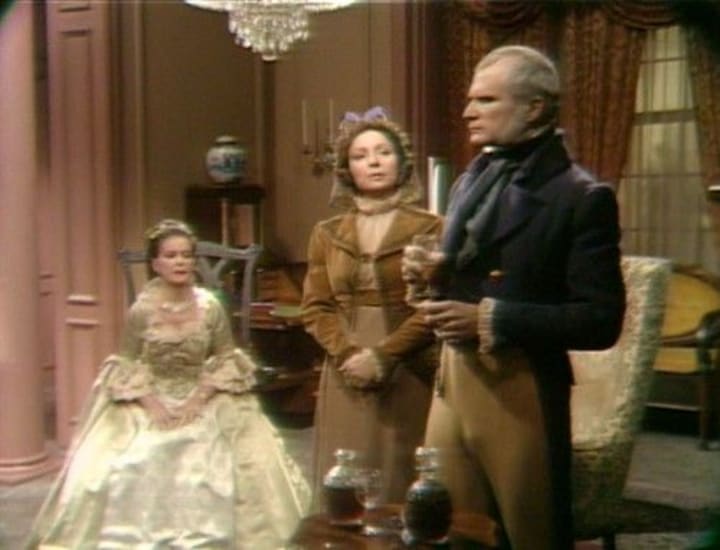
The 1795 arc is my favorite of “Dark Shadows”, as it explores the origins of Barnabas’ vampiric curse. Unlike traditional vampires, turned into a creature of the night after being bitten by another vampire, Barnabas was cursed to this existence. At this point in 1795, Barnabas had a brief affair with Angelique Bouchard, played by the amazing Lara Parker (you may recognize the character of Angelique as the villain of the 2012 movie, played by Eva Green). However, Barnabas fell in love with Josette. As Josette and her family come to Collinwood to marry Barnabas, they bring Angelique as Josette’s maidservant without knowing that she is, in fact, a witch. As the saying goes, “hell hath no fury…”. Trying to win back Barnabas, Angelique casts a series of spells and curses on the Collins and the DuPres families. Eventually, Barnabas discovers that Angelique is behind everything. As he tries to destroy her, she puts a curse on him, condemning him to be a vampire. As icing on the cake, the curse also commands that everyone that Barnabas loves will die.
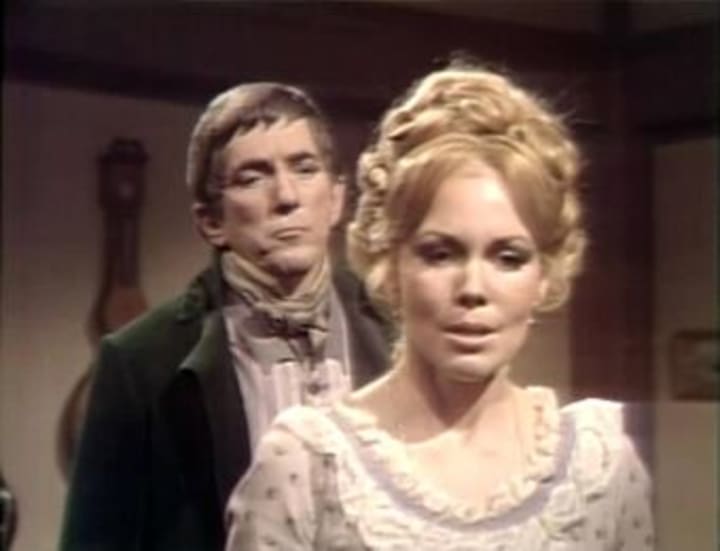
This short synopsis doesn’t do justice to the 1795 arc. It’s filled with tragedy and gravitas, and the quality of the storytelling is as good as the best vampire movies out there. There are also a lot of memorable supporting characters in this arc, but Angelique is the clear standout. Lara Parker a terrific actress and, like Barnabas, there is complexity to the character even through Angelique acts as the main antagonist. Despite being on a path of revenge, there is a definite feeling that Angelique is genuinely hurt and suffering and lost herself in her pain.
Speaking of pain, the most tragic part of this storyline is the episodes after Barnabas gets turned into a vampire. We see the full effect of Angelique’s curse takes place, as Barnabas’ vampirism begins to affect his family and friends. The final episodes of this arc beautifully close the story as we discover how Barnabas was locked in a coffin and placed at the Collins mausoleum, where he was awoken 175 years later.

The 1795 storyline and the episodes that follow it are the best that Dark Shadows has to offer. These episodes increasingly embrace the supernatural and fantasy aspects of the show, taking inspiration from classic gothic literature and mixing these ideas with the “Dark Shadows” world. In the next arc, for example, a mad scientist creates a monster out of dead body parts, much like in the novel “Frankenstein”, by Mary Shelley. In “Dark Shadows”, the scientist uses Barnabas’ vampiric life force to bring his creature to life, and in the process cures Barnabas: as long as the creature, aptly named Adam, lives, Barnabas will remain a human.
It is a great pleasure to see how elements of classic stories mix with “Dark Shadows”. For example, at this point in the show, Angelique is revived in the present through a painting of herself as a young woman. To defeat his long-time foe, Barnabas asks Maggie’s father, who is a painter, to modify the young woman’s portrait into an old lady. To defend herself, Angelique blinds the painter, who ends up creating a relationship with Adam. Frankenstein fans will recognize the parallels between this storyline and the monster’s relationship with the blind old man in Mary Shelley’s novel.
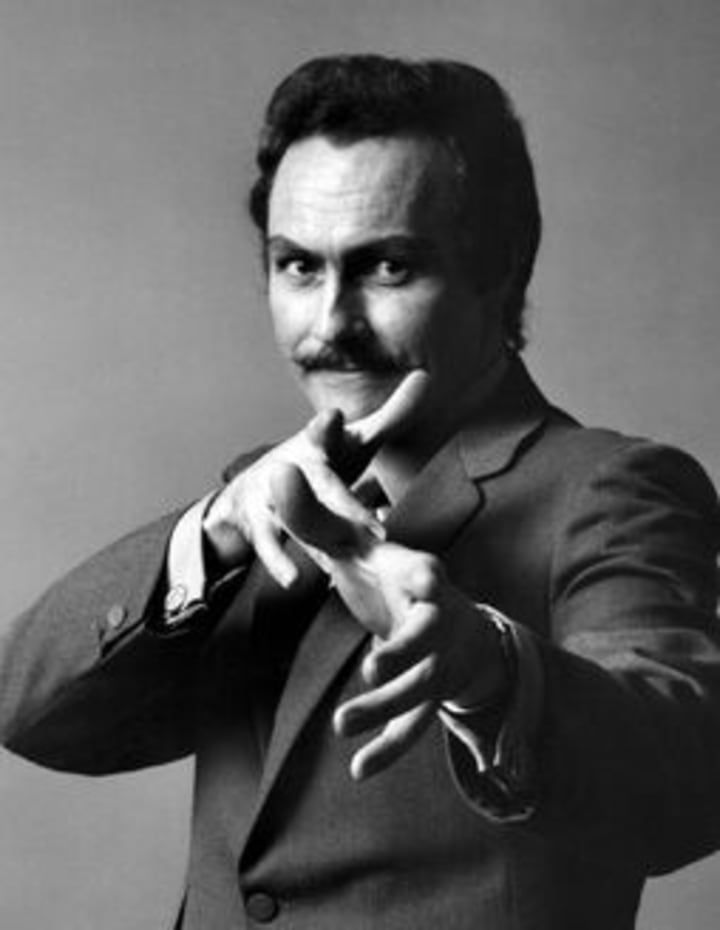
These episodes of “Dark Shadows” are great fun and include many twists and turns, including the introduction of Nicholas Blair (played by Humbert Allen Astredo), a warlock that helps Angelique against Barnabas and his allies. Blair is such a mustache-twirling villain and Astredo has so much fun playing him that it is impossible to not smile every time he is on-screen. Just as a quick example of how crazy this show gets, at one point in this arc Angelique goes to hell and talks with her master, the Devil! All this in a day-time soap opera that is over 50 years old. You have to see it to believe it.
The next major storyline takes a page out of “The Turn of the Screw” (the horror novella that inspired the recent Netflix show “The Haunting of Bly Manor”) and, in the best “Dark Shadows” fashion, ideas and themes from this story are mixed with characters and settings from the soap opera. Much like in the novella, young David Collins and his friend Amy Jennings (Denise Nickerson) get possessed by ghosts! The one who is in control is revealed to be Quentin Collins (David Selby), who lived in the year 1897 at Collinwood. As if this weren’t enough of a problem for the Collinses, a werewolf is also stalking the streets of Collinsport.
Eventually, Barnabas and Julia go back in time to the year 1897 to uncover this mystery, and we get to see Quentin before he was a ghost and the reasons that led to his death and eventual haunting. In the best “Dark Shadows” tradition, Quentin starts as a villain but quickly becomes an antihero that we want to root for. In 1897, Quentin was a bon-vivant who didn’t care who he hurt. He left his wife, Jenny (Marie Wallace), to go travel the world with his brother’s wife, none other than Laura Collins, the phoenix! After a series of events, Jenny becomes crazy and is locked in the Collinwood tower (any similarities with “Jane Eyre” are not coincidental). After Quentin comes back, Jenny attacks him and is accidentally killed. Jenny’s sister, a gypsy named Magda, puts a curse on Quentin: he, and all his firstborn male descendants, will become a werewolf when the full moon is shining.
This is the very basic synopsis of the 1897 arc. Barnabas, Julia, and eventually Angelique get involved in the mysterious goings-on, trying to prevent Quentin’s death in the past so he doesn’t haunt Collinwood in the present. As if Barnabas didn’t have his hands full already, in 1897 he was still a vampire, and so he becomes one again while in the past. This adds great tension to the story and seeing Barnabas as the reluctant vampire again is truly tragic. This is also the first arc in which Angelique starts to become more of an anti-hero than an antagonist.
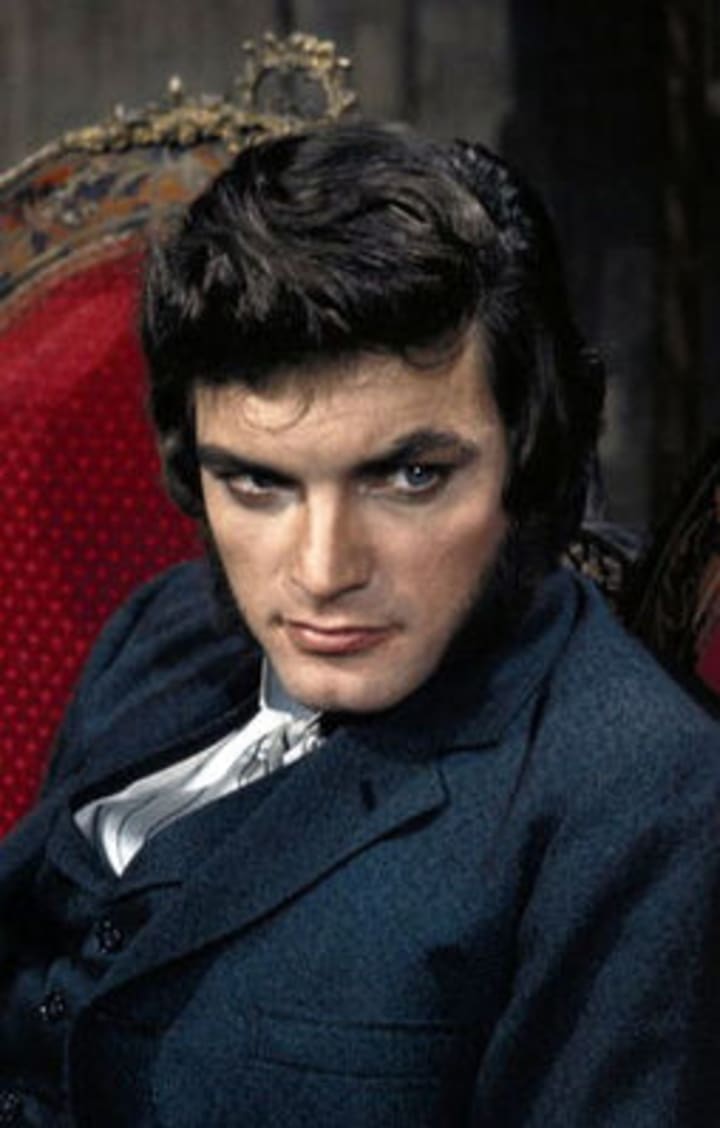

While 1795 is my favorite “Dark Shadows” arc, the 1897 storyline is one of the most fun. It gets so crazy and wacky that, at one point, the story becomes a loose adaptation of “The Portrait of Dorian Gray” as an evil sorcerer creates a painting of Quentin to keep his curse at bay: Quentin will always be young and dashing, an immortal, while his painting becomes increasingly old. In full moons, the painting becomes a werewolf instead of Quentin!
Trust me, though: this is just the beginning of what this arc has to offer. Introducing the portrait into the story also allows Quentin to be a recurring character in the present timeline once Barnabas and Julia avert the disaster in the past and go back to their own time.
Unfortunately, this is when “Dark Shadows” finally begins to show signs of fatigue. The next arc involves the Leviathans, a mysterious elder race of powerful beings that want to bring about the end of the world. The Leviathans brainwash Barnabas and several Collinses, making them servants of the antichrist, the leader of their people (in the “Dark Shadows” world, this is known as a Tuesday). Meanwhile, Julia Hoffman, Quentin Collins, and other characters try to stop the Leviathans.
In my opinion, this arc is not as bad as people make it out to be. However, it is one of the weakest. The idea of elder creatures haunting Collinwood is not bad, and it introduces a cosmic horror element ripped straight from the pages of an H.P. Lovecraft novel with the potential to be very interesting. Unfortunately, several issues decreased its quality.
First, the pacing is very slow, especially in the first episodes. To make matters worse, the evil antichrist starts as a baby, which quickly grows into a small child and eventually a fully grown man. However, there is a large number of episodes in-between where we see the child being taken care of by Maggie Evans, who is the new governess of Collinwood (at this point, Victoria Winters is living in 1795 with the man she fell in love while there – as I said, I am just scratching the surface of all plot points and storylines here). Seeing the antichrist as a child is just plain boring and dull; this child should be menacing, like in “The Omen” movies, but here the evil antichrist who is supposed to bring the apocalypse just comes across as a spoiled brat. Even when he eventually grows up, taking the name of Jeb Hawkes (Christopher Pennock), the character is still not much of a menace as he falls in love with Carolyn Stoddard and eventually turns against the Leviathans, helping Barnabas ¬– who was once again turned into a vampire after breaking free of the Leviathans’ mind control – to defeat them.
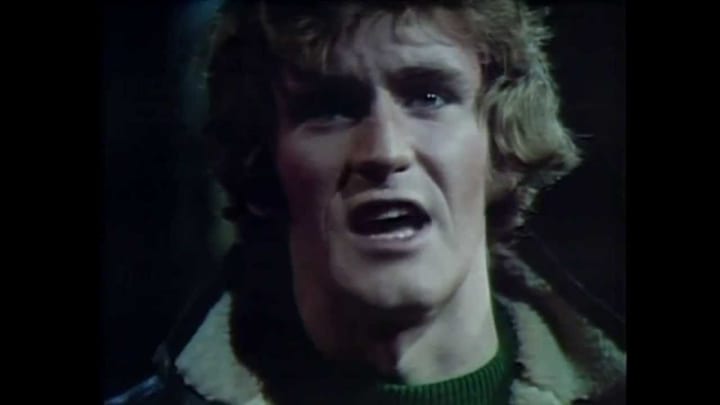
Despite its shortcomings, there is still a lot to like about this arc. When the cosmic horror works, it works, and some scenes are truly chilling. Both Angelique and Quentin come back as allies, and Barnabas being turned into a vampire again in the present timeline adds some much-needed tension that was gone since he turned into a human with the creation of Adam. Nicholas Blair, the evil warlock, also returns in this arc, and it is always a treat to watch his character’s evil schemes.
At the end of the Leviathan arc, the show is approaching its 1000th episode, and the story starts to pick up again with the introduction of Parallel Time: a timeline that is parallel to the main continuity, with the same characters that made different choices than the ones we know. Barnabas discovers the entrance to Parallel Time in a room in the forbidden wing of Collinwood and enters it in the hopes that he will not be a vampire anymore – expectations that prove, of course, unfounded¬ –, and Julia Hoffman follows him. In this Parallel Time, Quentin is the head of the Collins family and has recently married Maggie. His previous wife, Angelique, was killed under mysterious circumstances. Willie Loomis and Carolyn Stoddard are married, and Julia Hoffman is the Collins maid. She was also Angelique’s confidant and ally at this time.
While we have seen actors playing different characters in the show, this is the first time that they play the same roles but with different traits. In PT, Julia Hoffman is a full-blown villain, and Grayson Hall does a great job of portraying her. New characters are also introduced, including a doctor named Cyrus Longworth (Christopher Pennock, who was Jeb in the previous arc). Cyrus is researching a formula to separate good from evil in people and in the best “Dr. Jekyll and Mr. Hyde” fashion takes the formula himself, becoming an evil creature named John Yeager. I am a huge fan of the PT arc, which serves as a soft reboot of the show after the sub-par Leviathan storyline and introduces interesting fantasy and sci-fi concepts into the show.
When Barnabas and Julia try to return to the main timeline after their stint in PT, they are accidentally transported to 1995, where Collinwood is destroyed and the surviving members of the Collins family are long gone, dead or crazed. They also discover that the powerful and vengeful ghost of Gerard Stiles (James Storm) is haunting the abandoned mansion. Managing to get back to their own time from the future, Barnabas and Julia try to discover who Gerard Stiles was and prevent the destruction of Collinwood. Unfortunately they are too late, as the ghost of Stiles brings an army of zombies into Collinwood! Barnabas and Julia manage to escape to 1840, where they hope to meet Stiles while he was still alive and prevent him from becoming a ghost. I am personally not a fan of this batch of episodes, as I find the pacing to drag. However, I really enjoy the 1840 arc.
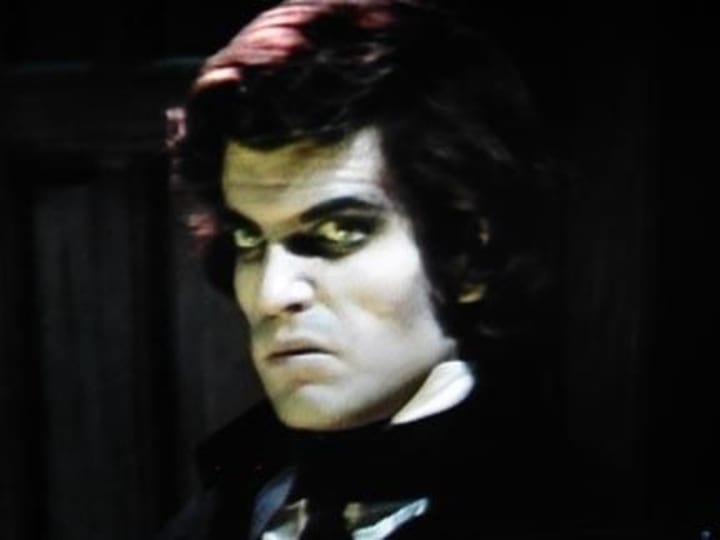
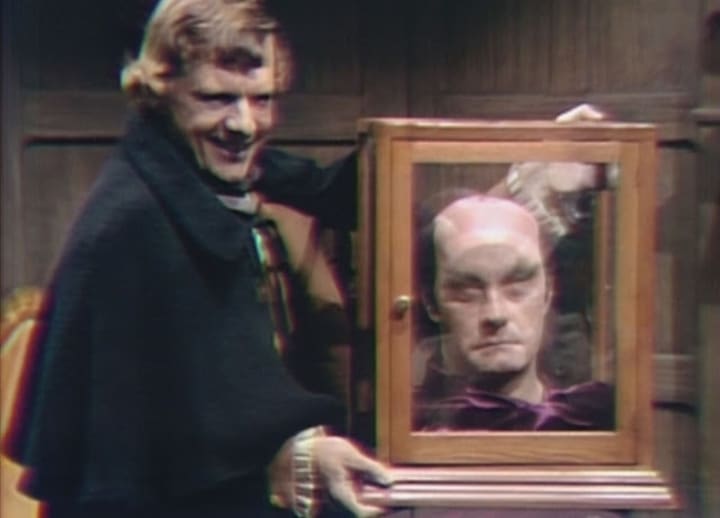
While it is generally considered to be the weakest of the three “time-travel” arcs of “Dark Shadows”, 1840 it is tied to the 1897 arc in my opinion: while 1897 certainly had a lot more going on, with crazy and fun ideas mixed to make for exciting television, I believe 1840 has the superior storytelling. It is also the scariest arc of the show, as it revolves around a decapitated head!
This head, sitting in a box as a cursed relic, belonged to a man named Judah Zachary, said to be the son of the devil. He led a cult in 1692 until he was beheaded, and his body was buried under a giant cross. Of course, his head is still alive and tries to take possession of Gerard Stiles – which is the reason why the ghost of Stiles comes back in the present timeline and destroys Collinwood. This storyline has some really disturbing imagery, including the huge, decapitated body of Judah Zachary walking around Collinsport and killing people. This arc also has a conclusion to the relationship between Barnabas and Angelique that not only makes perfect sense for the characters but is truly heartbreaking.
The final arc occurs in 1841 Parallel Time. By far the weakest story of the show, it doesn’t include any character from the main continuity. Even Jonathan Frid, who was Barnabas through every time travel and parallel universe, plays here a character named Bramwell, inspired by Heathcliff from the novel “Wuthering Heights”. Bramwell is in love with Catherine (Lara Parker), but she is destined to marry his cousin Morgan Collins (Keith Prentice). The 1841 PT arc centers around a lottery that the Collins family must do every generation to select a member of the family. This person must spend the night in a locked room in Collinwood, although all who did it went either mad or crazy. The setup itself is not bad but the arc is very slow, and the fact that we don’t have any characters from the main continuity also contributes to a decrease in interest. There are some nice twists to be found here, however, and the end of this story has a nice bookend both to this arc and to the series as a whole.
In 1971, after dwindling ratings, the show was finally canceled. There are many opinions as to why the ratings declined. Many people mention that after the popularity of the 1897 arc, the weak reception of the Leviathan storyline led to a general loss of interest in the show. Scheduling changes also affected ratings, preventing it from becoming the “show that kids ran home from school to watch”. Finally, many say that Dan Curtis, the show’s driving force, lost interest in the series, which contributed to lackluster final arcs. Whatever the reason, it is undeniable that the 1225 episodes of “Dark Shadows” comprise one of the most interesting, unique, compelling, and outright crazy runs in television history.
I absolutely love “Dark Shadows”, and after reading through this review it is not hard to understand why. This 50-years old soap opera has everything that a sci-fi and horror fan could want, from monsters and demons to time travel and parallel universes. These concepts are backed by a superb cast of characters who are genuinely interesting and have complex arcs throughout the show, especially Barnabas Collins, and the actors take the material seriously. The storylines also adapt works from gothic and horror literature, including classics such as “Dracula”, “Frankenstein”, “The Portrait of Dorian Gray”, “Dr. Jekyll and Mr. Hyde”, “The Turn of the Screw”, and several H.P. Lovecraft stories. The special effects are very well-made for the period and are a joy to watch.
All of this is not to say the show is perfect. Since it is a long-running soap opera, the characters and stories get a bit confusing at times. Barnabas Collins, the immortal reluctant vampire, suffers the most in this regard, with several convoluted love interests throughout the show which minimize the impact of his original lost love, Josette. In addition, due to the nature of the show with one episode per day, every day of the week, it is not uncommon for some of the arcs to be slow, and the pacing does vary a lot throughout the series. Finally, the low production values and conventions of the period can be an issue for some viewers, especially those that are not used to watching older content. These criticisms, however, pale in comparison to the epic horror fantasy that is “Dark Shadows”. While the episode count may be intimidating, it is definitely worth the time and effort to watch it. Take your time, don’t rush, and enjoy your journey into the shadows. Who knows where you will be at the end of it?

The show in its entirety is available to watch, as of this writing, in Prime Video and on Tubi TV. In addition, there is a lot more “Dark Shadows” content out there. Below, I prepared a list of resources to help you get to know more about the Dark Shadows Expanded Universe. Before we get into it, if you liked this review please leave a like and a tip if you can and check out my sci-fi and fantasy fiction on Vocal!
Movies:
In addition to the 2012 movie, two movies were made by Dan Curtis and the series’ cast following its cancellation:
House of Dark Shadows (1970) – A high-budget retelling of Barnaba’s first appearance in Dark Shadows but focusing on the character as a villain. It plays more like a Christopher Lee Dracula movie, and it is a great, gory, and violent horror movie in its own right.
Night of Dark Shadows (1971) – A Parallel Time movie starring David Selby as Quentin, who in this timeline just got married and inherited Collinwood. However, the ghost of Angelique is lurking about the grounds… I personally like this movie, and it plays as a “Dark Shadows” version of The Shining (although it came before it). 40 minutes of the movie were cut before release, and fans have been trying to convince the studio to release a full version as most of the cut footage is intact.
If you are interested, you can find the full script for both movies in the following book:
A documentary focusing on Dan Curtis’ career and production of “Dark Shadows” was released in 2019, featuring interviews with several original cast members. The documentary is titled “Master of Dark Shadows”.
Revivals:
There have been two attempts at rebooting “Dark Shadows”. One, in 2004, only got so far as a pilot order (which can be found online). However, a full season with 12 episodes was made in 1991 starring Ben Cross in the role of Barnabas. The revival is a retelling of the introduction of Barnabas Collins and the 1795 arc, but with a better budget and tighter script. I highly recommend it for horror fans.
Books:
Author Marilyn Ross wrote 32 books that re-tell and expand the story of “Dark Shadows”, including titles such as “Barnabas, Quentin and the Mummy's Curse” and “Barnabas, Quentin and the Body Snatchers”. I haven’t read them yet, but I heard they are really good. These books just got re-released, and they are also available in audiobook format.
Actress Lara Parker, who played Angelique in the show, also authored a 4-part book series that serves as both a prelude and continuation to the tv show. Parker is a great writer and her first book, “Angelique’s Descent”, focuses on Angelique’s origins and her point of view throughout the show. This and the next two books in the series, “The Salem Branch” and “Wolf Moon Rising” are great chillers (I haven’t read the fourth book yet). You can get signed copies of her books here: https://laraparkersite.blogspot.com/
Big Finish Audiobooks:
Big Finish Productions released over forty audiobooks, starring the original actors from the series, in the “Dark Shadows” world. I cannot overstate how truly great these are, both respecting and expanding the original material. I highly recommend listening to them.
The Collinsport Historical Society:
This is a great source of all things Dark Shadows, and I highly recommend checking it out: http://www.collinsporthistoricalsociety.com/
About the Creator
Keep reading
More stories from Pedro Velmovitsky and writers in Horror and other communities.
The Character Who Isn’t on Payroll
Posted to r/nosleep I work at Disneyland. I won’t say my department, but I’m close enough to characters that I see schedules, handoffs, rotations—the boring, logistical side of “magic.” Which is why this has been driving me insane.
By V-Ink Storiesabout 5 hours ago in Horror


Comments
There are no comments for this story
Be the first to respond and start the conversation.