
Michael Myers Is Not Halloween's Worst Villain
Bad as Myers was, his doctors were the real bad guys.


Halloween night, 1963. Haddonfield, Illinois.
You know what happens. Michael Myers killed his older sister. He was only six at the time.
Why'd he do it? Because she'd been upstairs screwing around with her boyfriend, while he was dressed up in his clown costume waiting for her to take him Trick-or-Treating. Was that enough for her to deserve a death sentence?
Of course not. And Michael seemed stunned by his own actions afterward. You know the scene, when his parents drove up and saw him standing outside the house holding a kitchen knife.

Michael was sent away to a mental facility in Smith's Grove, where he was assigned to Dr. Sam Loomis. Loomis ended up being Michael's doctor throughout his entire childhood until he turned 21. Imagine, the same doctor for 15 years.
And when Michael escaped on October 30, 1978, we got to hear about Loomis' thoughts on his long-time patient. Here's a video to jog your memory:
I met him, fifteen years ago. I was told there was nothing left. No reason, no conscience, no understanding in even the most rudimentary sense of life or death, good or evil, right or wrong. I met this six-year-old child, with this blind, pale, emotionless face and, the blackest eyes... the DEVIL'S eyes! I spent eight years trying to reach him, and then another seven trying to keep him locked up for I realized what was living behind that boy's eyes was purely and simply... EVIL!
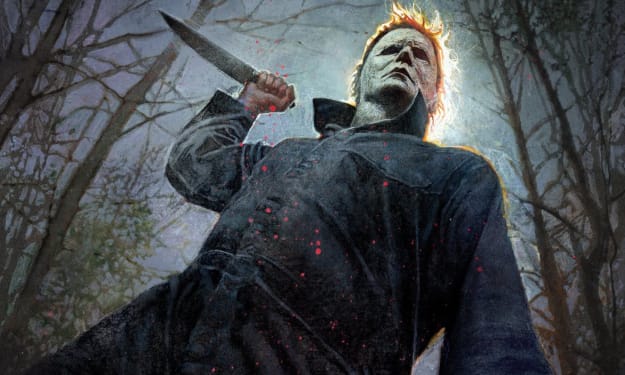
So Michael's own psychiatrist called the boy pure evil with the devil's eyes. Now look again at that photo of little Michael. Doesn't that look evil...or just dazed and in need of help?
I recently wrote on Quora that it seems like Dr. Loomis was a total failure if he believed a six year old child who doesn't talk is pure evil.
What did Loomis base that very un-medical opinion on, if Michael didn't talk and didn't seem to have any " understanding in even the most rudimentary sense of life or death, good or evil, right or wrong."
Obviously Michael had very serious mental health problems. We don't know why, because we have no idea what his home life was like (other than the suggestion that his sister, who was 11 years older than him, might have been prone to ignoring him). The brief glimpse we get of his home and parents make everything seem normal.
So what exactly was wrong with Michael?
The medical facility he was assigned to could never determine that, much less adequately address it and help the child. Did his family secretly abuse him? Did he have brain damage or some terrible chemical imbalance?
We don't know what Michael's illness is, but it was Loomis' job to find out. And he had 15 years to do it! From age six to 21, Michael had the same doctor, under whose treatment the boy saw no improvement.
In fact he got worse. Why? Probably because Loomis was incompetent and maybe suffered from delusions. He seems to have built a fantasy around the boy, thinking of him as a devil, pure evil, etc.
Over the course of 15 years, Michael likely picked up on that. And when it was time to leave, he lived up to it. It became a self-fulfilling prophecy, as Michael took on all of the bizarre traits that his doctor, one of the only people he ever got to see or listen to, projected onto him for a decade and a half!
The fact is, the first Halloween film shows Michael as a sick serial killer, which he was as an adult. But it does absolutely nothing overtly to make the audience think that Michael was an objectively "evil" boy, as Loomis suggested.
In fact, the movie shows that many people don't believe in Loomis' ravings. He's portrayed as paranoid and unhinged. But then, when Michael shows up and starts killing people, suddenly it appears as if Loomis has been "proven right," that he has been vindicated.
Well, he wasn't wrong about Michael being dangerous. But I don't think he was right about Michael being "evil." Michael's adult behavior is a testament to Loomis' failure as a doctor and to the mental health system's failure to provide proper care to a patient for 15 years. Again, the patient never spoke, so what was it about him that made Loomis so afraid of "the Boogeyman."
In later films, the mythology surrounding Michael expands and the scriptwriters make him virtually unstoppable. But that's not how he started out, and the 2018 Halloween movie undid all of the other films' storylines, to serving as a direct sequel. Once again, with the Blumhouse sequel, we see Michael shown as a silent man in a mental facility, with a deranged doctor (Dr. Sartain) in charge of him.
This time, the doctor outwardly appears saner than Loomis at first, but we soon learn he's much worse that Loomis ever was. Indeed, Dr. Sartain was obseesed with Michael but also wanted to exploit him. He had no problems taking two journalists out into a courtyard where Michael and the other patients spend an hour every day, even though those other patients are clearly disturbed by the presence of the outsiders. That's the first sign that he wasn't entirely ethical, and of course we learn later just how sick the good doctor really is.
In his article for Little White Lies, writer Frazer MacDonald note how that scene was, "another instance of mental illness being used as a fear tactic, much like it was in Carpenter’s original and so many of the films it has inspired."
I agree, but to go further I believe that the scariest part of Halloween is the thought that, with better medical care, perhaps Michael Myers would have gotten better and never hurt anyone else after his sister.
About the Creator
Matt Cates
As a freelancer, Matt has written for 300+ clients in almost every niche imaginable! He also served in the Air Force for 21 years, retiring as a Master Sergeant.
Keep reading
More stories from Matt Cates and writers in Horror and other communities.
Killer Life Lessons from Michael Myers
I've often said we can learn a lot from villains. And whether we like to admit it or not, we're always drawn to those characters who flaunt the rules of society and go after their dreams... however sick and twisted those dreams may be.
By Matt Cates7 years ago in Horror
Boundless
A geographical map could take you there. To the places I've been, to the sights I've seen, to the landscapes I've climbed. But no compass could point you in the direction of my memories. To the experiences I've lived, to the happiness I've felt, to the wonder I've held so close to my heart.
By Alyssa Musso6 days ago in Writers



Comments
There are no comments for this story
Be the first to respond and start the conversation.