

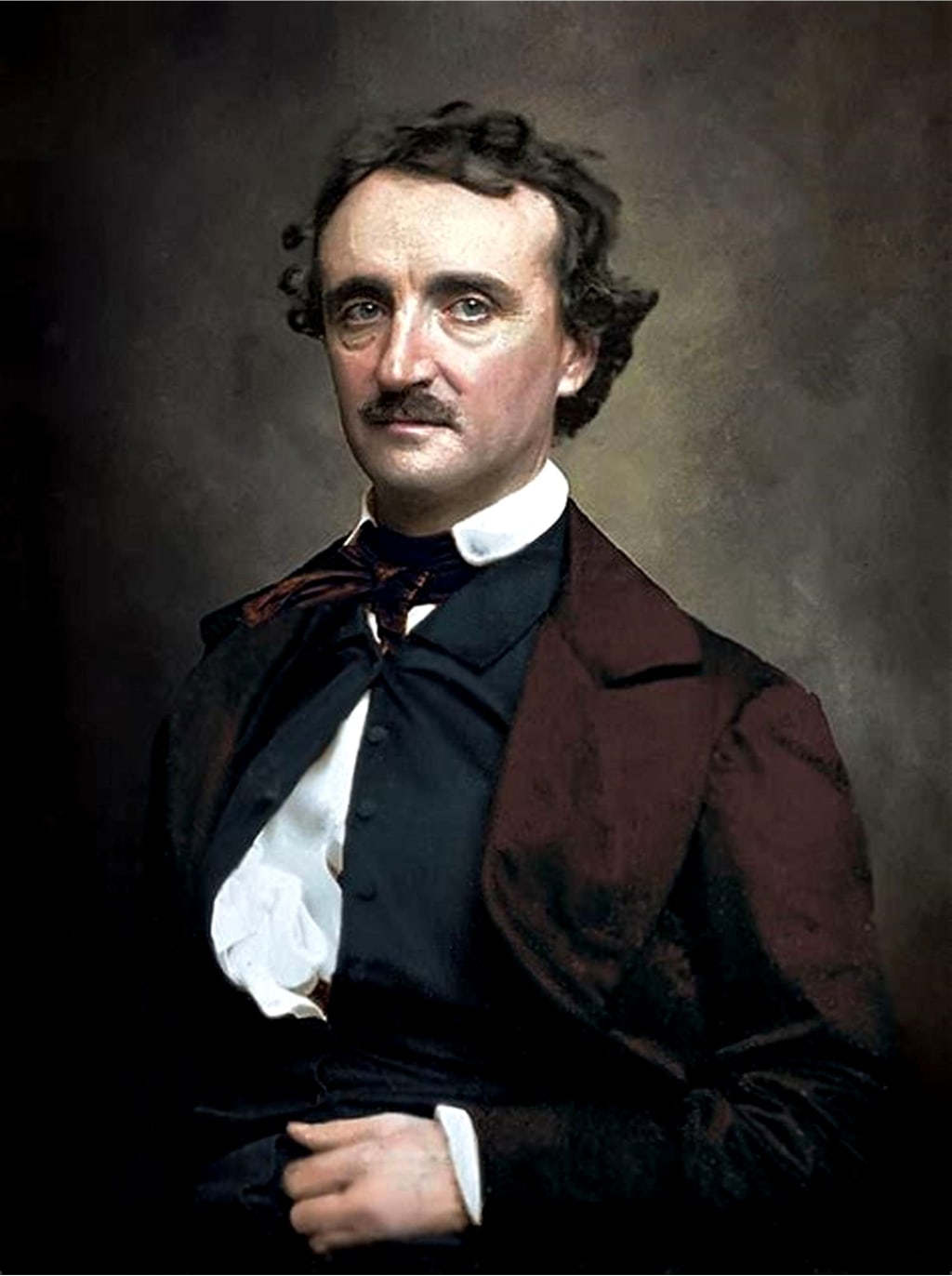
M. Valdemar hovers somewhere between life and death, and as our narrator opens the tale, thus it has been for seven months. Once a vibrant and respected man, lauded for his talents, enterprise, and erudition, Valdemar’s brilliance was slowly eclipsed by the ravages of consumption. His decline was inevitable, and despite the attention of two skilled doctors, neither held any hope for his recovery. Death, they agreed, was certain
Yet, even as Valdemar’s body wasted away, with his breath rattling in his chest and his skin growing waxen, a strange intervention forestalled the finality of death. The narrator, obsessed with the power of mesmerism, believed he could arrest Valdemar’s passing by suspending his consciousness at the very threshold between life and the void. And so, moments before Valdemar’s heart ceased its beating, the narrator applied his mesmeric powers, luring the dying man into a deep trance.
For seven months now, Valdemar has remained in that liminal state—neither living nor truly dead. His body is cold, his eyes closed, yet when addressed, his voice responds, an eerie and disembodied sound, affirming the terrible truth: “I am dead.”
M. Valdemar's death is suspended, his existence now a grotesque limbo—a state neither life nor true death, an unlife more ghastly than mere oblivion. He hovers in a purgatory, where no peace of Heaven nor suffering of Hell touches him, and his presence in this world is an affront to the natural order. To the narrator, who once pursued the experiment with scientific curiosity, this state becomes a personal torment, as if he has taken on the role of some irate, sadistic demon. He feels as though he dangles Valdemar from the precipice of the abyss, refusing either to release him into death or to restore him to the warmth of life.
And yet, the narrator knows with chilling certainty that Valdemar cannot be returned to life. His body is a corpse, decaying and stagnant, but still, his consciousness remains—a prisoner of the mesmeric force that holds him. Worse still, Valdemar’s mind is trapped in utter horror. His voice, a broken, hollow thing, reveals his anguish: Hell has opened wide for him, the gates of death thrown ajar, beckoning, but he is denied entry. His soul lingers with one gangrenous foot in each realm, rotting both in this world and the next.
This half-existence, this macabre suspension between two fates, twists the narrator’s fascination into dread. He knows that Valdemar’s suffering, so cruelly prolonged, is his doing.
For seven long months, M. Valdemar remains trapped in this ghastly state, his consciousness suspended between life and death, enduring an existence far more agonizing than any suffering the living might imagine. At one point, his voice, hollow and rasping, begs to be released from this living death. His plea, so pitiful and desperate, chills the narrator, for it reveals the unspeakable torment of remaining tethered to a rotting body—aware but powerless to escape.
The narrator, haunted by the unnatural hold he has over Valdemar, finally resolves to free him. Yet as the mesmeric spell is lifted, Valdemar’s body, devoid of any true life, reverts instantly to the state nature had long delayed. The corpse, preserved by mesmerism, now succumbs to rapid and grotesque decay. His form collapses into a foul, putrefied ichor, a rancid ooze that seeps into the sheets, corrupting everything it touches.
The servants, who had already been unnerved by the unnatural spectacle of Valdemar’s suspended death, flee in terror long before this final dissolution. Left alone, the narrator watches helplessly as what remains of Valdemar dissolves, his human form disintegrating into nothing more than a grotesque reminder of the experiment's horror.
And what are we to make of this ghastly tale, a whisper from the void, a kiss from a secret love in the dark—though one whose lips are the bluing hue of suffocating death? Is it a warning against the perils of scientific hubris? A cautionary fable of overreaching, of meddling with forces beyond the ken of human understanding? Or perhaps, more unsettlingly, it is an expression of secret wish fulfillment on the part of the author, whose life was so deeply entangled with death that one can’t help but wonder if Poe harbored, deep within the recesses of his tortured subconscious, a yearning to forestall the inevitable.
Poe, whose existence was marked at every turn by the grim specter of loss—of loved ones claimed by illness, by the relentless hand of fate—must have pondered the meaning of death daily. Its cold, clammy touch had mocked him so many times before, clutching those he cherished most, like his sweet Virginia Clemm, and jeering in his face with skeletal contempt. Death haunted him as both an enemy and an obsession. In this light, "M. Valdemar" reads not simply as a tale of horror, but as an exploration of Poe’s morbid fascination with the end of life and the terrifying possibility that death might not be the quiet, final rest he so longed for—but something much worse.
Valdemar's suspended state offers a vision of death not as a peaceful embrace, but as an alien and horrifying other. Rather than welcoming it as the natural conclusion of human affairs, the tale confronts the reader with a new terror—the dread of consciousness persisting beyond the dissolution of the body. Valdemar’s very existence speaks of the beginning of another life, one wracked with agony and trapped between realms, where the mesmeric force holds death at bay. Yet, when that force is finally lifted, the horror that unfolds is not a triumphant return to life, nor a peaceful release into the unknown, but a grotesque eruption of decay—a black ichor that spills from his disintegrating form, as though all the pent-up forces of death, so long denied their due, now rush in with vengeance.
In the end, the Red Death, ever relentless, claims its victory. The tale serves as a chilling reminder that death, no matter how it is delayed or defied, will always hold sway over all. Perhaps, then, Poe’s narrative is less a meditation on scientific ambition than it is a reflection of his own despair—a grim acknowledgment that despite all efforts to stave off the inevitable, death comes for us all, in forms more terrifying than we dare imagine.
The Facts in the Case of M. Valdemar
Connect with me on Facebook
About the Creator
Tom Baker
Author of Haunted Indianapolis, Indiana Ghost Folklore, Midwest Maniacs, Midwest UFOs and Beyond, Scary Urban Legends, 50 Famous Fables and Folk Tales, and Notorious Crimes of the Upper Midwest.: http://tombakerbooks.weebly.com
Getting Serious About Comedy (Part I)
If I were asked to remark on my life and the childhood that paved some road leading me to this point, I would have to say something about all the funny people who surrounded me for the last 26,872 days (and counting). Somewhere along that road, I became a big fan of laughter and the comedy that spawns it – and, I mean not only my own laughter, but the laughter of others, some of which I have actually been responsible for inducing.
By John Oliver Smith7 days ago in Humor


Comments
There are no comments for this story
Be the first to respond and start the conversation.