
Lost at Sea
A tale of a northern fishing village, the King's men, and ancient graveyards.


Through dense grey fog, a bell tolled for a stranger’s soul. Its heartless note pealing ‘cross the sombre village from westward moors — where spirits darted betwixt gorse and juniper — to the sodden sands of the secluded shore, as the tide turned once more. Momentary silences, a vacuum existing fleetingly between the flat rings of clapper ‘gainst metal, a place for contemplation. Though no sooner had the mind settled than a clank of the bell dislodged it.
Lost at sea.
Another nameless body washed ashore; a distant family wondering what happened to their man. Lost at sea was easier than the grim reality. Lost at sea preserved hope; grief not so immediate.
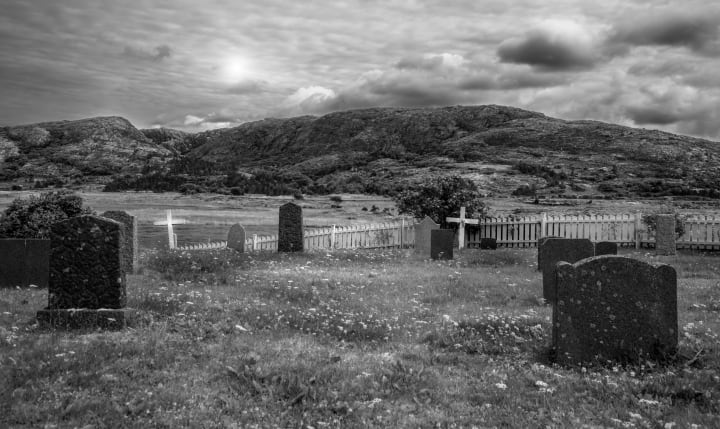
Tradition had it these fellows of the sea were shown a last courtesy by those who discovered them. Buried along the coast, in clifftop graveyards, without their names but with a final blessing from God. And so, half-a-mile north of the village, on the cliffs, above the mournful fog, a small gathering of strangers — three locals and a man of the cloth — laid to rest the anonymous outsider at the new cemetery as the bell rolled out its sorrowful gratitude from the lanes below.
Along the coast, from Humber to Tees, ancient graveyards littered the cliffs, each filled with folk that owed their lives to the sea. The briny expanse beckoning still after death. Never resting waters, abundant and demanding. The great provider. A benevolent ruler, generous and plentiful; commanding and brutal. For every king taxes his subjects, and woe betide the fool that welcomes wares from the waves without understanding it to be the most temporary of arrangements. A pact between man and white horses. Quid pro quo.
Even in death the sea demanded its share, scraping back the land, gnawing, little by little, eroding cliffs till the burial grounds themselves succumbed, collapsing onto the beaches below. And in doing so spilling their hidden treasure: headstones, coffins and all. Souls no longer at peace. It was not uncommon to see a pine box poking out of the cliff face after a storm. Teetering as the tides taxed the dearly departed. The waters claiming back their dead, along with the land where an old boneyard once lay. Death as part of life, the veil between two worlds thin, hazy. And yet life continued unabated, full, robust, and vital.
At the new cemetery, the man’s soul had been laid to rest under God’s graceful gaze; safely moored among the peaceful dead — for now, at least. His grave marked with a simple wooden cross and a posy of flowers plucked from the fields and tied on the slow walk to the top. The non-mourning mourners — minds drifting back to their own lives — brushed dirt from their knees and headed towards town. Sober of heart, satisfied their duty to the stranger from the beach was done, they chatted quietly about the day ahead. Of children and chores, markets and moors.
At the harbour, fog clung to the buildings, draped from the eaves like fishing nets set to catch the very air the people breathed. Knitted cables of white cloud wound round the tops of cottages, twisting into thick grey ropes as they became one with the chimney smoke. It weaved its way through the narrow lanes as it crept in from the sea, swaddling the village and obscuring life as it inched inland and upwards.
The windows of the tavern glowed with candlelight diffused in the gloom, a warm escape from the bleak weather. Tables stood empty, save one old man, snoozing by the hearth, half a glass of ale resting before him. There were jobs to be done before the working men joined him for their daily beer.
James Thresher — gentle of spirit; kind of heart — worked his net after a successful day at sea. His catch, by now, at the smokehouse, suspended in a shed, split and salted, and secreting its heavy scent. An early start for this young man left him hungry and, though his bones ached, satisfied at his day’s work. His mind drifted to Sarah, sweet, spirited Sarah, doing her duty to God, and the man swept ashore two days since. Up where the moors meet the cliffs, making her way back to town.
In the door of the pub appeared Louisa, a ruddy woman, hands on hips, chin held high and a twinkle in her eye. '‘Ere Jim, give us a hand, would ya?'
'What’s that?' James called back.
'I need someone with a strength of arm to shift these casks for me. There’s a drink in it for you.'
'Aye, give me a minute.' James finished a knot and carefully laid down his tools. He followed Louisa inside and down to the cellar where, with good cheer, she instructed him where the barrels were to go.
Back above the village, as Sarah followed the narrow path trodden by so many folk through time, a noise entered her daydream. The measured, dull drumming of wood on leather — doof-doof-doof — slowly. Then a second beat, slightly off. A third drummer joined them and it clicked. They were the drums women used to warn their men. Getting louder; increasing in urgency. In no time, the entire village was awash with the noise rattling through the fog. Sarah looked across to the sea and there it was, a galleon, sinister sails hanging from yardarms, dark and ominous on the horizon. It waited patiently, biding its time, motionless. In front, heading into the fog and towards shore, a smaller vessel. A gloomy old jolly boat flitting through the waves, fierce, focused on impressment.
A press gang was heading to land. James!
Sarah quickened her pace, hurrying, each foot landing in time to the beat as the women of the village drummed their warning. It would be fine, she told herself. Surely James would have heard the drums and taken to the tunnels beneath the village. Her steps shortened as she started down the steep hill back to town, and with it she disappeared into the fog. The drums now different, muffled yet echoing. The sound of a thud as the noise bounced off buildings and cliff face. The path gave way to steps as Sarah came upon the outermost building. She focused on her feet as she descended, knowing she was still some way from where James might be.
'Row!' bellowed the coxswain, 'Row!' The men powered towards shore. They knew in a place like this, once they’d lost the element of surprise, speed was all they had left. Six sailors made up the gang, brutes, merciless, with the backing of the King. Through the fog, they heard the alarm — the drums echoing across the water.
'Row!'
In the cellar James asked, 'Is that the lot?'
'Yes, my love. I think it is. You've been a real help. Those draymen were no more use than a hat on a herring today. Let me get you a cup from upstairs and I’ll pour you that beer.'
'No need, Lou. I must get finished. If you’re still here later I’ll come back and you can pour me one then, okay?'
'Aye, grand.' Louisa wiped her hands on her apron and made for the stairs. James followed. As she reached the top and pushed open the door, the rhythmic sound of drums met them. Turning back she said, 'Oh, Jim. Maybe you should stay down here for now.'
'Not to worry,' he replied, concern creeping into his voice. 'I’ll have plenty of time to get to the top of town.'
'I don’t mind, honest. There’s one of the old smugglers’ tunnels back there, behind that crate, you could wait in there till they leave.'
'No, really. It’ll be fine. They’ll take an age to land in this fog.'
'Well, if you’re sure…' The pair continued up the steps and into the pub where the old man snoozed. The beating drums filled the air.
'Honest…' James tried to reassure himself as much as his friend. He walked to the door and slowly pushed it open, the chill of the air biting as he stepped outside. 'See, nothing. They’ll be a while yet. Will you keep an eye on my kit though? I’ll just nip up King Street and disappear into the lanes.'
'Aye,' replied Louisa, with a nod.
Sarah made her way across the village towards the harbour. Weaving through the stone cottages and down towards the sea. If she got there in time, she could at least make sure James wasn’t in danger. Her heart raced. Had the jolly boat landed yet? Could she distract them if need be? Did she need to, or was James secreted away by now with the other men of the village? She pulled her skirt a little higher and picked up her pace.
James leaned over the gunwale of his little fishing boat as he placed the last of his net inside the hull. The drums rang through him as he realised the gravity of the situation. In the high window of a cottage, on the curve of King Street, he saw a woman banging a small hand-held drum. Frances Dawson, looking grievous. James raised a deliberate hand in greeting.
'Frannie,' he called to the woman. Her face, serious and vacant, illuminated in horror. She recoiled, backing away from the window into the blackness of the room as a heavy hand landed on James’s shoulder.
'I think you’ll find you’ve just accepted the King’s Shilling, my friend,' came a voice in his ear — hot, close, heavy. The sailor slipped a coin into James’s pocket and grabbed his arm as James tried to swing round. He shook his shoulder and scrambled to escape the man’s grip. As he turned he was faced with four more, the King’s finest, moving in. Two secured his arms, another seized a leg and threw him off balance. As he fell backwards, James looked across the harbour and saw Sarah rushing towards him.
'Get away, Sarah! It’s okay!'
'Let him be!' she screamed, grabbing the closest man. 'Get off him!'
James grappled and writhed as Sarah swiped at them from behind. A solid arm and clenched fist knocked her off her feet and sent her reeling across the cobbles.
'Do not obstruct the King’s men!' roared the assailant, jabbing a pointed finger at her as she collected herself on the floor. Sarah leapt up and ran at him once more. Another of the gang, thickset with a prominent nose, grabbed her around the waist, lifted her off the ground and spun her away, losing his hat in the process. James struggled and yelled at the men as he saw Sarah flung to the ground again.
And then — with a baton to the head and a click of a handcuff — it was over. Dazed and trapped; destined to his fate. Pressed into action. James fell to his knees as he buckled under their force. His gaze met Sarah’s as she sat on the cold stone ground. Her eyes, filled with dread, darted from James to his captors with a sense of pleading, hoping to appeal to their sensibilities. She knew it was futile. With one last burst of energy, and catching the men off guard, she got up from the floor and threw herself at James, wrapping her arms around his shoulders, knowing this was the last time she would hold him.
The press gang, with their man in shackles, knew she could do nothing. Still, one seized her arm and tugged her away, but not before Sarah had slipped a ring from her finger — a simple silver band inlaid with jet — and pressed it into James’s hand.
'Keep this, my love, until we meet again,' she whispered before being dragged away.
James slid the ring onto the end of a finger. 'Don’t worry, Sarah, I’ll come back to you.'
The gang, keen to get on and find others like James, hauled him down the slope of the harbour to their boat, where they thrust him in. The coxswain, who had waited behind, fastened the handcuffs to a metal ring in the hull and sat back idly watching their first captive of the day. It only took an hour for the press to make their way through the village. During that time, they collected four men. Frightened, confused and clueless as to their fate, they were delivered to the waiting ship before moving up the coast to another village.
Sarah spent that night curled on her bed, crying for James. Her future torn away as she’d watched the boat, with its crew of thugs, row through the fading fog. Back to their ship with their human cargo. How would she live without him? Their plans for marriage, children and a home together now dashed. She searched herself for a glimmer of hope, yet found none. Sarah knew, in the pit of her being, she would never see James again.
Over the weeks and months that followed, Sarah rebuilt her life as best she could. She took a job as a scullery maid at the newly built Raven Hall. It was tough work, drudgery, but it kept her mind from wandering, distracting her from thoughts of James and what fate had befallen him. The hall was a half-hour walk south of the village, along the cliff tops. Every day she would wander to work, looking wistfully out to sea, hoping to spot the ship that had ended their lives. She’d heard, once a campaign was over, men were free to return home, but two years on there was no sight. Hope had vanished.
Sometimes, when the tide was far out, Sarah took the narrow wooden steps down from the cliffs at Raven Hall and walked home along the beach. She carefully stepped over rock pools and through patches of seaweed, taking strange comfort that she was close to James. The sea a messenger between two souls. Her whispered words of love carried on the breeze, over the waves and across the miles to wherever he might be. And where, indeed? Europe, the Americas? He could be in Africa by now. Living below deck, nights in a hammock, days fighting strangers, his skin dark from the sun, his spirit broken. She couldn’t bear not knowing. Yet, nor did she want to know. A purgatory of the mind.
Sarah walked along the beach one evening, kicking pebbles as she went, wondering as always where her James might be. Ahead of her lay a mass of seaweed which had landed ashore with the last tide. Reckoning it easy enough to tiptoe through, she kept a steady path. As she approached, she noticed a strange shape, as if the seaweed had piled high over a small boulder. But this was no boulder. She approached cautiously, lifting her skirt so as not to get the hem wet, and leant down to investigate. She stopped, gasped, and caught her breath. It had been a long time since they had found anybody on the sands, but she recognised the shape immediately as that of a man. The frock coat and tricorn hat covering his face, a dead giveaway. This was a Royal Navy uniform, she had stumbled across a sailor, someone of rank.
Sarah knew she would have to fetch someone, but the town was some distance away, and she hesitated. She picked up a stick and pushed back the man’s hat, flinching as she revealed the side of a face with flesh missing. She could clearly make out teeth through the man’s cheek and a dark socket where once lay an eyeball. Wincing, she teased the hat back across his face and settled to return to the village to let the harbour master know what she’d found.
Her eyes moved along the man’s body. A shoe was missing, his breeches unfastened at the knee and filthy from the sea. His frock coat was fairly recognisable despite the state of the rest of him, and she noticed an epaulette. A small tear at the shoulder led her eyes down his arm, twisted strangely in an inhuman position. His hand, the skin half missing, formed a barely clenched claw-like fist and there on the man’s little finger, a ring.
A ring.
A simple silver ring inlaid with jet. Sarah fell backwards into the slimy seaweed at the realisation this mangled body, half eaten by creatures of the sea, was what remained of her beloved James. The sea had delivered back to her what it had taken away. Quid pro quo.
Through dense grey fog, a bell tolled for a man’s soul. Its heartless note pealing across the sombre village from westward moors — where spirits darted betwixt gorse and juniper — to the sodden sands of the secluded shore, as the tide turned once more.
A gathering of townsfolk, led in grief by a man of the cloth, laid James Thresher to rest at the new cemetery. The bell rolled out its sorrowful gratitude from the lanes below. Behind the mourners, on the edge of the moor, a dark figure of a woman stood, shrouded, defeated, her life claimed by the sea. She watched on as they buried her man in the ground.
The congregation paid their respects and returned to the village, leaving the graveyard on the cliffs desolate aside from a patch of freshly turned earth, a simple wooden cross, and Sarah Hesp, a broken woman, lost in herself. She laid a small posy of flowers, picked on the walk to the clifftop, on his grave and whispered into the wind, 'Goodbye my love, I’ll see you soon.'
Sarah walked away, slowly but steadily, towards the cliff edge where she stopped. Staring out to sea, she saw nothing but the gathering fog at the edge of the water. The tide was heading back. In an hour the saltwater would lap once more against the bottom of the cliffs.
'Goodbye, my love,' she said once more and without taking her eyes from the horizon, stepped off the edge and plummeted to the rocks below.
About the Creator
Richard Douglas
British writer penning articles, blogs, short stories, plays and novels. Well just the one novel right now...
Seeking representation so, if you're an agent, get in touch. If you're not, then I hope you enjoy what I write anyway.
Keep reading
More stories from Richard Douglas and writers in Horror and other communities.
Sinister Observers
Imagine waking up in the middle of the night. In the dim light of your room, you see a black humanoid shape standing in the door way. Startled, you turn your head to look quick but the figure vanishes. You wonder if what you saw was just your imagination.
By Jasmine Aguilar4 days ago in Horror
The Ritual of Winter Challenge Winners
Welcome to the Winners Announcement for The Ritual of Winter challenge. This prompt focused on winter rituals and the meaning that settles into them over time. The top pieces stay grounded in ordinary acts and repeated routines, letting winter shape the work through pace, attention, and restraint.
By Vocal Curation Team2 days ago in Resources


Comments