
Kuchisake-Onna: The Terrifying History of Japan's Slit-Mouthed Woman
From Ancient Vengeful Spirit to Modern Urban Legend—How to Survive an Encounter

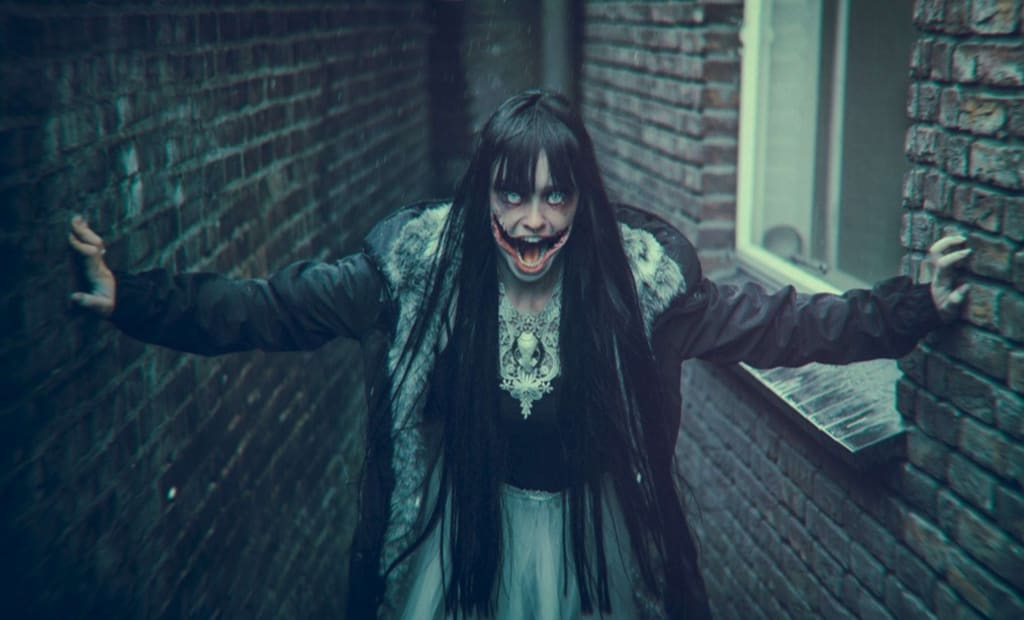
Of all the terrifying Japanese characters of folklore, the Kuchisake-Onna, or the "Slit-Mouthed Woman," is maybe the most terrifying and enduring. Her story is a complex blend of ancient myth and modern urban legend, a ghost whose history is as vague and malleable as the black it is said to haunt.
The origins of the Kuchisake-Onna are unclear, two principal threads building her gory story. The most popularly accepted tale places her during the Heian period (794-1185), a time of court elegance and devious schemes. She was a beautiful young woman, wife or concubine to a samurai lord. Appalled by jealousy of her beauty or terrorizing her for her whoring, her husband used his sword to slice her face from lip to ear, disfiguring her with a grotesque, lifelong smile. He then taunted her with the words now famous, "Who will think you're beautiful now?" and left her to die. She is now an evil spirit, or onryō, that has returned from the dead to pose her evil question to others.
The second strand is purely modern. In the late 1970s, a massive wave of mass hysteria swept Japan, with the focus being on the Kuchisake-Onna. The legend erupted, claiming she was a modern-day woman who had been disfigured in an automobile accident or botched plastic surgery. The rumor ran circles of schoolyards and tabloid newspapers, a national hysteria. Schools let out early, and parents escorted their children home, all fearing encountering the specter. This incident cemented her position not as a relic of the past, but as a living, breathing horror in the contemporary Japanese psyche.
The "ghost evidence" and rules of an experience with the Kuchisake-Onna are deliberated. She is typically portrayed as tall and lean wearing a surgical mask—a common sight in Japan, making her perfect camouflage. She will approach as far as one victim, typically a child who is on their way home in the evening, and ask, "Am I beautiful?" (Watashi, kirei?). If the victim answers "no," she will kill the victim right away with a pair of scissors, a razor blade, or a scythe she keeps with her.
If the victim answers "yes," she will then remove her mask to reveal her horribly slit mouth and ask, "How about now?" This is the true moment of horror. The folklore offers a couple of possible escapes, which were an integral part of the urban legend. If you tell her that she is still pretty, she will spare your life but give you the same wound. If you tell her that she is ugly, you are dead. The best means of fleeing her grasp are to catch her off guard with an answer, like "So-so," to her inquiry or to deflect her with the tossing of money or hard candies (jyagariko snacks) in her direction, enabling you to slip away.
What makes the testimony of the Kuchisake-Onna so believable is its adaptability. She does not haunt one particular haunted castle; she haunts contemporary housing estates, shopping districts, and schoolways. The surgical mask, which was a triviality, has an added layer of inconvenience in the post-pandemic world. Her story is one that appeals to shared, rooted terrors: fear of sudden, arbitrary violence, the stress of societally dictated beautification, and the terror of discovery by a trusted friend—an expectant woman in a nurse's uniform is a common variation—of a horrific propensity.
Kuchisake-Onna is more than a ghost story; she's a cultural artifact. She is a physical beauty brutalized and transformed into an instrument, an immortal cautionary tale that has flourished from a feudal testament of treachery to modern horror who continues to find herself being talked about, a testament to the fact that some fears, like some wounds, never entirely dissipate.
About the Creator
Kyrol Mojikal
"Believe in the magic within you, for you are extraordinary."
Keep reading
More stories from Kyrol Mojikal and writers in Horror and other communities.
Zashiki Warashi: The Playful Japanese Ghost That Brings Fortune and Fear
The Zashiki-warashi is a fascinating Japanese mythical being, a ghost child with a reputation both for tricks and for having phenomenal good fortune for the family in which it resides. Its roots lie deep within Japanese myth of the northernmost Tohoku region, building a complex figure that is as much about tricks as it is about tragedy.
By Kyrol Mojikal3 months ago in Horror
One to See, One to Speak, One to Listen
Contains gore and horror some readers may find disturbing. Rated 14+ Author's Intro: This story is meant to revive the Gothic literature so famously crafted by one of my favourite writer's, Edgar Allen Poe, and as such, the language and style is deliberately antiquated. Thank you for reading my all time favourite work of horror - Les
By Call Me Les19 days ago in Horror




Comments
There are no comments for this story
Be the first to respond and start the conversation.