
I. The Pied Piper of Hamelin
A tale of Doom, Treason and Infection
No one remembers when the rats arrived.
One day, they simply weren’t there. The next, they danced between the bakers’ legs, gnawed at the bell tower ropes, and slipped into cradles as softly as they entered dreams.
Hamelin was a small, colorful, and silent town.
It had more windows than people, more flowers than bread, and more secrets than it could ever hold.
The adults told the children to ignore the rats.
Don’t look them in the eyes.
If one speaks to you, plug your ears and recite the Wheat Psalm.
But children never obeyed.
The rats whispered beautiful things.
They promised candies that didn’t exist, games that didn’t hurt, and a city beneath the ground where adults never punished anyone.
The first disappearances came slowly.
A little girl left her ragged teddy bear in the plaza and never returned to fetch it.
A boy was seen chasing a rat with a silver tail.
A mother wept for three days before sewing her lips shut with hemp thread.
The mayor claimed it was the price of spring.
That the fields were green.
That the dead do not complain.
And then… he came.
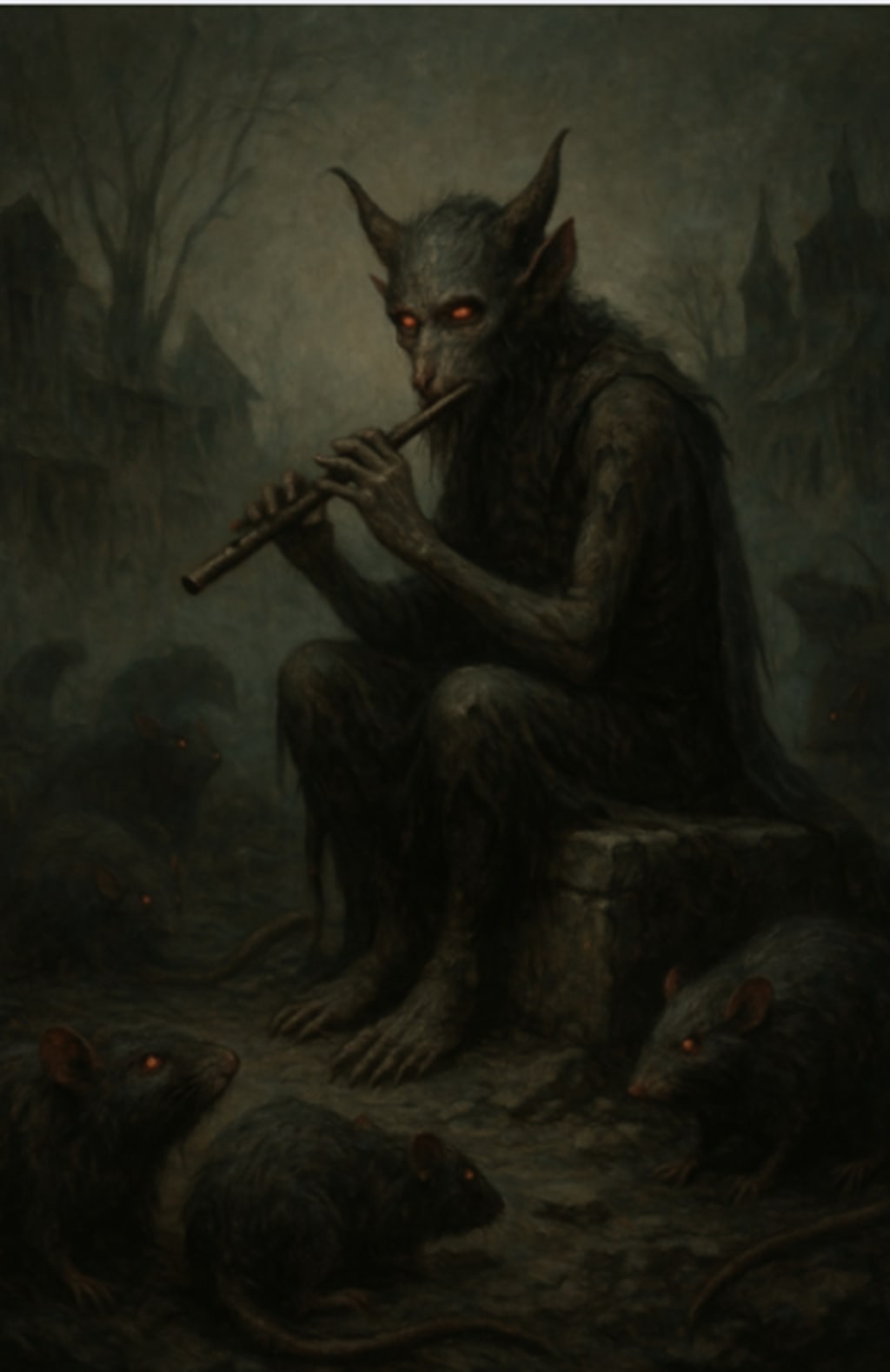
One morning, he appeared in the center of the square.
Tall, hunched, clad in a velvet coat of deep darkness, a long silver flute hanging from his belt.
His face—pale and kind—was half-hidden beneath a wide-brimmed hat.
His eyes were sorrowful, but his smile… honest.
The children called him “the man of music.”
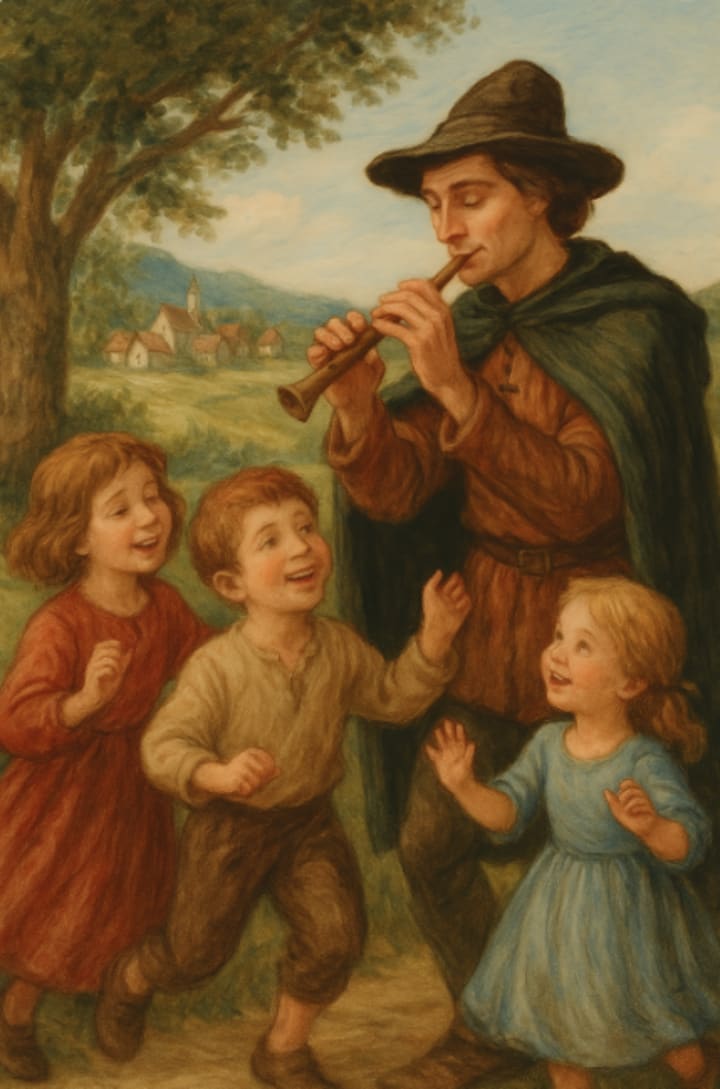
He played his flute.
It was no ordinary melody, but something between a chant and a soft lament.
The rats came forth—not running, but dancing.
They spiraled upward, twirling around him as if in reverence.
The music ceased.
The Piper bowed politely and disappeared down a narrow alley.
That night, there were no rats.
Nor the next day.
Windows opened wide. Children laughed again.
The adults called it a miracle.
On the fourth day, he returned.
This time, he did not play. He only spoke.
—Work has a price. You live. You pay.
And he asked for gold.
The mayor agreed, gladly.
But then he asked for more.
—Give me the child who has never cried.
Give me the milk of mothers who no longer breathe.
Give me the forgotten names from the cemetery.
This time, the mayor said no.
The Piper nodded without anger and walked away.
That night, the rats came back.
But they did not walk as before.
They no longer squeaked. They did not flee.
They did not smell of cellars and dung.
They smelled of flesh.
Their eyes gleamed like wet coals, and their paws—once sliding silently through cracks—now struck the cobblestones like fists.
They had grown.
They had fingers.
They had claws.
Some walked upright.
Others laughed.
The first bites went unnoticed.
A baker lost a finger and blamed a knife.
An old woman screamed through the night and woke up with blood on her tongue.
A boy chewed off his own nails, claiming a rat had commanded him to.
The Piper did not play again.
He merely watched, high above from the tallest tower.
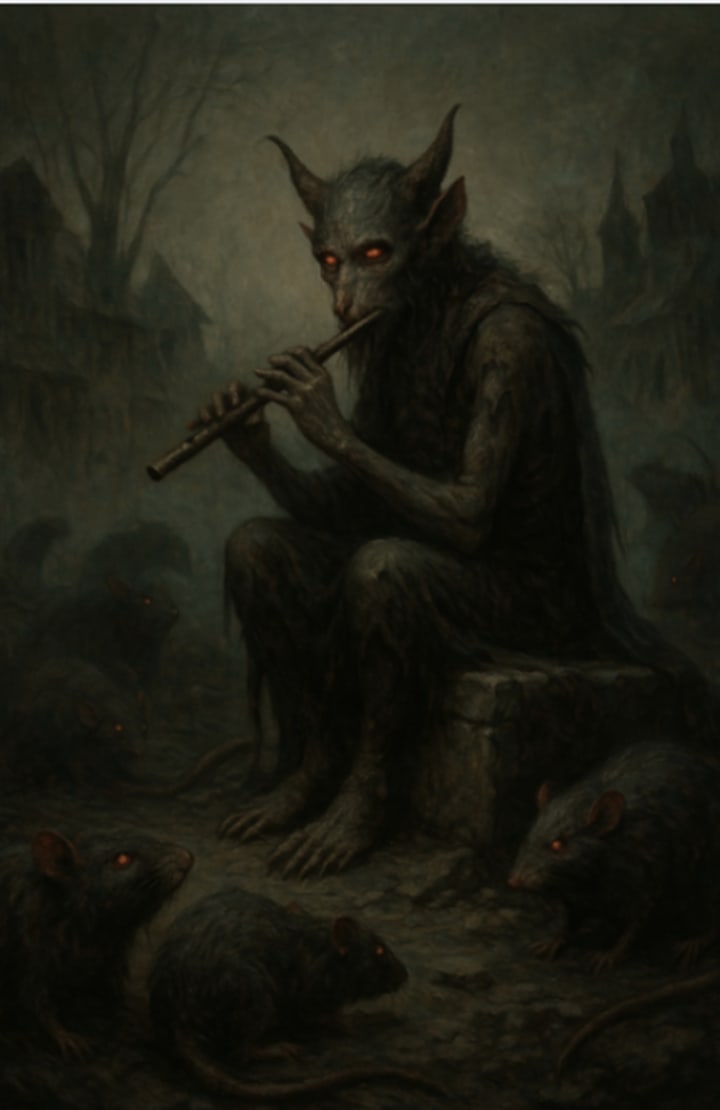
His coat was no longer velvet—but feathers soaked in dampness and sleeping rats.
His true nature was revealed: a monstrous hybrid of man and rat.
The transformations began with the weakest.
First, a fever. Then, silence. And then… the change.
Bodies bent backward.
Mouths stretched.
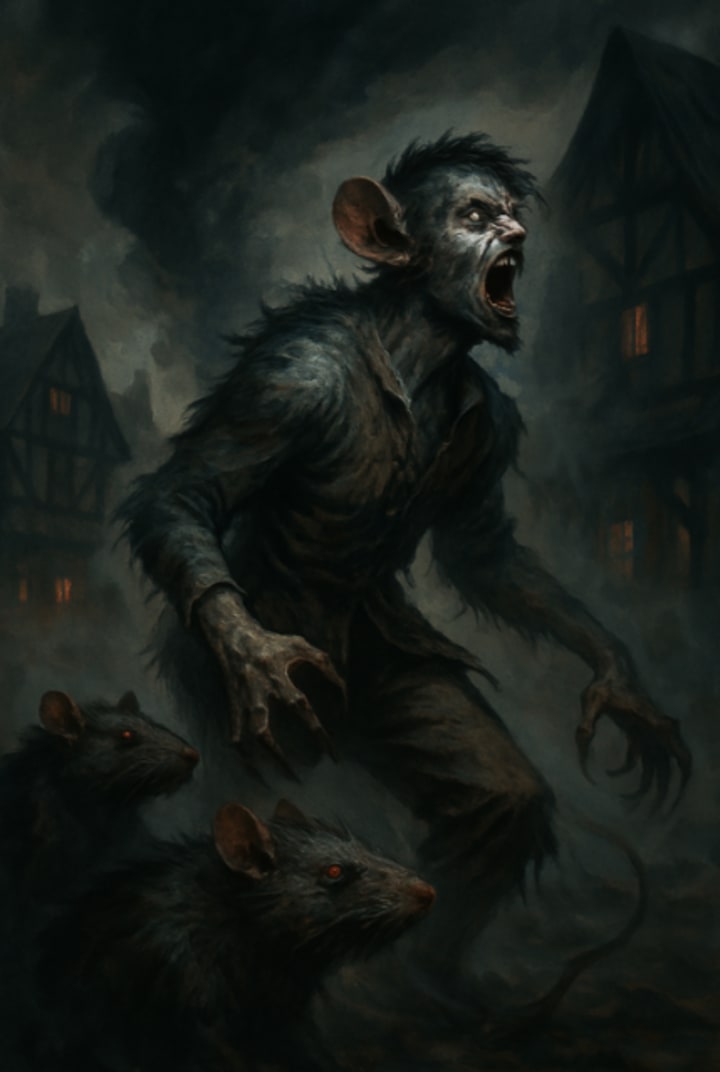
Skin peeled in strips, revealing pink scales and twitching spines beneath.
One by one, the townsfolk began to crawl through the streets.
Not like the sick…
But like kin.
Like family.
The mayor was the last to resist.
Locked in his stone house, surrounded by traps and crosses, he listened to the voices of his dead wife, his forgotten daughter, and his own reflection.
The church became a warren.
The well, a womb.
The homes were devoured from within.
The cobblestones pulsed like sleeping flesh.
The sky turned a sickly greenish-gray and stopped raining.
Only a cacophony of shrieks and muffled screams remained—lulled by a sweet, distant flute.
And all the while…
The Piper walked.
Naked now, bones showing beneath moist skin.
His ghastly flute hung from his neck.
His song recruited a new army:
The once-peaceful villagers, now grotesque amalgamations of rat and human.
A fog, thick as spoiled milk, blanketed the valley.
The roads to Hamelin vanished.
Even the forest recoiled, as if it feared what rose from the soil.
And at the center, where the plaza once stood, now lay a pit of flesh:
A hole into which the houses bowed, as if in prayer.
The Piper sat upon a stone that bled slowly.
He did not speak.
He did not breathe.
He simply waited.
The new children of Hamelin emerged from the walls.
Eyeless. Tongueless.
Some walked with exposed ribs.
Others dragged wet tails like living roots.
All of them carried the same song in their throats—
A melody without breath,
An echo without sound.
And then… the last child confronted the hideous Piper.
His name was Elias.
His hair was white. His fingers red.
His parents had offered him as a sacrifice—through tears and desperate prayers—
But Elias did not cry.
He simply looked at the Piper.
—Why? —he whispered.
—What are we now?
The Piper raised his flute.
But he did not play.
He broke it in two.
And from inside did not pour pieces or air…
But names.
The names of the vanished.
Of the unborn.
Of those yet to come.
Elias closed his eyes.
And when he opened them…
They were no longer his.
The next village knew nothing of Hamelin.
Only that, on certain nights, when the wind blew from the north,
They could hear footsteps—
And a music without instruments,
A sound between a human scream…
And the shriek of a rat.
Over time, what was once Hamelin was burned to ashes by neighboring kingdoms—terrified of what the peaceful town had become.
All the beasts were executed and incinerated.
The village was erased, isolated from the world.
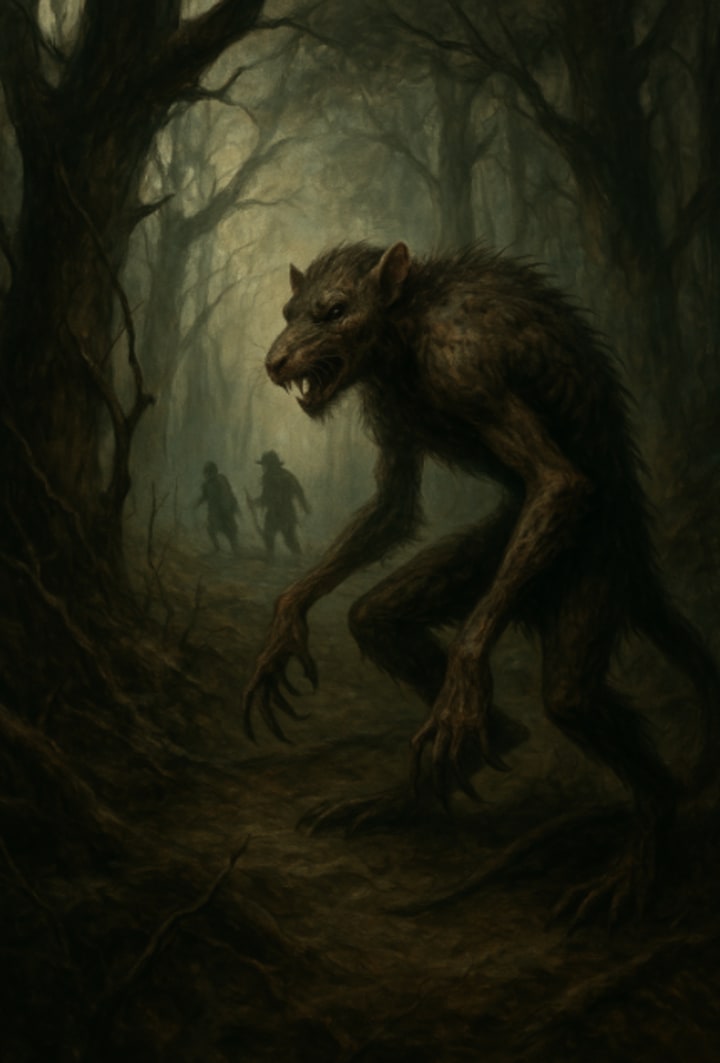
Only dark legends remained—of monstrous hybrids lurking in nearby woods, hunting humans to join their ranks.
As centuries passed, people misnamed them “werewolves,”
though that was never quite true.
The town of Hamelin remembers their true origin well.
And in the eyes of the world,
this dreadful tale was transformed into a cheerful fable—
a bedtime story of a kind Piper who saved a magical town from a plague of rats.
They do not know that Hamelin was very real.
And that the story… did not end so happily.
To this day,
no one knows what became of the Piper—
or his dreadful army of rats.
Moral of The Story
“Hamelin taught us one thing: Never break a promise to a man with a flute… and rats for friends.
— The Lost Tales
About the Creator
The Lost Tales
The Lost Tales reimagines classic fables as dark, corrupted stories. Forgotten gods, broken worlds, and ancient warnings. Some tales were never meant t
Because some stories don’t want to be forgotten.
And some truths were buried for a reason
Keep reading
More stories from The Lost Tales and writers in Horror and other communities.
Killing him slowly
There’s an intruder in my house again. He stumbles through the door, wet carrier bags in hand. He’s bought me offerings. I show my appreciation, letting him caress my beautiful body. He wants to touch me. I rub myself against his legs. He sighs, dropping the bags. He can’t resist touching me. Running his hand slowly down my spine, I arch my back towards his caress, let out a low purr. It’s what we both need.
By N J Delmas4 days ago in Horror
Dusty Bones
A rickety worn shack swayed ominously as a malicious wind tore after it. A fevered cry from the weathered boards fell upon an old man’s ears. He paid it no mind however and continued to stare forlornly out the shattered panes into the ocean’s depths below. An internal battle raged through his mind as a lone candle flickered threateningly. “All alone… everyone’s gone… my fault.” His tattered memory danced across his lips as his ghosts relentlessly tormented him. One peering inside the shack may mistake him as a lone ghost himself, for his pale and frail bones looked skeletonized from his fever crazed state. He stands at this fractured window and stares at the sea, haunted always haunted.
By Mikayla Decker 3 days ago in Horror




Comments
There are no comments for this story
Be the first to respond and start the conversation.