
I Am the Only Sane One Here
Abandon Hope, All Ye Who Enter Here

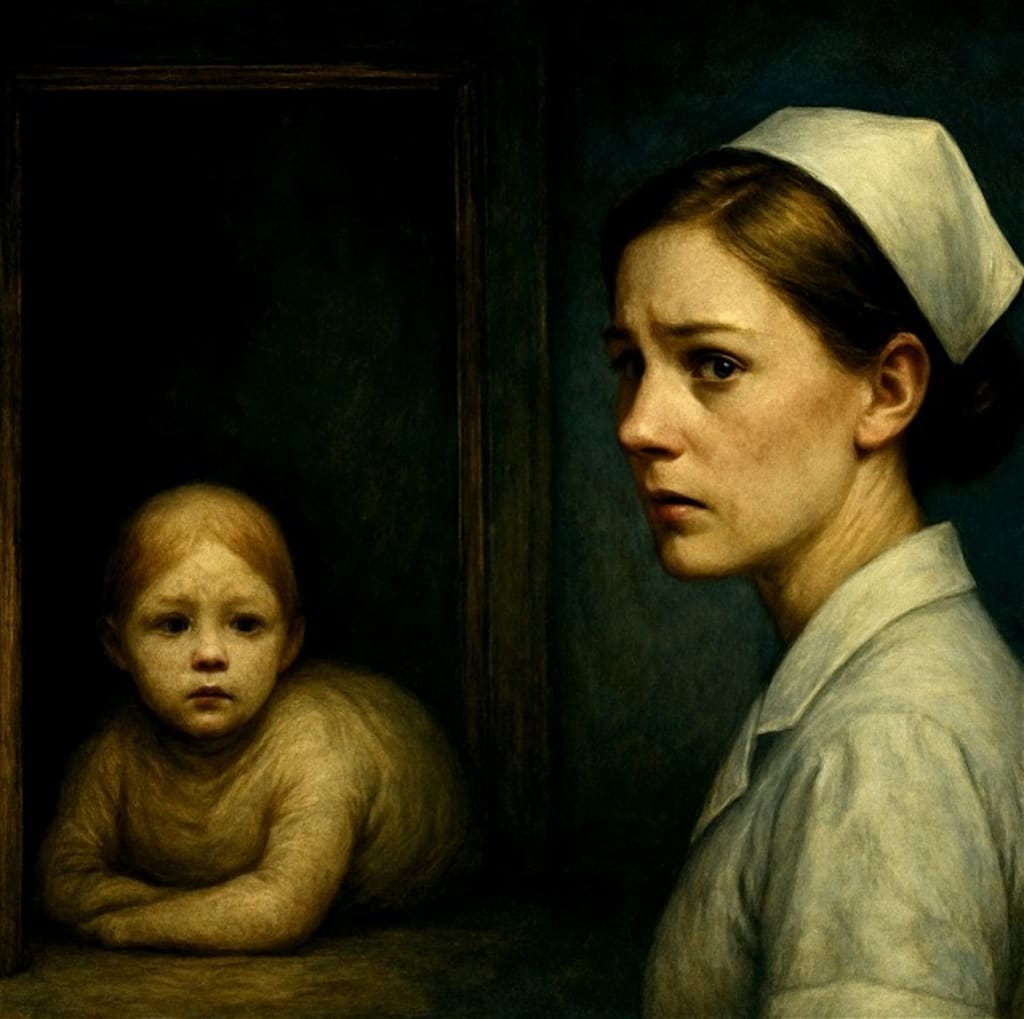
In this life it is said one alternates inexorably between love and despair. I say love is embodied in hope, but, all the same, both are transitory illusions.
I don't know if what I am about to relate was real or a dream. It is sandwiched between waking thoughts like a dim-remembered excursion on a summer day. I must have been traveling when I came upon the place, alone and forbidden, and wasting away in the warm summer sun. The sky was a pale blue shade of deep milk. I parked and went inside.
The porch sagged and creaked, the door rattled open on rusted hinges. I was met by a man in a black, nondescript suit. Curiously, I cannot well remember his face.
"Greetings," he said. "How good of you to come! I've been here alone." He suddenly said, "But you may wonder at that. I'm not really alone. But I can assure you I'M THE ONLY SANE MAN HERE."
I was slightly confused by his contention; but should I have been? I was, after all, a psychiatric nurse. In much the same way as Kafka asserted that man had to be cautious upon awakening that he had journeyed up from slumber to the same world upon which he had closed his eyes the previous night, I felt myself somewhat lost, or at least, at a disadvantage. Now the memory is a damned thing, and it can always play you false.
How much of memory is dream, and how much dream memory, is a matter for the philosophers to ponder.
The foyer or lobby was like that of an old-time hotel. One could take it straight back into the shadows—presumably kitchen, parlor, dining room—or one could walk upstairs to the various bedrooms, guest rooms, and perhaps library and examination room. Closets might be leering like the knife-edged grin of a dark, encumbered maniac, with the preserved, though desiccated relics of bones wired together. At any rate, I already knew this was madness.
"Come," he said, his face teetering upward as he pointed one oddly white-gloved hand to the ceiling. "I want to introduce you to our residents. You'll find them a peculiarly endearing lot, I think. However, that is for you to determine."
Up the groaning staircase we went, I following close behind, my hand trailing the huge banister as we ascended into the dim, shadowed upper floor.
The hallway presented itself at the top of the stairs, revealing a dark shadowed corridor of stifling air and simple, though strangely claustrophobic configuration. There were four doors on one side of the hall, four on the other. In between, the most stultifyingly common pictures—bought from second-hand shops perhaps—depicted average scenes: nature walks across lonely fields, paths cutting through trees, freckle-faced fisherboys with their rods held over the creek. One lonely picture depicted a young girl with an expression I could not help but feel depicted gaiety covering a melancholy sense of dread. At least spiritual sadness. I shuddered, but said nothing.
"You'll forgive our taste in art," he said. "I'm afraid it's rather indifferent and comprised of what was expedient, and available. Now," and with a slight, comic flourish of his hand, he approached a door marked, inconspicuously, with a giant golden 'One,' and said, "Allow me to introduce you to our first and most esteemed of the Seven Deadly Sins. Our inmates, you see, are all comprised of a peculiar, particular obsession."
And before I could reply he had thrust the door back. My eyes steadily adjusted to the light spilling in from the film sash, the window directly in back.
A man sat on a pile of silk cushions in the center of the floor. His face was a comic-grotesque mask of aged ugliness. His teeth were buck, his hair white wisps, and his nose a great bulbous radish. He held, in one quivering, liver-spotted hand, a round, handled mirror set in a gold frame. His veined and seamy hands teased his curling, white wisps of hair as he gazed at himself entranced.
"This is Narcisse," said my guide. "Rather appropriately named, no? He represents the sin of pride. One can well determine that. Though he admires his vast beauty in the mirror, it must surely be presenting to him an illusion, a projection, of his besotted brain. But come, I do not wish to tarry long at each room. You'll get a brief introduction to our somewhat eccentric retinue of residents."
We proceeded to Room Two across the hall. He opened the door.
"Here we have Charley. He is infused with greed, is an embodiment, one might say, of the quite natural human emotion." He then added, reflectively, "With all that that entails."
Charley looked so much like Narcisse that at first I was convinced that the man from Room One had somehow taken a secret passageway to Room Two, and there changed costumes quickly. But this would have been impossible, I knew.
Charley sat on a similar pile of silk cushions, cross-legged, as if presenting himself to us as we peered into the room. In front of him, heaped piles of coins, certainly none of them real, were spilling forth from open sacks. His face was exultant, drool running down his chin, as his shaking fingers swam through piles of counterfeit wealth.
Onward to Room Three. A woman reclined on a bed of silk.
"This is Agnes. Dear, sweet Agnes, bereft of shame and wanton, lewd, with the peculiar satisfaction of contravening her own guilt." It was then that I saw the shadow bent before her, over her form. It was curling black fingers, twitching, long nails clacking at her throat. A hideous imp. A demon of sleep. Its face, as it turned its head toward us, revealed the wizened visage of the goat-legged satyr.
He shut the door quickly, extolling, "That will be enough of that," and began to mop his brow with a kerchief he produced seemingly from nowhere.
Room Four revealed, "Clara, our dear sweet little child, with her ragged dolly." He pointed one long, curling finger. I could see it was withered, stained, and capped by an exceedingly long nail. "You would never dream such an angelic visage could hold such miserable depths of Envy, which is the sin she embodies. At least, in her tortured mind."
And then I had to blink, for it was as if the image doubled, and Clara sat beside herself, still clutching dolly. But whereas the former Clara looked a ragged child with a ragged doll, this Clara was the picture-perfect image of a child doted upon, cared for lovingly, with kept curls, a frilly new dress, and a look as if she had just been fed a handful of candy or chocolate treats.
Clara One turned her head and stuck out her tongue at Clara Two. Tears streamed down her cheeks as she began to cry. My guide shut the door slowly. Silently, we proceeded to Room Five.
"Now this," he said, as if concealing a slight smirk, "may require a bit for you to stomach." He thrust open the door slowly, but it was somewhat too dark inside to adequately view whatever lay beyond. I stepped in cautiously. Then I could see why—a good portion of the window beyond was blacked.
A great white mountain of flesh lay, like a beached sea animal, in the center of the dark, barren room (all of the rooms were barren, void of furnishings, save for the madman's tableaux). The smell was almost beyond endurance.
It lay amid a sewer of filth on the floor surrounding it: empty cartons, rusted cans, and piles of hog-like swill or slop. The face? But how can I describe a face drowning in chins, folds of hideous fat punctuated by a vulgar, lolling tongue protruding from heavy red lips? The eyes were glittering, black, pig-like jewels. The nose approximated a snout (but this may have been false).
"Our dear friend Mabel is, of course, the sin of Gluttony. Observe—"
A small man with a tiny shovel, who may have been a clockwork soldier or nutcracker by the way he was costumed, stepped forward suddenly, swimming into my awareness for the first time. He shoveled slop into Mabel's jaws. It went spilling out across her face, and, running down to the floor, further added to the sickening pool upon which she reclined. I could hear a vomitous belch as my guide placed his kerchief over his mouth, and shut the door.
"Very hard to...digest that one. Unappetizing, to say the least. Come, onward. Never pleasant to visit Mabel when she is feeding. Which, incidentally, is all the time."
Inside Room Six, a man in a cage was taunted, tormented, and thrust at with pitchforks. Held by little devils, that may have been orphaned street urchins in Halloween dress, his flesh seemed poked and prodded. It was his face, however, covered with fur and boasting fangs and the countenance of a man turning into a hungry beast, glittering eyes burning with hellish fury. Upon his wrists hung suspended chains from broken manacles.
Then, a milling throng entered and began to encircle his cage. I blinked, my mouth falling open. Where had all these people come from?
They began to taunt and jeer, pointing and laughing and speaking among themselves, as the Little Devils drew back, and the Beast Man in the cage ("His name is Waldo," my guide informed me) reached out his hairy, nearly clawed fingers, and said, "Come closer, closer! Just a hair's breadth more and I can touch you. I promise, I'll harm not a hair on your head! I want to feel you, caress you, one final time."
But he most certainly did not seem as if he wanted to caress any of the crowd; simply rip them to shreds. But whatever he meant by his imprecations, my guide closed the door, and, turning, said, "One more door, of course. Penelope. Our Lady of Perpetual Lethargy. Not the most appetizing of all titles, perhaps. Here—"
Opening Door Seven, I saw a nightmare image that shocked me much more than any I had hitherto seen. I thought I was in the presence of a great white serpent, and almost recoiled, fleeing in terror. But I could see by the head that it was indeed not a serpent. It was a tremendous, slug-like abomination of oily, white flesh, and, what I could see, were tiny, stub-like appendages.
"Penelope, well, she embodies the Sin of Sloth. Look at her sinister black-eyed gaze. Her disdain for physical movement has caused her body to...mutate. To atrophy. Her limbs are quite useless to her now. Her disdain for physical work, and finally physical movement, was brought about by her great capacity to envision, to dream. She lived in the world of her illusions, and still does, until it is that that world has closed her off, trapped her behind its doors, keeping her bound forever to the hallucination of being, while her real, physical body has deteriorated and distorted beyond repair."
The face was a rubber mask, indeed; it stretched out to hideous dimensions. The eyes were black, filled with something evil and unpalatable. I fancied, in the light I saw trickling in behind the frilly curtain, I could see her in her youth, as she was long ago. Sitting by the lake, in her fantasy of yesteryear, waiting for her Prince to come riding up on a black stallion, to deliver her from the humdrum and boredom of her existence, perhaps as a serving-girl, and sweep her to his castle keep, his barony. But, of course, this was simply a dream, and her Prince would never arrive. Instead, she would recline, unmoving, by the lake, eternally.
Soon, her bones would begin to atrophy, her face stretch to grief-stricken, horrible proportions. Her dimmed, turning-to-black eyes would stare eternally into empty spaces beyond, and, like a giant slug, she would squirm in a bed of her own slime, alone.
It was too horrible a fate to contemplate. I reeled away from this display in disgust. Rattled, my nerves screaming in my skull, I turned to the left, to the last door, and, gaining possession of myself, said, almost as in a whisper, "And that door. What is behind that door?"
My guide suddenly looked apprehensive, and quietly said, as if in reluctance, "That door? Behind that door, I fear, is the most disturbing display we have in the entire house. You may wish to proceed, or you may not. Your choice."
He opened the door, and hovered at it for a second, and, as I cautiously approached, he pushed it gently open.
It swung forth. My eyes adjusting, I crept cautiously within. The milky sunlight illuminated nothing—at first, I thought it an empty room. Then I saw it.
It was a patch of cardboard only, hanging suspended from a string. On it, scrawled in black ink, were the words:
Hope / Despair.
"The last, and most deadly of all sins."
I turned, as if for an explanation. Hope. Despair. The last and most deadly of all sins. But which was it?
But he was gone. And suddenly, the door swung shut.
And I've been here ever since. The sun goes up. It comes down. They push my meals beneath the door on a plastic tray. Occasionally, I awake, and a pitcher of cooling water is beside my mat.
Hope. Despair. I see both every day, suspended above me. Like Poe's pendulum.
When I dream, I sometimes see a man carrying ten staffs across a landscape. His back is turned to me. Ahead of him, in the dim mists across an open plain, a city with tall spires, towers ranged upward to the darkening sky, looms. I fancy he is going with staffs aplenty, each to strike the back of one who has wronged him, of whom he seeks vengeance. I reach out to him, as if to grasp a staff for my own. But surely that is just a dream, a vague fantasy; an irrational hiccup of my sleeping brain.
Stop smiling. You act as if I'm mad. Why, I'll have you know:
I'm the only sane one here.
Author's website
Follow me on Twitter/X: BakerB81252
About the Creator
Tom Baker
Author of Haunted Indianapolis, Indiana Ghost Folklore, Midwest Maniacs, Midwest UFOs and Beyond, Scary Urban Legends, 50 Famous Fables and Folk Tales, and Notorious Crimes of the Upper Midwest.: http://tombakerbooks.weebly.com
The Homes Flagged for Follow-up
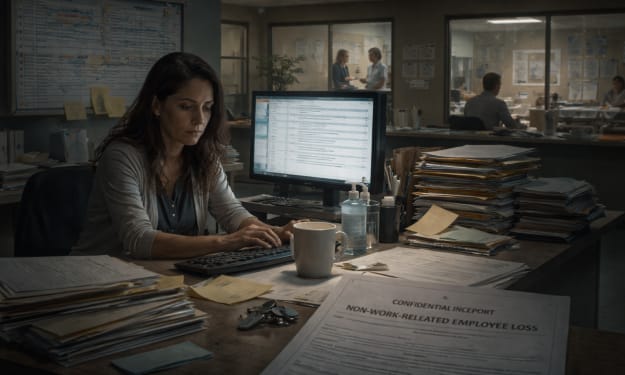
By eight each morning, our office smelled of coffee, disinfectant wipes, and printer heat, which is to say it smelled like concern that had learned to invoice. I unlocked the care-management dashboard and began assigning fifteen people to the homes where they would bathe strangers, sort pills, warm soup, and sign for it in blue ink.
By Jesse Shelley5 days ago in Horror



Comments
There are no comments for this story
Be the first to respond and start the conversation.