


Homicidal (1961), along with Psycho (1960), and—God help us—Ed Wood’s Glen or Glenda (1953) [1], expose the societal prohibitions of the era regarding gender-bending, transvestism, and the basic flaunting of societal conventions, especially as it relates to identifiable sex roles and how a person identifies, gender-wise. We have the same debate raging today, the same sense of taboo and the same prejudices played out on a much more open and more furious scale—also with a greater sense of understanding and acceptance. William Castle, the famed provocateur and impresario who shocked the heinies of Eisenhower-era America by wiring their theater seats for The Tingler (starring the always incredible horror thespian par excellence Vincent Price), here delivers a passable little thriller readymade to ride the coattails of the box-office success enjoyed by Psycho, which had the cross-dressing Norman, who imitated a woman for a reason entirely unrelated to actual transvestism.
The film opens with Emily (Jean Arless, a.k.a. Joan Marshall, in a dual role) as the standard 1960 blonde beauty of low-budget film lore, going to a cheap hotel and hiring an unsuspecting bellhop to marry her for an undisclosed amount of money (I think it was five thousand, but I can’t remember now). They head to the J.O.P.—a guy that seems straight out of Psycho (remember the scene where Lila Crane and Sam Loomis go and find out that Norman’s Mama is actually dead?). The old geezer gets fresh, and so he’s gut-stabbed by Emily in a bloody fashion that leaves the viewer with the impression the rest of the film might be a promising Grand Guignol of crimson delights. Alas, this is not so much so, although a head does literally roll at the climax.
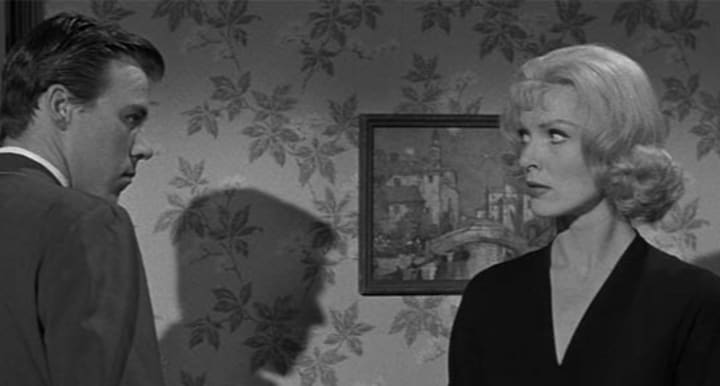
Emily’s brother is the very weird Warren, who is just back from Denmark. Emily’s and Helga’s (her lifelong caretaker’s—or Warren’s) relationship is odd; Helga is mute and in a wheelchair, communicating by clack-clacking a little wooden object (what? She can’t write?). Of course, in Psycho, Norma Bates is wheelchair-bound too, though this isn’t revealed until the end—and poor Norma is hardly in any condition to clack-clack. Tony Perkins comes racing in in Victorian schoolmarm drag with a butcher knife—but you already know all of that. Homicidal imitates overall, but it still has a weird, unsettling power all its own. The Southern sleaze factor is strong here: film noir and dark, Hitchcockian folderol. The flavor is pure camp hijinks in many ways. It’s not a stellar pic.
Moving along, the intensely creepy Warren (whose dialogue seems dubbed) is introduced, along with Miriam Webster (Patricia Breslin), who is actually NOT an anthropomorphized dictionary, and her beau, Karl (Glenn Corbett), who runs a flower shop. Or drugstore. (Was it Miriam that ran the flower shop? Ah yes! Indeed. The plot thickens.)
The movie hinges on the inheritance of the Warren/Emily duo (Castor and Pollux, Sacred Twins, Gemini with the convulsive, volcanic nature?), male and female potencies, the Two of Cups, Lovers, but also The Devil. And here, The Devil is given full reign. Jean Arless, as Emily, is every bit the 1960 high-camp, blonde-headed movie scream queen/screen queen that Candace Hilligoss is in Carnival of Souls (1962), of which she seems wildly reminiscent.
Besides the fact that this one always gets confused in my mind with Straight-Jacket, starring Mommie Dearest herself, Joan Crawford (also directed by Castle and written by Psycho author Robert Bloch), Homicidal is best viewed through the lens of the paranoid fixations of a generation shifting from postwar All-Americanism and Eisenhower-affluence baby booming to a much more volatile and convulsive (Gemini) era when sexual roles were not only going to be questioned but thrown straight through the effing window. Hence, Norman (based on Wisconsin cannibal, grave robber, and multiple murderer Ed “Fast Eddie” Gein, albeit very loosely), and just a few years prior (1953), Ed Wood making his plea for tolerance of his own transvestite fetish in the execrable cult classic of shit cinema, Glen or Glenda—a film which confused transvestism with the post-operative transsexual Christine Jorgensen (the film documents this to an extent, at the end).
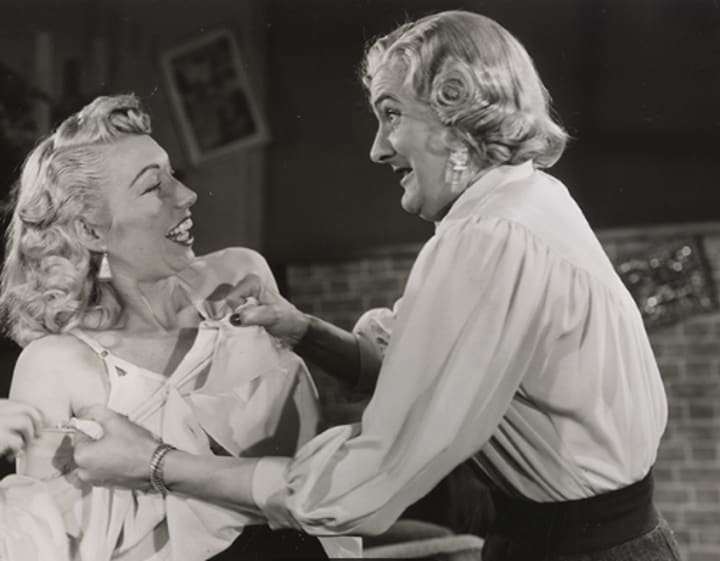
Glen or Glenda (which also stars Bela “Count Dracula” Lugosi as a “god-like being”) is an incomprehensible mishmash, but it does feature a character, “Captain Dezita,” who had very impressively demonic eyebrows. Homicidal, Psycho, and Glen or Glenda all give silver-screen life to the lurking fear that as matronly, traditional womanhood was challenged by those who felt their gender identity was misaligned with who they actually were, society itself would be rendered—in the symbolic form of Helga or Norma Bates—a thing motherless and mute with disgust. This was the pervasive anxiety underscoring these films: transphobia, bigotry, and cowardice, really.
But that was well over fifty years ago, G. We live in more enlightened times, do we not?
Well?
Don't we?
Note. [1] The cult slasher classic Sleepaway Camp (1983) plays on the same fear of transsexualism, portraying the demented killer as a semi-feral creature at the end of the film—one driven to homicidal mania by a mother who insisted on raising her boy as a “little girl.” So, the theme didn’t really go away; it just evolved with the times. One might be hard-pressed to find modern examples quite so brazen, but the undercurrent of anxiety about gender nonconformity still runs deep in the genre’s bloodstream.
Homicidal | FREE MOVIE (Glenn Corbett, Patricia Breslin, Eugenie Leontovich)
My book: Cult Films and Midnight Movies: From High Art to Low Trash Volume 1
Ebook
My book: Silent Scream!: Nosferatu. The Cabinet of Dr. Caligari, Metropolis, and Edison's Frankenstein--Four Novels.
Ebook
About the Creator
Tom Baker
Author of Haunted Indianapolis, Indiana Ghost Folklore, Midwest Maniacs, Midwest UFOs and Beyond, Scary Urban Legends, 50 Famous Fables and Folk Tales, and Notorious Crimes of the Upper Midwest.: http://tombakerbooks.weebly.com
"Scream 7" (2026): Running out of Fresh Screams
This is the seventh time we’ve had a Ghostface crisis. Scream 7 is the latest edition of the Scream franchise. Sydney Prescott and her family are under attack by another anonymous killer dressed in a Ghostface costume. While having issues with her daughter, Tatum, they run from the bloody murders, trying to determine who is behind it all.
By Marielle Sabbag6 days ago in Horror
Day 19: Loose Allegiances
Day 19: Loose Allegiances This isn’t hard to deduce if you’re here. During said gap, I was told that Wolfman Patrick wanted everyone to catch up to the most notable now of our research. The two shifts typically saved for this exercise were spent getting shouted at by Coldman Jason in his office for insinuating that the Brochure has nothing new to contribute, starting the tenacious argument that will go on for days. He asked me to be open-minded; I scoffed at the disrespect and refused to apologize for throwing the book. Details were to be strictly ordered in chronological order, as remembered; my 'tampering' will not be tolerated, apparently. However, once the storm started, it became clear who paid attention to Harvest-woman April’s briefing. Fucking taking fault for anything that went wrong would be a gross additional neglect of attention to facts that are so ghastly important. Anyway, Day 10: The ‘Reign’ Begins.
By Willem Indigo4 days ago in Horror
Review of 'Man on the Run'
My wife and I saw Man on the Run, a nearly 2-hour documentary on Amazon Prime, about Wings, Paul McCartney's group that flew around the world from shortly after The Beatles broke up in early 1970 to shortly after John Lennon was murdered at the end of 1980, making a Beatles reunion forever impossible.
By Paul Levinson6 days ago in Beat



Comments
There are no comments for this story
Be the first to respond and start the conversation.