
Halloween Urban Legends: Fact or Fiction?
Sifting through spooky stories about Halloween can be tricky. Here are three creepy stories debunked, well, sort of.


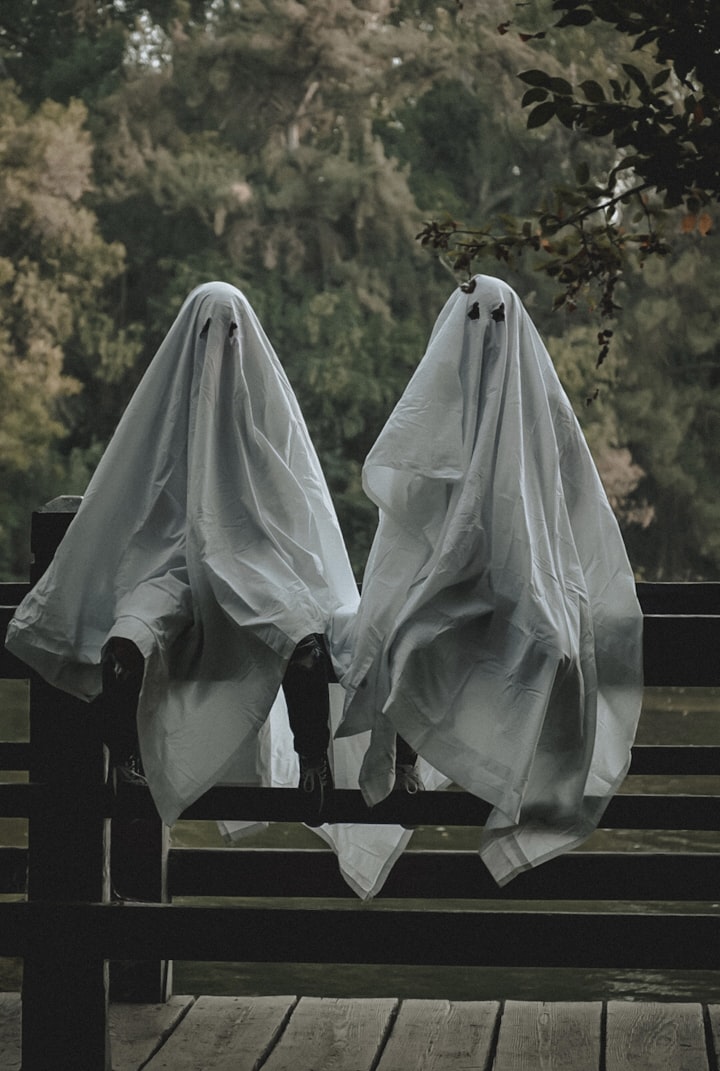
Halloween abounds with stories that raise the hair on the back of our necks, but how true are they? Are they all fiction, or is there just enough fact mixed in, duping us into believing these farfetched tales?
Here are three Halloween myths debunked, well, kind of anyway.
LSD Laced Temporary Tattoos
In this Halloween urban legend, it is believed that unscrupulous drug dealers dolled out LSD-laced temporary tattoos to kids instead of candy in the hopes of garnering new customers. This urban legend has been around since the 1970s.
Gaining New Customers
There are so many things are wrong with this legend. Where to start? Let’s address the first piece of silliness: getting new customers. LSD isn’t addictive, so it would make more sense to get new customers with something that would create repeat customers, like an addictive substance.
The Problem with Temporary Tattoos
Dispensing LSD in candy would be a great way of getting the drug into someone’s system. Temporary tattoos react when they get wet. Placing a liquid drug on them would render them useless. Not to mention that LSD can’t be absorbed through the skin. If you want to get high on LSD, you have to ingest it.
Real Fake News
The legend of LSD laced temporary tattoos began in the 1970s and then resurfaced in 2016 when the story appeared in Empire News, an actual fake news site. The article was written by Bob the Empire News Potato. The article claimed that police had discovered LSD tattoos at an elementary school which was a complete fabrication.
Halloween Prop or Corpse?
This Halloween urban legend has circulated far and wide for decades. A person dressed as a scarecrow or some other creepy Halloween favor is posed on the porch waiting to jump-scare unwitting trick-or-treaters. Then the living prop dies from a heart attack or other silent death and remains part of their spooky Halloween scene for days, sometimes weeks, before anyone notices. Except, it actually happened, once, sort of.
In 1976, the Six Million Dollar Man was shooting on location at the Pike Amusement Park in Long Beach, California. One of the crew was arranging the props in the funhouse for filming when the arm (or finger, depending on the source) of a wax figure came off in his hand. To his surprise, the “dummy’s” arm (or finger) contained real human bone. It turns out that the wax dummy was actually Elmer McCurdy, a hobo from Oklahoma who had died after a train robbery with several other men in 1911. The undertaker who received McCurdy’s body preserved him in arsenic. When no one claimed McCurdy, the undertaker decided to make back the time and money he’d put into getting the body ready for burial. He charged people a nickel to take a gander at “The Bandit Who Wouldn’t Give Up.”
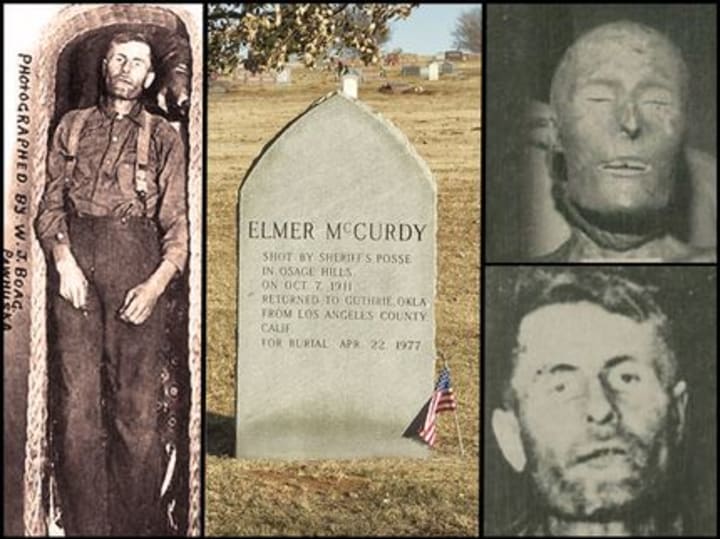
McCurdy’s mummified body would change hands several times and traveled the US as a sideshow attraction until he ended up in Long Beach. His arm (or finger) was accidentally severed from his body by an unsuspecting props guy.
Other Grizzly Discoverers
In 2005, a Delaware woman climbed a tree and hanged herself. Her body remained in the tree, visible to traffic, for several hours before someone identified her as a corpse and not a Halloween decoration.
Then in 2009, 75-year-old Southern California resident Mostafa Mahmoud Zayed lay slumped over on his third-floor balcony for days before police discovered the life-like dummy was actually Zayed, who had a single gunshot wound to the head.
In 2015, Ohio construction workers discovered the body of 31-year-old Rebecca Cade. Cade’s arms were tied to a fence, and the workers thought she was a Halloween prop. She died from blunt force trauma to her head and neck.
Halloween Pet Murders Myths
“Kill a Pit Bull Day”
In 2012, an email went viral that warned people of “Kill a Pit Bull Day.” The email urged people to keep their pit bulls inside because they may be hurt or even killed by lunatics who had pledged to kill any pit bull they came across on Halloween.
The truth
The viral message was a prank aimed at Slater, Missouri city council member Terry Jordan who had written a strict “Vicious Dog” Ordinance for Slater in which early drafts of the legislation singled out pit bulls.
Satanists Sacrifice Black Cats on Halloween
Another more persistent Halloween urban legend centers around Satanists and the sacrificing of black cats. While there is no proof that a single black cat has been harmed by a Satanist on Halloween or otherwise, many animal shelters refuse to adopt black cats in the weeks leading up to Halloween. The simple fact is that everyone should keep their pets indoors during Halloween because there is more traffic on suburban streets, raising the potential that your pet will be run over. Keeping your pets away from frequently opened front doors is also advised on Halloween. Pets can get frightened by all the ruckus and slip out opened doors and get hurt or lost.
Black Cats & Halloween
The connection between black cats and Halloween goes way back. Tales of sacrificing black cats during the Druid celebration of the Lord of the Dead date back 2,000 years. During the middle ages, there was the belief that witches could disguise themselves as black cats. Many people accused of witchcraft were burned alongside their feline companions.
Myths about black cats
- It’s bad luck to have a black cat cross your path.
- Don’t turn your back on a black cat because it will curse you.
- If a black cat gets in the bed of a sick person, it is an omen of death.
Fun fact, In Asia, black cats are considered a sign of good luck
Black Dog Syndrome
Obviously, an animal with black fur is no different than an animal of any other fur color. Black dog syndrome is when people pass up dark-furred animals for adoption over animals with lighter fur. Shelters find that adopting black-furred pets is hard year-round. Some theories as to why it’s harder to adopt dark-furred pets are:
- They don’t photograph well for fliers and the web
- People believe it’s hard to discern facial expressions of dark pets, making it harder to bond with them
- Negative associations with them from media and movies perpetuating superstitions around black animals.
If you are in the market for a new family pet, keep an open mind when checking out the black kitties, doggies, and bunnies. You might find an amazing companion you might have otherwise overlooked.
Most of what gets spread around at Halloween are fun ghost stories with a kernel of truth at their center. It's best to do your due diligence in debunking outlandish tales instead of blindly believing them. But then again, that Halloween dummy on your neighbor's porch might actually be your deceased neighbor.
Author's Note
I am an award-winning short story writer working on editing my first full-length novel. I am the former host of Demiworld, a dark podcast that examined the underbelly of society. I live in Portland, OR with my husband, son, and two cats.
If you enjoyed this article, please consider clicking the heart.
Similar Articles
Are you thinking of sighing up for Vocal+? Follow the link below to get a reduced price on your first month.
About the Creator
Cynthia Varady
Award-winning writer and creator of the Pandemonium Mystery series. Lover of fairy tales and mythology. Short stories; book chapters; true crime. She/Her.
Keep reading
More stories from Cynthia Varady and writers in Horror and other communities.
The Killer Upstairs and other Babysitting Urban Legends
Urban legends inform our social beliefs. They convey how to act in public and help align our moral compasses. For teens, the message is clear: stay close to home, cars are a gateway to death and destruction, and girls are always a target, even while babysitting. Here are a few babysitting urban legends retold and unpacked for their hidden meanings.
By Cynthia Varady4 years ago in Horror
How Bludworth Survived Death?
In Final Destination films, Bludworth (played by Tony Todd) was known to be the "Grim Reaper" and the Coroner of the film series. Bludworth has been an expert on Death giving advice on how to escape from Death that was until the Final Destination: Bloodlines, which would be Todd's final performance, Todd's character William John Bludworth (his full name) actually escaped Death decades ago at the Sky View where he was supposed to die along with his mother who was the singer of the band at the Skyview. During the until Iris who was in her 20s (played by Brec Bassinger) who had a Premonition that everyone is going to die on the Skyview, she stops the performance just to saving everyones lives including Bludworth. In the Final Destination: Bloodlines, Iris (played by Gabrielle Rose) now at old age, dying of cancer in hiding away from had two grown children who have their own children. One of their children, Stefani (played by Kaitlyn Santa Juana) had the same premonition met with Iris. Iris was living in a gated solitary home away from the outside world. Iris gives Stefani a book that shows who will die next and information on what happened after the SkyView to save their family before accepting Death's fate. After her death, Iris's son (played by Alex Zahara) dies next and Stefani's cousin (played by Anna Lore) which made Stefani get depth with Grandma Iris's book.
By Gladys W. Muturi4 days ago in Horror


Comments
There are no comments for this story
Be the first to respond and start the conversation.