
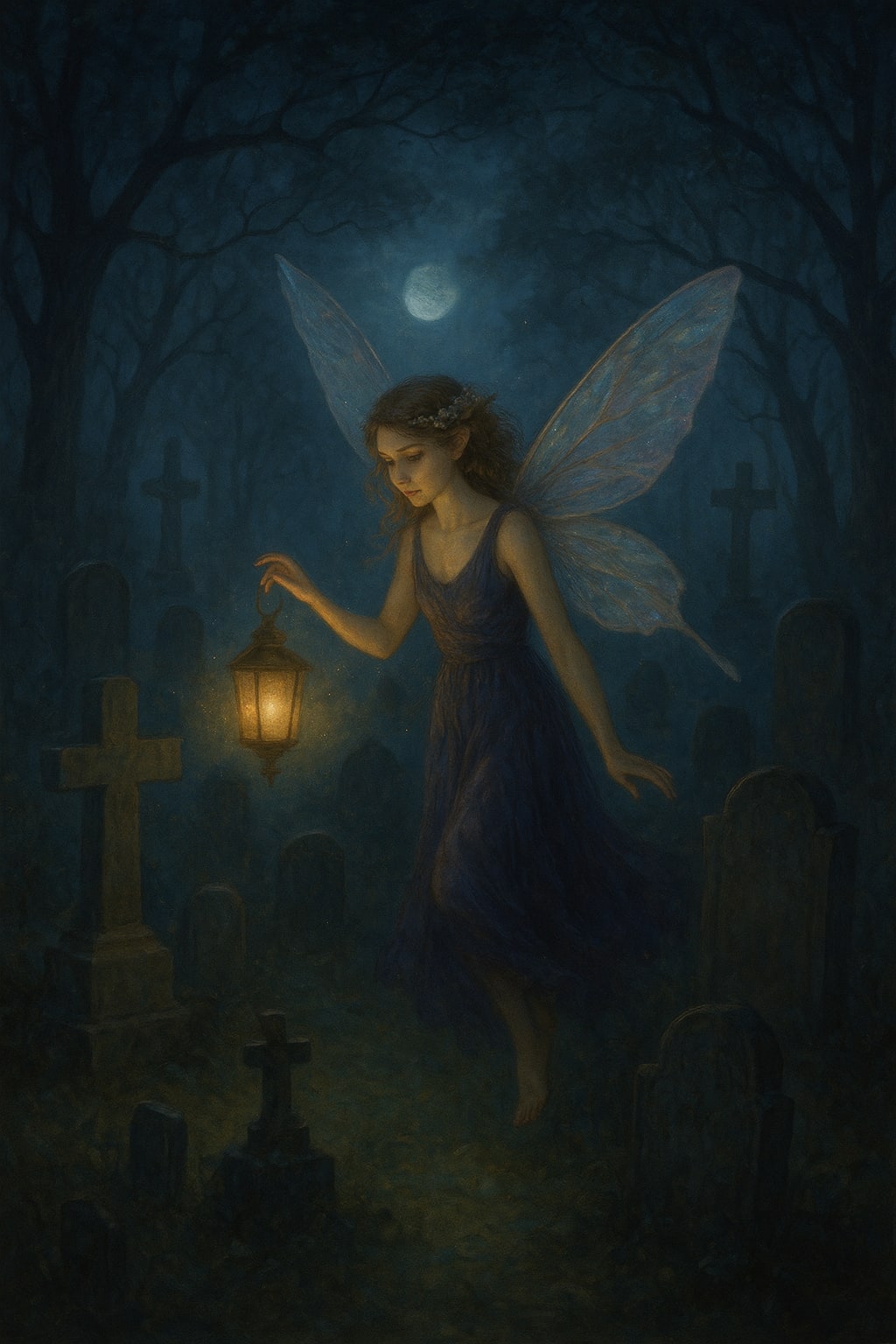
The graveyard was always quietest when the moon rose high, veiling the crooked stones in silver light. Most people avoided the cemetery at night—whispering superstitions of restless spirits, unblessed grounds, and shadows that were not their own. But for the two sisters, Elara and Miriam, the graveyard was more home than any house they had ever lived in.
Elara was the elder, her eyes dark as storm clouds, her presence commanding even in silence. She often carried roses with her, plucked from the tangled garden behind their cottage. Miriam, softer and pale, followed close behind her sister, never straying far, though her gaze always lingered on the forgotten graves with a kind of mournful wonder.
The villagers called them the “Graveyard Girls.” Some spat the title with suspicion, claiming the sisters consorted with ghosts. Others whispered it in awe, as if the girls knew secrets the living should never touch. The truth, however, was far stranger.
Elara and Miriam had grown up under the care of their grandmother, a woman who had lived on the edge of the cemetery for decades. She taught them the names of herbs, the language of flowers, and how to listen to the winds that carried the voices of the departed. “The dead are not gone,” their grandmother used to say. “They are only waiting for someone to remember them.”
When their grandmother died, she was buried among the roses she had once tended. On the night after her funeral, Elara and Miriam returned to her grave, unable to sleep. That was the first time they heard the whisper.
It was faint at first, a tremor in the air like a leaf brushing against a window. Miriam swore she imagined it. But Elara bent low and pressed her ear to the earth. What she heard chilled her, yet she did not flinch. Their grandmother’s voice murmured from beneath the soil: Do not fear the shadows, my girls. Fear only those who would silence them.
From then on, the graveyard became their sanctuary. Each night, they walked among the stones, listening. Some nights, they heard nothing at all. Other nights, the air shimmered with whispers—fragments of memory, echoes of lives that once were. A woman’s laughter cut short. A soldier’s prayer for home. A child’s unfinished lullaby. Elara gathered these voices as if weaving them into a tapestry, while Miriam spoke gently back, offering comfort in the language of the living.
But not all voices were kind.
One autumn evening, when the wind turned cold and the moon hid behind heavy clouds, the sisters strayed deeper into the graveyard than they ever had before. There, beneath an ancient yew tree whose roots twisted like claws, they found a grave so old the name on the stone had long worn away. No roses grew here, only brambles and thorn.
“Do you hear that?” Miriam whispered, clutching her sister’s sleeve.
Elara nodded. The voice was unlike the others—low, hungry, seeping into their bones. It did not plead for remembrance. It demanded release.
Free me… it rasped. Free me, and I will give you power beyond your years.
Miriam trembled. “Elara, we should go. This voice—there’s something wrong with it.”
But Elara lingered, her hand brushing the cold stone. For weeks, she had felt powerless—powerless against the village’s cruel stares, powerless to protect her sister from whispers of witchcraft. And now here was a promise, dark and dangerous though it was.
The voice coaxed her night after night. She began bringing roses to the nameless grave, laying them among the thorns. Miriam begged her to stop, sensing the change in her sister’s eyes. But Elara grew sharper, her voice heavier, as though the shadows had seeped inside her.
One stormy night, Miriam woke to find Elara missing. She ran to the graveyard, rain soaking her thin nightdress, lightning tearing the sky apart. There, under the yew tree, Elara stood with her hands pressed to the earth. The ground shuddered, as though something beneath was clawing its way upward.
“Elara, no!” Miriam cried, rushing forward. “This is not Grandmother’s wisdom—this is something else, something foul!”
But Elara’s face was pale and entranced. “He will give us power. No one will mock us again. No one will call us cursed.”
The soil split. From the grave rose a shape like smoke and bone, its eyes hollow, its mouth a jagged maw. The sisters recoiled as the figure twisted in the storm, reaching for Elara.
Miriam, desperate, remembered her grandmother’s words: Fear only those who would silence the shadows. She seized the bouquet of roses from Elara’s hands and scattered the petals over the grave. Their scent filled the storm, and the figure howled as if the very memory of life burned it. The ground groaned, then closed, swallowing the spirit back into darkness.
Elara collapsed, sobbing, as Miriam cradled her. The roses, drenched in rain, glowed faintly before fading into the mud.
From that night on, Elara no longer listened to the graveyard voices. Miriam alone carried the burden of their whispers, gentler and more careful than her sister had ever been. And though the village still called them the “Graveyard Girls,” the sisters knew the name now carried two truths—one of reverence, and one of warning.
The grave beneath the yew tree remained, silent and still. But sometimes, when the night was quietest and the moon hung low, Miriam thought she could hear a faint rustle beneath the soil. A promise unfulfilled. A secret still buried in the dark.
About the Creator
"Scream 7" (2026): Running out of Fresh Screams
This is the seventh time we’ve had a Ghostface crisis. Scream 7 is the latest edition of the Scream franchise. Sydney Prescott and her family are under attack by another anonymous killer dressed in a Ghostface costume. While having issues with her daughter, Tatum, they run from the bloody murders, trying to determine who is behind it all.
By Marielle Sabbag2 days ago in Horror
The Bridge That Whispers
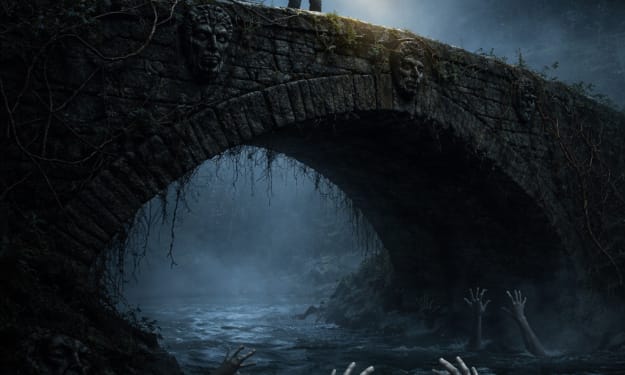
In bridge no one used anymore. It curved gently over a narrow river, its surface cracked and moss-covered, as if time itself had tried to bury it. Locals crossed the modern bridge downstream, leaving the old one to the fog, the wind, and the stories. Tourists were told the bridge was unsafe. Children were told it was haunted. Elena heard about it on her first night in Greyhaven. She had come from the city to catalog historical structures for a regional preservation project. Greyhaven was her last stop—quiet, remote, and perfect for work. The innkeeper, a thin man with pale eyes, hesitated when she mentioned the old bridge. “Don’t go there after sunset,” he said. “It talks.” Elena laughed politely. She had spent years documenting ruins, castles, and forgotten churches. Every village had a ghost story to protect a pile of stones. Still, she noticed how the innkeeper’s hand trembled when he handed her the room key. The next morning, Elena walked to the bridge with her camera and notebook. In daylight, it looked harmless—beautiful, even. Wildflowers grew between the stones, and the river below whispered softly. She took photographs, measured the arch, and noted the erosion. There were strange carvings on the sides: not words, but twisted symbols, worn almost smooth. That night, she dreamed of water. In her dream, she stood on the bridge in thick fog. The river beneath her was silent, black as ink. From the stones under her feet came a low sound, like breath passing through teeth. Come back. She woke suddenly, heart racing. Outside her window, the fog was rolling in from the hills. Elena told herself it was only a dream caused by fatigue. But the next night, it happened again. This time, the whisper was clearer. Come back to us. On the third day, she asked a woman in the village café about the bridge. The woman stopped stirring her coffee. “They drowned there,” she said quietly. “Long ago. When the river flooded, the bridge broke in the middle. A wedding party was crossing. Carriage, horses, music… all gone. People say the stones remember the weight of them.” Elena felt a chill run down her spine. “That’s just a story, right?” The woman looked up. “Stories begin somewhere.” That evening, driven by curiosity and something darker—something pulling at her—Elena returned to the bridge at dusk. Fog wrapped around the riverbanks like a living thing. The modern bridge lights glowed far away, safe and distant. She stepped onto the old stones. The air felt colder in the center of the bridge. Her breath became visible. Then she heard it: soft footsteps behind her. She turned. No one was there. The river below began to make a different sound—not water, but voices. Murmuring, layered and slow. Stay. Elena backed away, but her foot caught on a broken stone. She fell to her knees. The carvings along the bridge seemed deeper now, sharper. They formed shapes—faces, frozen in stone, mouths open in endless screams. Hands rose from the mist. They were pale, dripping, reaching for her ankles. Elena screamed and scrambled backward, tearing her coat on the rough stone. One cold hand brushed her skin, and in that moment, she saw it: a flash of the past. Horses panicking. A carriage tipping. People crying out as dark water swallowed them. And then silence. She ran. By the time she reached the inn, her legs were shaking so badly she could barely stand. The innkeeper saw her face and said nothing—only locked the door behind her. She left Greyhaven the next morning without finishing her work. Months later, her report mentioned “structural instability” and “severe erosion.” It said nothing about whispers or hands or memories trapped in stone. But sometimes, when Elena stands on bridges in other cities—busy ones filled with traffic and noise—she feels a vibration under her feet, like a distant echo. And in the sound of rushing water, she hears a familiar voice: Come back.
By Iazaz hussaina day ago in Horror
A Planetary Alignment will coincide with Mercury Retrograde
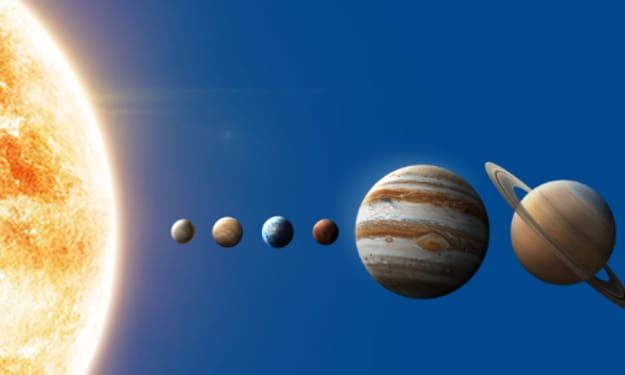
Double phenomena in the heavens Some people say in jest that the planets have aligned in their favor when life works the way they desire. Were you aware that there are seasons when things do line up in the heavens? There will be a planetary alignment AKA a planet parade, on February 28, 2026.
By Cheryl E Preston6 days ago in FYI


Comments
There are no comments for this story
Be the first to respond and start the conversation.