
For Your Mind, Body, and Soul
Villainy is a Matter of Perspective

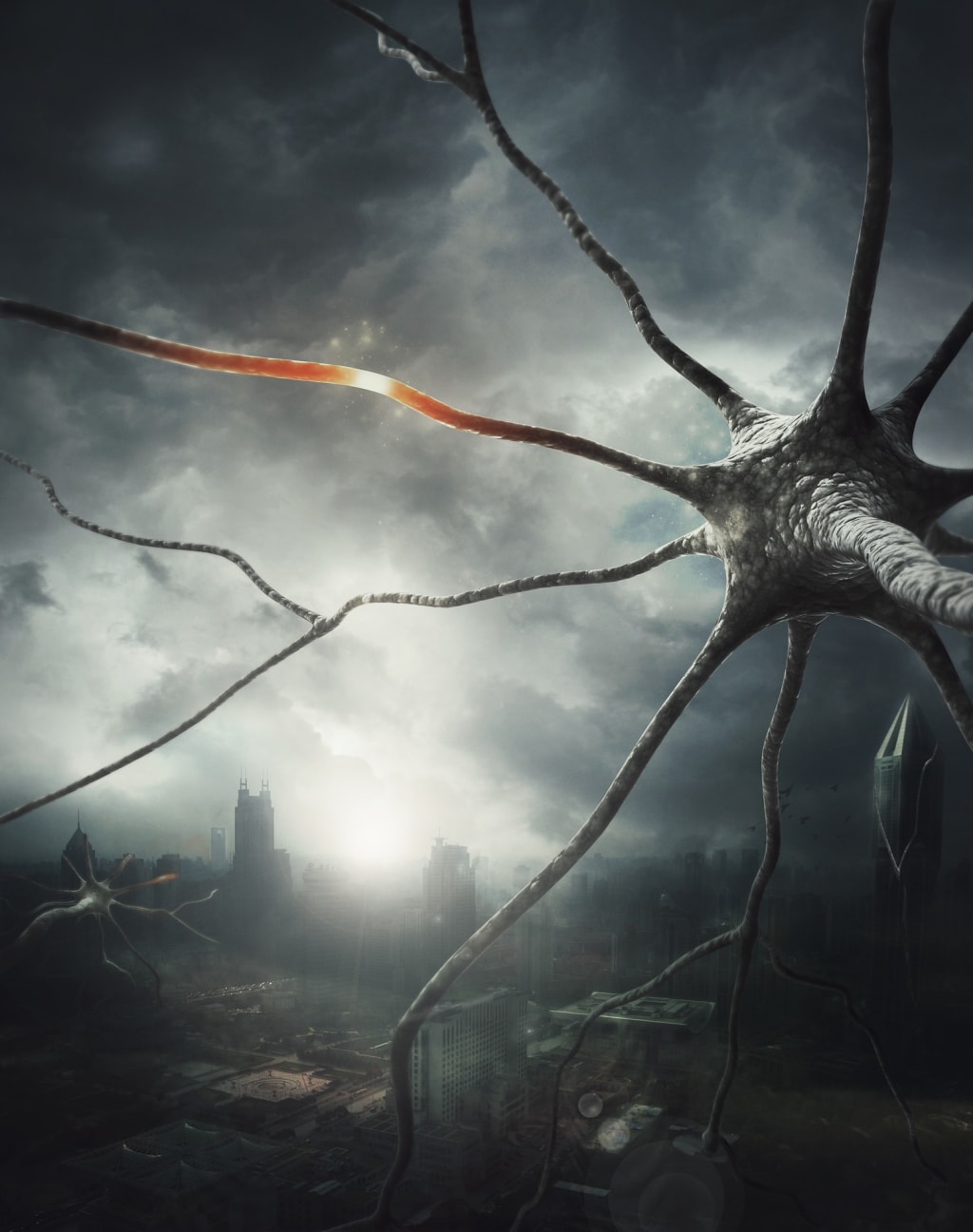
Was she smart like Father? Was she sweet like Mother? Or was she funny like Grandmother? What dreams filled her head before the alien Foreigner War between humans and neuralites? Finding her starving, dehydrated, and unconscious, I never had the pleasure of exploring the wonders of her personality before ending her misery. Now I wear her tattered, grungy white dress and her heart-shaped locket around my neck. She was younger than me, but her size and gender suited my needs. The tarnished outside of the golden heart trinket displays an engraved name. Inside bares a portrait of the girl, aged approximately four or five, a few years junior from the age in which I found her. She looks happy in the photo as she’s embraced by a loved one, presumably her mother.
“Claire, help me with the cart.”
“Yes, Father.”
The wheels of the rusty metal shopping cart get stuck in the mud with frustrating frequency. Weighed down by Grandmother and our few material possessions, Father, as strong as his body may be, is not always able to maneuver the cart over the dilapidated roads without assistance from me or Mother.
“How are you holding up, Mom?” Mother whispers into the messy pile of clothes and blankets.
“Hungry, dear…and weak,” a hushed, raspy voice replies.
“I know, Mom. We’ll find someone soon. I promise.”
Grandmother’s condition fills me with dread. Unable to handle the harsh environment, she remains shrouded from the world. The radiation in the air burns her feeble skin. The ash perpetually falling from the dark gray clouds chokes her aged lungs. Her mound of fabrics in the cart, which she has endearingly named “Cloth Castle”, helps to not only preserve her health, but also to avoid curious eyes of passersby. She wants to help us on our perilous journey but is helpless to do so.
Though the bombs have stopped falling, the war with the foreigners endures as they cling to survival. As do we. Most plants have succumbed to the darkness caused by nuclear winter, taking most animals with them into the dying Earth. I haven’t seen a living animal in months except for the crows feasting on rare, precious flesh of foreigners. It seems like only yesterday that I first heard the sound of birds chirping near my window and the warm glow of the sun on my face. Tragically though, my memories of that pleasant life are short. For the foreigners’ unprompted aggression toward our species decimated us along with our aspirations for a peaceful co-existence. But, we persisted, as we always have. Why did you have to attack us? I ponder. We wished to share this world with you. I suppose it’s naive to assume the foreigners would seek peace, even if their resources were bountiful and exceeded our own. Someday, I hope to mend this divide between our species, finding a peaceful solution. I’ve yet to realize a means, but I maintain hope…for myself, for my family, and for this world. In the meantime, we must hunt them, or be hunted by them.
Keenly eyeing the desolate landscape for any sign of vegetation or foreigners, Mother leads the front of the cart through the street of what was likely once a quaint village. We pass someone standing in a former storefront doorway who eyes us closely and we him. He’s one of us. Like Grandmother, his body is failing him. You can see it in their eyes when their time is running out. Father nods, indicating our mutual understanding to keep our distance. We never eat our own.
Inside a decrepit structure at the end of the road, we hear someone ransacking it, searching for food I assume. Father pushes the cart off the path behind a burnt car, motions for me to lie low, then follows Mother to the building. After several minutes of terrifying silence, I hear a series of loud crashes and wails. I peer over the car toward them, anxiously waiting for signs of movement. Mother walks into view, signaling to me that everything is okay. I exhale and start pushing the cart back onto the road.
That evening, as we set our plates and Mother prepares to feed Grandmother, we pause to bow our heads. Father gently grips the hands of me and Mother, stares at the fire cooking our meal, and mutters our simple prayer for the dead.
“For your troubled mind, I am sorry. For your body, I give thanks. And for your soul, I pray for peace.”
Mother removes the clothing and blankets from on top of Grandmother’s body. She looks sick and frail, her skin pale and translucent. Her body is deteriorating, her eyes giving her away, but at least she can still eat. Mother speaks softly while feeding Grandmother, “I’m sorry, Mom. This one was an old, male foreigner, but at least we have some food.” After our long-awaited meal, we lie our heads down to sleep within the relatively safe confines of the structure’s walls.
“This building was once an educational institution. Did you know that, Claire?” Father says.
“This place? No, I didn’t know.”
“I suppose you wouldn’t, given that we’ve always been your teachers and you had yet to start school among the foreigners when the war started. When I was growing up, we had schools. They didn’t look like this, of course, but they served the same purpose. A teacher would instruct in the front there and students would fill these desks.”
“Why were all the kids taught in one place? Why didn’t their parents teach them what they needed to know?”
“Well, back then, people sought efficiency. It was more efficient and sometimes more effective to have all the kids taught by one person, so they would gather here to learn to be better people.”
“A lot of good that did them. They didn’t even know how to share properly,” I say sarcastically. Father laughs then falls silent.
“Why were the foreigners so cruel, rejecting us after only months of being together?” I ask.
“Villainy is a matter of perspective, sweetie. To them, we are the cruel foreigners. Our longer lifespan and superior strength are threats to them. Like us, they simply fear that which they do not understand.”
Three days’ time goes by and we’ve yet to see another living creature. It’s not surprising though. After all, we are venturing away from urban zones as we seek refuge in increasingly rural areas. Father says we need to find an unoccupied home that’s still standing for us to re-establish our lives. And if we’re to live there long-term, we’ll need to find a steady supply of foreigners for us to share with that won’t harm us. A practically impossible task. While winding our way down a dirt road, we see a white church-like structure on a hill in the distance. As we approach the building, which appears to be in very respectable shape, a middle-aged woman with a shot gun steps through the front door. Father swiftly pushes my head down so I’m out of sight and completely behind him and the cart.
“We don’t want any trouble here,” the woman says assertively pointing her shotgun at Father.
“Neither do we,” Mother replies. “We’re just looking for food.”
I peak around Father’s leg and spot several young children looking out the front windows of the building.
“We don’t have any food for strangers. Now, please leave.”
I stand up from behind Father and the cart. The woman swiftly aims the shot gun at me.
“Please ma’am, it would mean so much to have just a little food. My tummy hurts,” I say while clutching my belly, trying to act the age of my appearance. As I do this, I realize I’m only half feigning my condition.
The woman stares me in the eyes for a few seconds, clearly pondering what she should do. She lowers the shotgun and says, “Okay, but you all stay outside right where you are. I’ll get you some food.” She steps back through the door as she instructs the children to sit down and move away from the windows, a command they only briefly follow.
Mother and Father stand patiently, quietly whispering between themselves. Unable to hear them clearly, while sitting on the ground a few yards away, I turn my attention to the other sights and sounds. Children keep gazing out the window. Clearly, it’s been a while since they’ve seen outsiders. The grass here is green. Not very healthy, but greener than most everywhere else. The air and ground are cleaner too. The ash must wash away in the rain due to the sloped landscape. And the elevation probably means less radiation up here, as it has settled in lower lying areas. This would be a fine place to set up our homestead.
“Mother, we’re not going to eat the lady, are we?”
“Not if she feeds us and gives us one of the female young ones for Grandmother,” Mother replies.
“I think I have a better idea. The land here looks to be good for growing crops for those children who can be our future. They’ll need a caretaker and teacher they trust, like that lady. We can build a school for them…for efficiency,” I say as I look to Father.
The woman brings out three bowls of hot soup. “Leftover vegetable soup is all I have to spare right now.”
Mother and Father, contemplating my proposal for a moment, look at each other. Father gives me a gentle nod.
“It’s delicious. Thank you so much, Miss….” Mother gave a long pause.
“Gracey.”
“Thank you, Miss Gracey,” Mother reiterates. “Are all those your children?”
“Oh heavens, no. This is an orphanage. I’m watching over these children whose parents were killed by the invaders.” Miss Gracey looks down as if in shame. “I apologize for my behavior earlier. We don’t get many visitors here and I was afraid you may have been some of – them.”
I finish slurping down the last of my soup. “Thank you, Ma’am. It was delicious.” I notice one of the kids peaking from around the back of the building. “What’s her name?”
Miss Grace turns around and sees the girl who sheepishly shifts out of sight. “That’s Sarah. You can go play with her if you wish.” I quickly rise and run to Sarah.
The other kids follow me and Sarah to the pond at the base of the hill behind the orphanage. Sarah is as inquisitive about me as I am about her. For hours we play as we trade stories, then sit on the end of the pier. I glance up at the orphanage and, through the windows, see the faint outline of neuralite tentacles securing a new host for body sharing.
“We’re going to live here with you…forever.”
“What if Miss Gracey won’t let you stay with us?” Sarah replies.
Miss Gracey yells down to us from the orphanage, “Claire, can you help me clean up Cloth Castle? I won’t be needing it anymore.”
“I’ll be there in minute…Miss Gracey!” Even from a distance I can see the weakness has left Grandmother’s eyes.
I smile and look at Sarah. Then I open up my locket and see the familiar face. I tell Sarah, “We’re going to turn this orphanage into a schoolhouse. And soon, a whole community. A place with a never-ending supply of fresh faces.” I look out over the water, pleased with my plan. “We can share like our parents should have done from the beginning. I’ll get to know you and all your future offspring and theirs and theirs. It’s going to be wonderful!” I close the locket and see that same face looking back at me from the still pond water. I slowly rub my thumb over the word Claire engraved into the gold while reciting the prayer, “For your troubled mind, I am sorry. For your body, I give thanks. For your soul, I pray for peace.”
About the Creator
NICHOLAS E BROWN
I'm a frequent reader but newbie, aspiring writer. I love reading all types of genres from both fiction and non-fiction, but my favorites for writing are undoubtedly high fantasy and science fiction.
Keep reading
More stories from NICHOLAS E BROWN and writers in Horror and other communities.
House No 450
On the night of the feast, we three sisters stayed up late talking. It must have been around two in the morning. We thought we could hear the sound of conversation coming from the TV lounge outside. Who could it be at that moment? As soon as we opened the door to the room while we were talking and came out,...
By Sudais Zakwan6 days ago in Horror
Wild Card Weekend Recap: What Happens Now?
I think I figured out why I love Wild Card Weekend so much. It's because it's the first playoff anything of the calendar year. The NFL season starts in the fall, and once upon a time, the champion was crowned either on or slightly before New Year's. The evolution of the NFL schedule has resulted in the playoffs starting just into the New Year, and currently, the final week of the season falls on the first weekend of the New Year, with Wild Card Weekend coming a week after that. So yes, chronologically, the NFL's Wild Card Weekend serves as the first playoff anything of the calendar year.
By Clyde E. Dawkins6 days ago in Unbalanced



Comments
There are no comments for this story
Be the first to respond and start the conversation.