
Fated
Sometimes the things that haunt us most are the things we already know...

Harrison raised a skeptical eyebrow. “Can you run that by me one more time?”
Zane Parsons, Harrison’s late mother’s attorney, grunted in acquiescence. He was a man of few words, it seemed. “Certainly, Mr. Jackman. Your late mother left you two things upon her passing. The first was the amount of twenty-thousand dol—”
“I didn’t even know she had any money,” Harrison interrupted. “And this isn’t from some kind of life insurance policy she had or something along those lines? It’s just… my mother lived practically in poverty for the past thirty years. She sank everything she had into making sure I went to school and got a good education. How could she have managed to save that much money?”
“That,” Mr. Parsons said slowly. “I can’t answer. I’m not privy to any financial information outside of the value of your mother’s estate and what she left behind. But she did leave you the money along with her journal.”
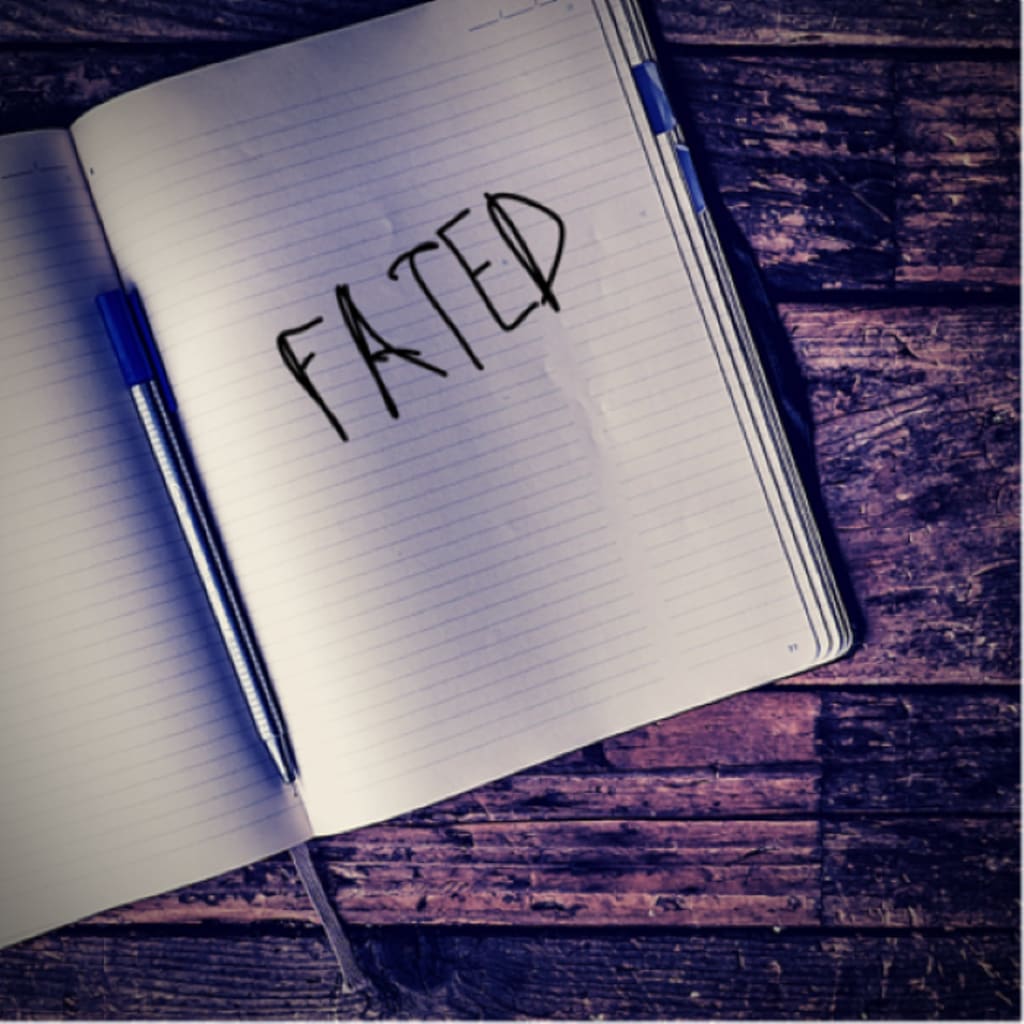
Harrison watched as the attorney pulled out two manila envelopes from his open briefcase. The smaller one was obviously the money. Interestingly, twenty thousand dollars didn’t so much as make the envelope bulge. The larger one appeared to be the second item Mr. Parsons had just mentioned, the journal. Harrison hadn’t even known his mother had kept a journal. But it would be interesting to read. Perhaps it would answer his previous question of how and why she had saved twenty thousand dollars. Or maybe it held the answers to other questions, such as why she had remained single nearly her whole life. Despite the family relationship, Harrison hadn’t known his mother as well as he should have. Her past, she had rarely spoken of, and she never ever spoke of the future. Maybe this would unveil the mystery behind his mother’s seemingly secretive nature.
“Before I can pass these on to you, I’ll need your signature on a few documents,” Mr. Parsons said, continuing to pull out additional items from his briefcase. Harrison watched as the two manila envelopes were set to the side and several papers with varying lengths of writing and checked boxes were set in front of him. “I’ll need you to initial here,” Mr. Parsons said, indicating with his pen. “Here. Here. And sign here.”
“What are these for?” Harrison asked.
“Just acknowledgments and acceptance of your late mother’s possessions and estate. After you sign, everything will be transferred over into your name.”
“Is there anything else besides the money and journal?” Harrison doubted that his mother had left anything else behind. She had lived in an apartment, a dingy old rundown place that had a permanent smell that he could only describe as stale. She hadn’t even owned a car.
“Just her personal possessions in her home,” Mr. Parsons answered. “As you probably know, your mother didn’t have much.”
Harrison nodded his head in acknowledgment. “Very true. Is there anything specific I need to know about before I sign anything? I mean, outside of what you just said. I’m assuming you summarized when you said they were just documents of my acceptance of my mother’s things.”
“Nothing else, Mr. Jackman.”
Harrison pulled the first paper close and signed it, not bothering to read the half-dozen paragraphs above the signature line at the bottom of the page. The two other papers quickly followed suit. Signed. Initialed. Done.
He pushed the papers back. “Is that everything?”
“Not quite.”
For the second time, Harrison arched an eyebrow. This time, however, it was in surprise. He had been under the impression that his business with the attorney would conclude with the signatures. Although that hadn’t been explicitly stated, he had assumed there wouldn’t be any further transactions outside of what had already been said.
“Now that you’ve signed, I am supposed to give you this,” Mr. Parsons pulled out another envelope, the simple white kind normally used for letters. “I was told that you must read this after you’ve accepted your mother’s possessions but before you’ve had a chance to look through them.” His words slowed as he spoke them, enunciating each one to emphasize their importance. “The instructions were explicit. Read this first.”
The envelope slid slowly across the desk, pushed by a single finger until it came to rest in front of Harrison. He reached for it. Tentatively. For some reason, he felt a vibe, a sense of anticipation or something. Maybe it had been the seriousness in Mr. Parsons’s voice when he had given the instructions concerning the final envelope. What the sentiment was, he wasn’t sure, but he was hesitant as he reached for the last item of his mother’s will.
His hand came to a rest on top of the sealed folded paper. He gave it a cautious tug. It didn’t move. Mr. Parsons’s finger pinned the envelope firmly to the mahogany desktop.
“Do you understand?” the attorney asked.
“Read this first. Got it.”
The finger lifted.
The attorney—who had leaned forward as he had spoken—leaned back into his oversized leather chair. “I won’t reiterate the number of times your mother told me to make sure you knew you needed to read the letter first. I’ll just emphasize it for you instead.”
“Have you read it?” Harrison asked. The letter was important, that much was obvious. But could someone convey that sense of importance without knowing its contents simply based on the emphasis someone else put on it? Of that, he wasn’t certain.
“No, no. Nor have I read the journal. I’m just here doing what was requested of me.”
“Fair enough.” Harrison paused for a second. “Is there anything else?”
“No, that is everything, Mr. Jackman. The letter was the final item, and we have completed all the necessary paperwork. Our business here is concluded.”
The meeting ended with a handshake and the customary well wishes. Within a few minutes, Harrison was out the door of the office building, the envelopes secured in the inner pocket of his jacket. Unfortunately, his business with his mother’s other belongings hadn’t yet been finished, and he still had some sorting and packing to do in her old stale apartment.
He pulled out his phone, ordered an Uber, and sent a text to his fiancée. His intention was to head to his mother’s apartment and finalize the remaining portion of work involving his mother’s possessions. Soon, all of this would be over.
Thirty minutes later, Harrison arrived at his mother’s apartment. He dreaded entering, not just for the unsanitary situation inside, but for the other reasons that he was there. He hesitated at the door, pausing with the key inserted but not yet turned to the unlocked position.
“Hey,” a familiar voice said behind him. Kennedy Griffin, his fiancée, stepped from the open door of another vehicle.
“I didn’t expect you to come until later,” Harrison said.
She gave a small shrug. “I didn’t have anything better to do. How’d it go?”
“I’ll tell you about it when we get inside.” He turned the key. The door opened.
Once inside, Harrison pulled the envelopes from his jacket pocket and tossed them onto an age-darkened round table. The ambiance in the room could only be described as dim. Perhaps it was the age of the building, the confined narrow type only found in old cities like New York or Chicago. Maybe it was the lack of light from only having windows in the front. Whatever it was, it was permanent. And almost palpable.
“So, it went… well?” Kennedy asked, moving over to the table. Harrison peeled off his jacket and tossed it onto a high-back chair.
“I have an inheritance,” he answered. “I didn’t know about it, but my mother managed to save twenty thousand dollars. Crazy, right?”
“Really? Wow. She must have sacrificed a lot to save it.”
“That’s what I thought.” Harrison moved over to one of the half dozen cardboard boxes that had been carelessly stacked against the wall. “And she kept a journal. I didn’t know she did that either.”
“That’s interesting. I wonder what she wrote about. She didn’t seem like the type that had many events to write about. I mean,” she paused as if looking for the right words. Harrison understood.
“I know. She rarely left, had no hobbies, and kept mostly to herself. I’ll be the first to admit she was strange.” He pulled one of the boxes from the stack, ready to sort through the things that would end up being either trash or keepsakes.
“I didn’t mean it like that,” Kennedy said. “It’s just… Well—”
“Damnit!” Harrison swore as the bottom of the box fell out, dumping its contents on the floor at his feet.
“I’ll grab a new box,” Kennedy said.
“No, no, I got it. I’ll just go through it here on the floor. Thanks, though.” Harrison began picking through old books and pictures. Random items such as trophies and old coins littered the ground in a haphazard fashion. Most were things that hadn’t seen the light of day in decades. Had they meant something to his mother? Or had they just been forgotten as they became some part of her past that was no longer relevant to her present or future?
“Harry?” Kennedy said. The question in her tone and the use of the shortened version of his name made him pause.
“Yes?”
“What’s today’s date?”
He should have known it immediately from when he signed and dated those documents. But oddly, it slipped his mind. Harrison pulled out his phone. “The twenty-second. Why?”
“Hmm… that’s odd. Why does your mother’s journal start on the twenty-third? It says right here, the twenty-third of October. Of… of this year.”
“What?” Harrison’s mind seemed to suffer a glitch as he tried to comprehend the question. That… that didn’t make any sense.
The instructions were explicit. Read this first.
He suppressed the momentary surge of alarm that coursed through him. It was nothing. Just an oddity. The letter was likely just an explanation of the journal. Why would it be anything else? But within him, the fear had awakened, the irrational, uncontrollable type first felt as a child imagining unknown terrors in the darkness.
“Let me see that,” he said, standing. He reached for the journal.
“Wait,” Kennedy said, holding out an arm to block him. “This is… my journal? That can’t be. But… that is my handwriting. And I signed it at the bottom…”
The fear took hold, hitting him hard enough to make him suddenly nauseous. “Kennedy!” Harrison yelled. “Give me the journal!”
He moved to grab it again, and she dodged away from him, flipping through the pages as fast as she could.
“All the dates are… in the future… oh… oh my…” Kennedy stopped, and Harrison saw her eyes grow wide in horror. A hand shot to her mouth, but it was too late to suppress the shriek before it escaped. She stumbled for a second before catching herself against the wall. She slid down, curling into a ball, sobbing uncontrollably. The journal lay open where she had dropped it. The black moleskin cover was opened to the last page. He saw the date.
Harrison rushed to the table and snatched up the letter and tore it open. He yanked the paper out and read it.
In his mother’s handwriting it said, DON’T OPEN THE JOURNAL.
About the Creator
Keep reading
More stories from writers in Horror and other communities.
Killing him slowly
There’s an intruder in my house again. He stumbles through the door, wet carrier bags in hand. He’s bought me offerings. I show my appreciation, letting him caress my beautiful body. He wants to touch me. I rub myself against his legs. He sighs, dropping the bags. He can’t resist touching me. Running his hand slowly down my spine, I arch my back towards his caress, let out a low purr. It’s what we both need.
By N J Delmasa day ago in Horror
The Door Opened By Itself
The Night That Refused to Stay Quiet It happened on a night so ordinary it almost felt staged—rain tapping gently against the windows, the clock blinking 2:17 a.m., the world outside holding its breath. I was half-asleep, drifting between thoughts, when the silence changed. Not broke—changed. Silence has weight when it’s about to give way to something else.
By LUNA EDITH4 days ago in Horror



Comments
There are no comments for this story
Be the first to respond and start the conversation.