
Falling Angel
An Essay on "Angel Heart" (1987), a Film by Alan Parker.

Note: this review may contain spoilers.
"No one will mourn one less lawyer in the world. There's death everywhere these days. But what gives human life its worth anyway? Because someone loves it or hates it? The flesh is weak, Johnnie. Only the soul is immortal. AND YOURS BELONGS TO ME." Angel Heart (1987)
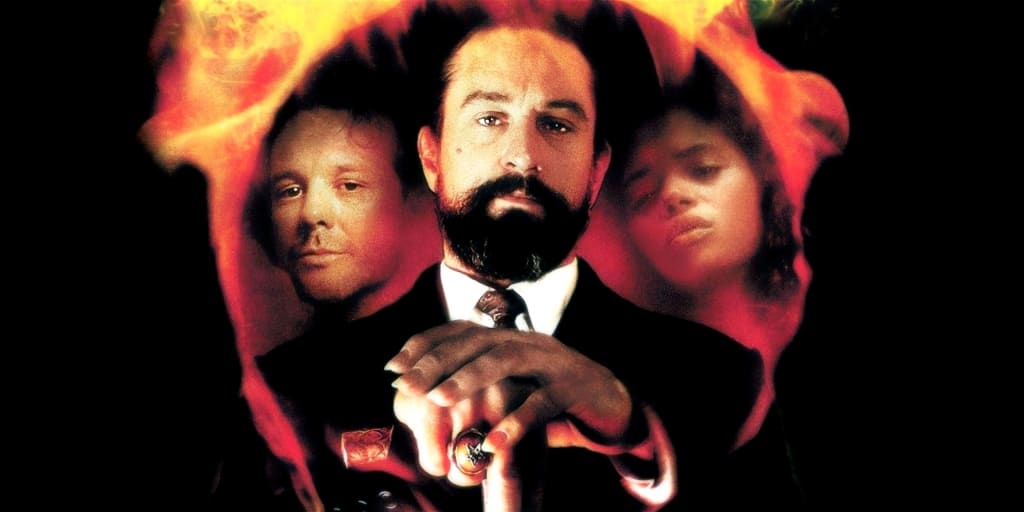
Angel Heart is undoubtedly one of the greatest films of the last almost forty years--one of the greatest of the unsung. It moves inexorably from its central mystery, its film noir opener in which the classic tropes of seedy, low-rent private dick ("Harry Angel" played by Mickey Rourke) and sophisticated, menacing employer are introduced to us amid a grey, Brooklyn background of rainy streets, dripping alleys, and cracked, bleeding pavement. We immediately like "Harold Angel," (the name is of course a play on the term "herald angel"), noting the tough-as-nails persona borrowed from Chandler and Hammett. His employer, played by Robert DeNiro, is the suave, mysterious, bearded "Louis Cypher" (a play on the word "cipher," as in, a "mysterious code"), who enjoins him to seek out a possibly dead "crooner" or singer by the name of "Johnny Favorite." So begins the spiraling circle downward for Angel, for the film's plot as it unwinds, moving as inexorably as the blades of the ubiquitous, window-mounted fans that recur, as a central leitmotif image, throughout the entire film. (Similarly, dancing feet clad in ornate tap shoes, and a veiled "woman in black" that seems to be waiting in the wings, are also employed.)
Angel questions a weird litany of former bandmates, as well as the Coney Island grotesques that worked with Favorite's old flame, Margaret (Charlotte Rampling), or "Madame Zora," a palm reader now working casting horoscopes. He goes to see her; she wears a nice little Satanic pentagram necklace. She ends up dead.
By this point, Angel is in New Orleans, and Margaret is mutilated in such a manner as to suggest Jack the Ripper has time-traveled to 1955 and is now stalking the French Quarter. A former bandmate, a jazz guitarist, Toots (Brownie McGhee), is similarly killed. Already, Angel has had one informant, a drug-addled doctor named Fowler, (Michael Higgins) who presided over the transfer of the wounded Favorite (who was drafted at the height of his career but ended up in a mental institution due to shellshock) ALSO end up dead, with Angel at the scene.
Margaret's father (Stocker Fontelieu), who, along with Margret, retrieved the amnesiac Favorite from the mental home using the name "Edward Kelly" (the name of medieval sorcerer John Dee's rogue accomplice), ends up taking a swim in his gumbo. Angel becomes more dirty and disheveled and ends up spying on Epiphany Proudfoot (Lisa Bonet), the beautiful jailbait daughter of Favorite's half-black paramour, who was a voodoo mambo.
The outcome, the shocking finale in which the mystery beneath the murk that threatens to keep bubbling, like a boiling cajun stew, to the surface of the film, finally is revealed in the breaking of an alabaster vase. De Niro, a perfectly suave, cool, calculated, yet somehow still mythological Devil, is there for the final, most eloquent confrontation. Harry Angel is not who he appeared to be, not who we thought him to be. But are any of us?
The Turning of the Wheel
The most ubiquitous images of Angel Heart, beyond the occult and voodoo imagery, the bloody murder, and the back-alley aesthetics of Brooklyn and the decayed ambiance of New Orleans, are the turning, clockwork fans, the tapping feet, the elevator headed forever down, and the hooded, revealed mysteriously as sexless or transsexual beings who are the "liers in wait" for the inevitable damning conclusion, the "clearing of accounts" as it were (Cyphre having previously stated that he hates "messy accounts"). Harold Angel has been drawn into the spider's web of his destructive demise, the cold, loveless clutch of his damnation, the elevator to Hell forever taking him downward, wherein his metaphysical incest with Epiphany, his betrayal of his "contract," and his bloodthirsty, rapacious violence can all be forever, eternally punished, by the same "Divine Wind," the metaphysical force of cosmic Justice that moves the blades of the fan, that inspires the toe-tapping feet, animates them. "You're gonna burn for this Angel," the obese New Orleans detective tells Harry at the end of the picture. "I know," he says. "In Hell."
It's the final summation of a very dark and troubling journey, one that slips over the viewer before he or she realizes what has even happened. Harry Angel looks in the mirror and realizes what he sees there is not, in any sense, what he believed it to be.
And, if we're honest with ourselves, neither is our reflection in any sense, "real."
But it may be true.
Written and directed by Alan Parker. Based on the novel Falling Angel by William Hjortsberg.
ANGEL HEART | 4K Restoration | Official Trailer | Starring Robert De Niro & Mickey Rourke
Connect with me on Facebook
About the Creator
Tom Baker
Author of Haunted Indianapolis, Indiana Ghost Folklore, Midwest Maniacs, Midwest UFOs and Beyond, Scary Urban Legends, 50 Famous Fables and Folk Tales, and Notorious Crimes of the Upper Midwest.: http://tombakerbooks.weebly.com
The Character Who Isn’t on Payroll
Posted to r/nosleep I work at Disneyland. I won’t say my department, but I’m close enough to characters that I see schedules, handoffs, rotations—the boring, logistical side of “magic.” Which is why this has been driving me insane.
By V-Ink Stories3 days ago in Horror

Comments (1)
Nice one