
Even More Facts That Will Melt Your Brain (Part 2)
From diamond planets to cube-shaped poop, reality is still weirder than your schoolbooks ever told you


10 More MIND-BLOWING Facts You Weren’t Taught in School (Part 2)If Part 1 left you scratching your head in amazement, get ready to take that brain-scratching to a whole new level. Our world—and the universe it floats in—is packed with bizarre truths, hidden gems of knowledge, and scientific oddities so strange they feel like fiction. Yet they’re all real. Let’s dive into another set of weird and wonderful facts they definitely didn’t cover in class.
1. Sharks Are Older Than Trees Yes, you read that right. Sharks have been cruising through Earth’s oceans for over 400 million years, while the first trees appeared about 350 million years ago. That means sharks were already ancient when forests first began to grow. Talk about seniority! They're the true elders of the animal kingdom.
Some sharks alive today, like the Greenland shark, can live for centuries—up to 400 years. Imagine swimming through icy waters in the Arctic, living longer than most human civilizations! Sharks are not just survivors; they are biological marvels with immune systems that rarely develop cancer and senses so sharp they can detect a single drop of blood in an Olympic-sized pool.
2. Wombats Poop Cubes Nature has its oddities, but this one wins in the weird-but-true category. Wombats, the adorable Australian marsupials, produce cube-shaped poop. Why? The shape helps prevent it from rolling away, which is important because wombats use their droppings to mark territory. Scientists believe their intestines are uniquely structured to create this unusual geometry. Evolution, you funky beast.
What’s even more fascinating is that researchers have studied wombat intestines to create better industrial cube-making processes. Yup, wombat poop might one day influence how your next machine parts are manufactured. Never underestimate the power of poop.
3. There’s a Planet Made of Diamond Somewhere about 40 light-years away in the constellation Cancer floats a planet called 55 Can cri e. This exoplanet is believed to have a carbon-rich core, and due to the intense pressure and heat, scientists think it might be one-third pure diamond. It's literally a blinged-out space rock. Just don’t expect to bring any of it home—it’s way too hot (over 3,900°F) and moving at breakneck speed.
Its glistening carbon structure has sparked the nickname "Super Earth," but this planet is anything but habitable. It completes an orbit around its star in just 18 hours. That’s less than a full Earth day! Diamond-studded and terrifying—space never fails to deliver on the weird scale.
4. A Teaspoon of a Neutron Star Would Weigh 6 Billion Tons Neutron stars are what’s left behind after a massive star explodes. They’re so dense that just a teaspoon of neutron star material would weigh around 6 billion tons—that’s more than all the humans on Earth combined. It’s the ultimate cosmic paperweight. Just… don’t drop it.
To put it in perspective, neutron stars pack the mass of our sun into a sphere the size of a city. Their gravity is so strong it warps time and space. If you fell onto a neutron star (don’t), you’d be stretched thinner than spaghetti by its gravity. It’s the universe’s way of saying: don’t mess with physics.
5. Your Stomach Replaces Itself Every Few Days Your stomach is a self-renewing wonder. It produces powerful acids that can digest food—and your own tissue. To protect itself, the stomach’s lining regenerates every 3 to 4 days. If it didn’t, your stomach would start eating itself. It’s like having an automatic repair system built right in.
Fun fact: stomach acid is strong enough to dissolve metal. Thankfully, your body is smarter than your breakfast burrito. The mucus lining and speedy cell regeneration work like a high-tech shield to keep everything in balance.
6. Sloths Can Hold Their Breath Longer Than Dolphins Sloths may be slow on land, but when it comes to holding their breath, they’re secretly impressive. Sloths can hold their breath for up to 40 minutes, while dolphins typically come up for air every 10 to 15 minutes. Sloths achieve this by slowing their heart rates dramatically. They’re the chill champions of the animal kingdom.
Their slow metabolism also means they only poop about once a week—and when they do, they climb down from the trees to do it, which is risky. But apparently, sloths take their bathroom breaks seriously.
7. The Coldest Place in the Universe Isn’t in Space—It’s on Earth At first glance, you’d think deep space is the coldest possible environment. And it’s cold, yes—about -270°C. But scientists at the Massachusetts Institute of Technology (MIT) created temperatures even colder using a method called laser cooling. In a lab, they reached a temperature of 500 nanokelvins above absolute zero, colder than anything in the universe. The coldest spot in the cosmos is literally human-made.
This temperature is so close to absolute zero that atoms practically stop moving. It helps physicists test the boundaries of quantum mechanics and understand the strange behavior of matter at near-zero energy levels. Our universe gets stranger the closer you look.
8. Butterflies Can Taste With Their Feet Butterflies don’t use their mouths to taste; they use their feet. Their taste sensors are located on their legs, allowing them to land on a leaf and immediately know if it’s suitable for laying eggs. They’re nature’s weirdest food critics, evaluating a plant the moment they touch it.
Different species of butterflies are picky about their host plants. Some even have specific leaves they prefer, and their feet are so finely tuned they can detect chemical differences we’d never notice. It’s like having Michelin-star food critics floating through your garden.
9. Earth’s Rotation Is Slowing Down Our days are slowly getting longer. Due to the Moon’s gravitational pull and the shifting of Earth’s mass, the planet’s rotation is slowing by about 1.7 milliseconds per century. That might not seem like much, but it adds up. Millions of years ago, a day was just 22 hours long. Who knows—maybe one day we’ll all get a 25-hour day. Sleep in, anyone?
The change is so subtle that only atomic clocks can detect it. But it affects things like how we measure time and even how satellites stay in orbit. Time, it turns out, is a moving target.
10. Trees Can Communicate With Each Other In forests, trees aren’t just standing silently—they’re talking, through underground networks of fungi called mycorrhizal networks. These networks allow trees to share nutrients, water, and even chemical warnings. When one tree is attacked by insects, it can send out distress signals to nearby trees, which respond by producing protective chemicals. It’s the Wood Wide Web—a real-life natural internet.
Some scientists even call the oldest and largest trees in a forest "mother trees" because they nurture younger saplings. They direct nutrients and signals to help their offspring grow. So next time you're in a forest, know that you’re standing in the middle of an ancient conversation.
Final Thought: The Universe Is a Treasure Chest of Truths Each of these facts might sound like something out of science fiction, but they’re very real. That’s what makes them so fascinating. From diamond planets to cube-shaped poop, and from talking trees to ancient sharks, the world is stranger and more wonderful than we give it credit for.
Curiosity is a superpower—keep using it. Because the more we uncover, the more magical the ordinary becomes. Stay tuned… there’s always a Part 3 waiting to be discovered.
Let your inner explorer thrive—because truth, it turns out, is often stranger (and way cooler) than fiction.
About the Creator
Haroon Bahramzai
Writer of motivational, tech, and health articles. Sharing stories that inspire, inform, and make you think. Always chasing knowledge—one word at a time.
Keep reading
More stories from Haroon Bahramzai and writers in Horror and other communities.
The Town That Vanished Overnight
What if one day, an entire town just… disappeared? No goodbye. No sign of struggle. Just silence. In the snowy wilderness of Canada lies one of the creepiest unsolved mysteries in North American history—a haunting legend that continues to baffle investigators, conspiracy theorists, and horror fans alike. Welcome to Lake Anjikuni, a place tied to one of the eeriest disappearances ever recorded. This is not fiction. This is a real story. And it’s scarier than most horror movies you've ever watched.
By Haroon Bahramzai10 months ago in Horror
"Scream 7" (2026): Running out of Fresh Screams
This is the seventh time we’ve had a Ghostface crisis. Scream 7 is the latest edition of the Scream franchise. Sydney Prescott and her family are under attack by another anonymous killer dressed in a Ghostface costume. While having issues with her daughter, Tatum, they run from the bloody murders, trying to determine who is behind it all.
By Marielle Sabbag6 days ago in Horror
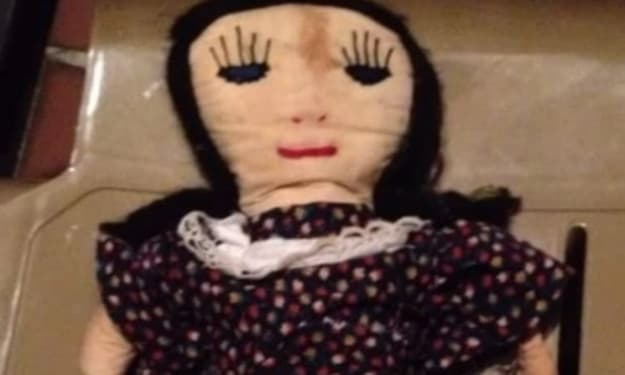
Haunted doll that is creepier than Annabelle
A Haunted doll? In 2014, I found a cloth rag doll at a thrift store one evening and decided to give it to my 3-year-old granddaughter, Jayla. The doll was in fair condition and had a few faded spots. She was wearing a long dress that looked like something out of the Antebellum era, and I visualized a little girl running through the yard playing with her.
By Cheryl E Prestonabout 5 hours ago in Horror


Comments
There are no comments for this story
Be the first to respond and start the conversation.