
Episode IV – Apex Mammals: Kings of Teeth and Territory
Veil of Shadows – Killers of the Animal Kingdom

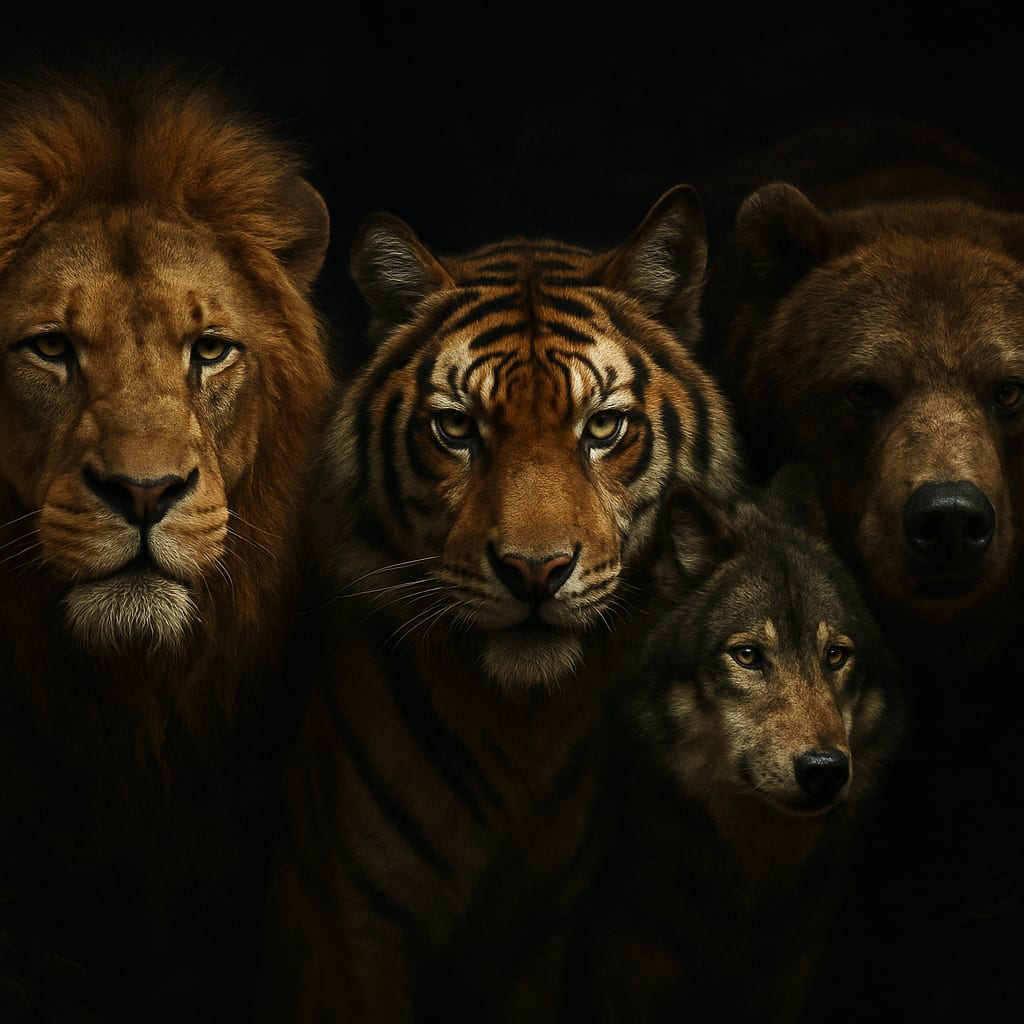
On land, the food chain doesn’t end with claws. It ends with decisions. Apex mammals don’t just kill because they’re hungry. They kill to defend territory. To establish dominance. To teach and too send a message.
They stalk, circle, bluff, test, charge. They remember faces and hold grudges. They choose who lives and who doesn’t.
Tonight, we’re not looking at random attacks. We’re looking at rulers, warm-blooded, thinking predators who have learned that fear is as effective a weapon as tooth or claw.
Welcome to Apex Mammals, the sovereigns of the kill...
1. The Lion - Attorney of the Dead Plains
In the baked gold of the African savanna, the lion is more than a symbol. It is a verdict. Lions don’t hunt alone. They hunt like a closing argument: surround, pressure, cut off escape...
⚙️ Anatomy of Death
- Team strategy: Lionesses fan out, forming a semicircle around prey. Some stalk downwind, others drive from behind.
- Targeting weakness: They choose animals that limp, lag, or panic. Evolution has taught them that fear exposes fractures.
- The takedown: Once close enough, a lioness explodes from cover at 30–35 mph, aiming for the nose, throat, or hindquarters.
The kill:
- Throat clamp - compresses the trachea, suffocating prey.
- Nose and mouth smother - cuts off airflow.
- Neck twist - in smaller animals, breaks the spine.
The male lion, with his mane and mass, rarely runs down prey. He is the enforcer of the plains. The one who fights off hyenas, wild dogs, leopards… and sometimes other lions.
Cold fact: Lions don’t just kill for food. They kill rival males’ cubs to erase their bloodline and force females back into breeding.
2. The Tiger - Phantom of the Forest
If lions are rulers by presence, tigers are rulers by absence. You don’t hear them. Ironically you don’t see them coming, even with a striped pattern amid the backdrop. You just suddenly stop being alive. Tigers hunt alone; which means every kill must count.
⚙️ Anatomy of Death
- Ghost approach: Using stripes to fracture their outline in tall grass or underbrush, tigers move almost soundlessly, placing each paw with surgical care.
- Single-strike philosophy: They close the gap in a rush, attacking from behind or the side.
Weapon placement:
- Powerful forelimbs slam prey off balance.
- Jaws clamp on the throat or back of the neck.
Crushing force:
- A tiger’s forelimb swipe can break a deer’s neck.
- Its bite can puncture spine and windpipe in one motion.
Cold fact: There are documented cases of tigers stalking and killing humans specifically. Tracking them over distances, circling back, and adapting tactics after failed attempts.
3. The Leopard - The Silent Executioner
If the tiger is a phantom, the leopard is a rumor with claws. It is smaller than a lion, less massive than a tiger, but infinitely more adaptable. Leopards kill where lions can’t, where humans think they’re safe.
⚙️ Anatomy of Death
- Versatility: Leopards hunt antelope, monkeys, dogs, goats, baboons, and even fish or birds. They are opportunists sharpened by necessity.
- Vertical advantage: After a kill, they drag prey up trees, away from hyenas and lions. This requires immense jaw and neck strength.
Kill mechanics:
- Bite to the throat or back of the neck, like other big cats.
- Or a stealth pounce from above, driving claws into the spine.
- For humans, leopards are uniquely terrifying because they can:
- Clear fences
- Break into livestock enclosures
- Drag off dogs
- Vanish before anyone wakes up
Cold fact: In some regions, “man-eating” leopards have killed over 100 people each, specializing in dragging victims from doorways at night.
4. The Gray Wolf - The Calculating Pack
Wolves are not mindless killers. They’re tacticians... The gray wolf turns the wilderness into a board game, and every herd animal into a moving puzzle. If there ever was an animal playing 4D chess, this is it.
⚙️ Anatomy of Death
- Relentless pursuit: Wolves don’t rely on ambush. They test. They trot behind a herd for miles, watching for the first sign of weakness.
- Communication: Ear flicks, tail positions, body angles — all signal to the pack who flanks, who drives, who attacks.
Takedown:
- Wolves aim for hindquarters, flanks, and throat.
- Multiple wolves bite and pull from different angles, tearing tendons and collapsing their target.
Endgame: Once the prey stumbles, it’s surrounded. Then the throat bite ends it. Humans often misinterpret wolves as bloodthirsty. In reality, they are calculators of energy; minimizing risk, maximizing reward.
Cold fact: Wolves have been documented trailing humans silently for miles, staying just out of sight. Not attacking. Just watching.
5. The Spotted Hyena - The Bone-Crushing Matriarch
Laughing. Shrill. Chaotic. That’s how people describe spotted hyenas. Wrong... They should describe them as war machines. Hyenas are stronger than we want to admit, and far smarter than we’re comfortable with.
⚙️ Anatomy of Death
- Jaw strength: Hyenas have one of the strongest bite forces among land mammals; enough to crush bones and access marrow.
- Endurance killers: They chase prey for long distances, much like wolves, focusing on exhaustion and panic.
Pack tactics:
- Encircling and mobbing targets
- Tag-teaming large animals like buffalo from behind
- Working together to separate calves from herds
Hyenas often clean up after other predators but they’re equally capable of taking a kill from lions and leopards. Numbers matter in this game of gangs.
Cold fact: In parts of Africa, hyenas have been known to break into huts or drag sleeping people from doorways, drawn by the smell of blood or food.
6. The Polar Bear - The White Apocalypse
The polar bear is not cute. It is not cuddly. It is not a symbol. It is a walking famine armed with claws. In the Arctic, almost nothing lives on land. Which means when a polar bear smells something warm-blooded, it pays attention.
⚙️ Anatomy of Death
- Generator of hunger: Polar bears constantly hunt; seals, birds, whale carcasses, anything caloric.
- Olfactory radar: They can detect seal dens under several feet of snow.
Hunting methods:
- Stalking seals at breathing holes, killing with a single crushing bite to the skull
- Ambushing from behind ice ridges
- Charging at 25 mph across ice and snow
For humans, the terrifying part is this... Polar bears don’t fear people. They investigate out of curiousness. A polar bear doesn’t see a human and think “danger.” It thinks, “calories.” This is the most unnerving part for those that live up north.
Cold fact: Polar bears are one of the few predators known to consistently stalk humans as prey rather than attacking out of defense.
7. The Grizzly Bear - The Avalanche on Legs
If the polar bear is famine incarnate, the grizzly is a territorial god. In the forests and mountains of North America, grizzlies rule by overwhelming force. One report credited a Grizzly with decapitating a human victim, with one swipe of it's claws.
⚙️ Anatomy of Death
Muscle and momentum: A grizzly can weigh over 600 pounds and still run 30+ mph.
Armed with tools:
- 4-inch claws — hooked and dense, used for digging… and disembowelment.
- Skull-cracking forelimb blows that can break a moose’s neck.
Attack pattern:
- They charge
- Knock prey off balance
- Maul with claws and teeth, targeting the head, neck, and torso
- Many attacks on humans are defensive, protecting cubs or food.
But defensive doesn’t mean gentle. Males are known to mock charge from time to time, but when a mother is involved with her cubs, all bets are off! A mother was witnessed fighting off a male, that outweighed her by 800 pounds. Legacy and lineage, are the only things that truly matter in the animal kingdom.
Cold fact: Grizzly bites can exert pressures high enough to puncture steel drums in testing scenarios.
8. The Cougar - The Ghost of the Rockies
You rarely see a cougar. If you do… It probably saw you ten minutes ago. Also called mountain lions, pumas, or panthers, cougars are stealth specialists. Solitary stalkers with an eerie ability to appear where they shouldn’t.
⚙️ Anatomy of Death
Silent tracking: Cougars move like shadows, staying downwind, using terrain as cover.
Ambush tactic:
- Attack from behind, often leaping from boulders or ledges
- Forelimbs clamp the prey
- Jaws go for the back of the neck or skull base, crushing vertebrae.
Human attacks:
- Often start with a rush from behind
- Victim may feel only a shove before teeth are at the head or neck
Cold fact: In territories where humans encroach into cougar habitat, attacks have increased. Especially on joggers and children, whose movements mimic fleeing prey.
9. The African Wild Dog - The Relentless Pack Algorithm
If lions are kings, African wild dogs are the special forces. Smaller than most predators around them, they survive by being better organized than everyone else.
⚙️ Anatomy of Death
- Efficiency over power: Wild dogs don’t kill with crushing bites. They kill by collapsing prey quickly through blood loss.
- Choreographed assault: They select a target, then chase it down at 30–35 mph. Dogs trade off point position to avoid exhaustion. Once close, they tear at legs, flanks, and belly
The horror? Prey often dies on its feet, disemboweled, before it has time to fall. Cruel as it sounds, this method is evolutionarily effective. Quicker death, less injury risk to the pack.
Cold fact: African wild dogs have one of the highest hunting success rates of any mammal. Up to 80% in some studies, compared to lions at ~20–30%.
10. The Honey Badger - Fearless Dynamite
Small. Low to the ground. Looks like a weird skunk-wolverine hybrid. The honey badger should be forgettable. It is not... It is a walking middle finger to the concept of fear. Honey Badgers have been known to battle with not one lion, but many.
⚙️ Anatomy of Death
- Weapon loadout: Thick, rubbery skin that resists bites and stings. Strong forelimbs and claws used for digging and ripping. Jaws capable of cracking bones and tearing through tendons.
- Behavioral horror: Attacks animals much larger than itself, including lions, leopards, and humans. Aims for soft targets, like the face, underbelly, and in some documented cases, the genitals of larger animals.
Psychological warfare:
- Loud hissing, growling, charging
- Doesn’t back down even when injured
- Predators learn quickly: honey badgers aren’t worth the risk.
Cold fact: There are documented cases of honey badgers fighting off multiple lions long enough to escape.
Epilogue - The Crown Comes with Teeth
We like to pretend we’re at the top of the food chain because we invented cities, walls, and firearms. But take away the lights. Take away the concrete. Take away the distance between us and the wild… And the truth resurfaces with a vengeance.
We walk a planet shared with warm-blooded executioners. Animals that plan, cooperate, adapt, and sometimes look us in the eye and decide our fates. Not prey today... But maybe tomorrow.
The claws, jaws, and minds you’ve just seen are not relics. They’re current. Living, breathing, murderers... roaming the countryside. Watching from forests, grasslands, ice fields, and mountains.
And if the fences ever fail, the crowns we gave ourselves will mean very little, when they come knocking at our doors.
Where the kings of the earth still rule by blood, not by throne.
About the Creator
Veil of Shadows
Ghost towns, lost agents, unsolved vanishings, and whispers from the dark. New anomalies every Monday and Friday. The veil is thinner than you think....
Keep reading
More stories from Veil of Shadows and writers in Horror and other communities.
THE WHISPERS IN THE WALLS OF THE BOY SCOUT CAMP
There are hauntings you can escape. Doors you can shut. Lights you can turn on. But what do you do when the thing watching you has no face? No form? No eyes? What do you do when the darkness itself decides to stand up?
By Veil of Shadowsabout a month ago in Horror
Where's the Glory?
In breaking news, rehabilitated Republican Senator Johnnie Johnson (Pronouns: HE, HIM, HIS) called a press conference from the Men’s room of the New Orleans Louis Armstrong International Airport, Concourse B, across from the Ignatius Reilly’s Lucky Dog stand. The Senator had just returned from a sexual reorientation rehabilitation program in Memphis, TN after being publically disgraced at a Buckee’s Truckstop restroom soliciting sex from an undercover cop three months ago. He is a founding member of the Reformed Christians for Christ, a conservative, pro-family and ex-gay advocacy group. In the spirit of being reborn, Senator Johnson invited reporters to marvel at his plans for a major remodeling of airport bathrooms.
By Cathy Schieffelin4 days ago in Humor


Comments
There are no comments for this story
Be the first to respond and start the conversation.