
Edison's Frankenstein (1910)
A Review

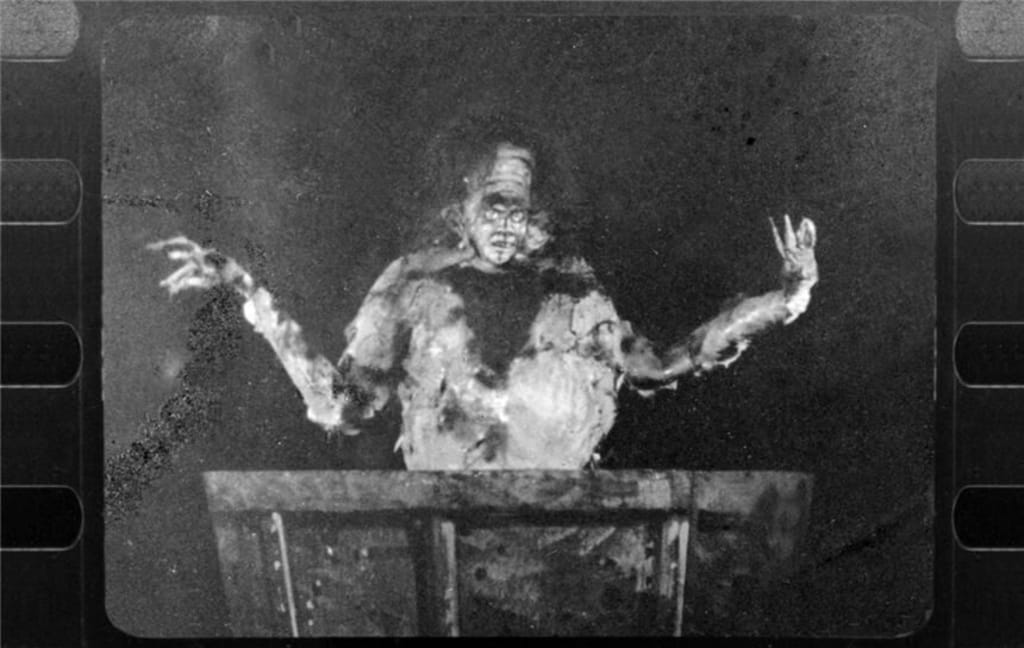
What can one say about a film that is a century old? Thought lost for many, many long decades, a complete (if deteriorated) print was finally found in the attic of an ancient theater, and restored until it was watchable. Its "Monster", predating Boris Karloff's iconic flat-topped ghoul, is a semi-idiotic-looking medieval peasant in filthy rags, Kracow shoes (pointed toes), and a few lengths of rope twisted about its torso. Its face is held in a stroke victim's frozen rictus of numb, unfeeling ugliness, and his eyes are wonderingly cow-like orbs under a fright-wig of filthy frizz.
His fingers are talons that seem to be covered either with gloves that are decaying, shredding into fragments--or, that is supposed to be his skin, perhaps.
The film is short and simplistic. The first title card reads: "Frankenstein Leaves for College." Mary Shelley may very well have turned over once in her grave.
This is not a brooding, morally-conflicted Victor Frankenstein: it is rather a drunken, exultant doctor sitting in his lab, facing out at the audience as if he were in a play, mixing concoctions with gay aplomb and finally hitting upon the sacred "secret of life." He writes as much to his beloved Elizabeth and then proceeds to bring his nightmare creature to life.
His lab, in the best scene of the short film, features what appears to be, or we assume, are leather doors with a view glass or window into which Frankenstein can look at the bubbling witch's cauldron, in which a moving, articulated skeleton emerges in a cloudy scene that seems to suggest bits of flesh flying through the air to stick to the creature's bones. Frankenstein is overjoyed at this. He is at one with his horrified audience; the film, like all of the films from this particular era, has the look and feel of a stage play.
Finally, the skeleton is transformed into a solid ogre of a "man," portrayed by actor Charles Ogle. The leaden door creeps open, and a clawlike hand emerges.
(As a child, i was quite badly frightened when a man, dressed as Dracula, hid behind a wall in an adjoining room, and held out just his hand in just such a manner, moving the long, claw-like fingers about menacingly. I threw a tantrum. To this day, I dislike that image immensely. Incidentally, I think the man was wearing Lee Press-On Nails.)
Frankenstein is aghast at the hideousness of the fairy tale ogre he has brought to life with, as the title card states, the "evil in his mind." He collapses across his canopied bed, but the monster finds him there and, opening the curtain, sends Frankenstein running home.
Here, he is greeted at the glass doors of the garden by Elizabeth and his father. Next, we see him reading in his study when Elizabeth comes in. They seem the picture of happiness, anticipating their marriage. However, there is still the Monster to contend with, the one Frankenstein's "evil" mind has conjured. He slips through the door (on a set that is remarkably similar to the one used a few years later in Paul Wegener's The Student of Prague (1914) , with a mirror at the far right-hand corner. Seeing himself for the first time, the Monster is enraged at being created. "I will be with you on your wedding night!" he promises Victor in the original novel. And, yes, that seems to be so.
The Monster hides as Elizabeth returns to the study. The Creature and creator then grapple to the floor. But the struggle has not ended yet.
The happy marriage day arrives (the film is tinted red, oddly). Frankenstein sees his wedding guests out, and then, I don't know, goes to the reception I suppose. The creature appears at the glass door to the garden (and now the film is even more strangely tinted blue). There is a glaring continuity error with a disappearing and reappearing stand of flowers. Elizabeth enters at some point, falls prostrate to the floor, and Frankenstein and his creature grapple again. He escapes out the glass doors.
Next, we see an interesting shot of the Monster staring at himself in the study mirror. He disappears, only as a reflection in the mirror, and Frankenstein enters, pointing at his beast of a man in horror. The Monster slowly vanishes until the only image left is that of Frankenstein. These were the dazzling special effects of 1910.
The last title card reads: "The Creation of an evil mind is overcome by love and disappears."
It all appears to have been presented as a dream, a nightmare; the creature, or rather Monster, an outgrowth of something sinister inside its creator, Frankenstein himself, whose life, otherwise, is a study in Victorian placidity and gentility. It was the hunger inside to KNOW, always the lust for "forbidden knowledge" that created the foul thing, the fairy tale ogre come to real life. Is this what Edison meant in adapting Frankenstein?
Overall, a creepily obscure film, with a number of nice touches for such an antique production (a plethora of skulls and skeletons, for instance), and the aforementioned scene where the creature just appears in a bubbling cauldron is a strange reanimation scene that would be echoed, decades later, by Clive Barker in his film of Hellraiser (1987). An interesting, primitive footnote in the history of horror.
Edison's Frankenstein can be viewed on YouTube
About the Creator
Tom Baker
Author of Haunted Indianapolis, Indiana Ghost Folklore, Midwest Maniacs, Midwest UFOs and Beyond, Scary Urban Legends, 50 Famous Fables and Folk Tales, and Notorious Crimes of the Upper Midwest.: http://tombakerbooks.weebly.com
"Scream 7" (2026): Running out of Fresh Screams
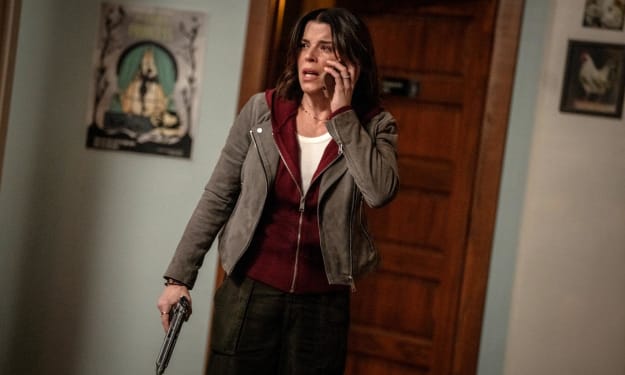
This is the seventh time we’ve had a Ghostface crisis. Scream 7 is the latest edition of the Scream franchise. Sydney Prescott and her family are under attack by another anonymous killer dressed in a Ghostface costume. While having issues with her daughter, Tatum, they run from the bloody murders, trying to determine who is behind it all.
By Marielle Sabbag8 days ago in Horror
The Telling Bone
Introduction This was kicked off by Catweazle's name for the telephone. Catweazle was a medieval sorcerer who ended up in modern times (the nineteen seventies). The full episode is all over Youtube and most of my readers might not even recognise what he is holding as a landline telephone handset.
By Mike Singleton 💜 Mikeydred 3 days ago in Horror


Comments
There are no comments for this story
Be the first to respond and start the conversation.