
Echoes in the Static
The signal was never meant to be found.
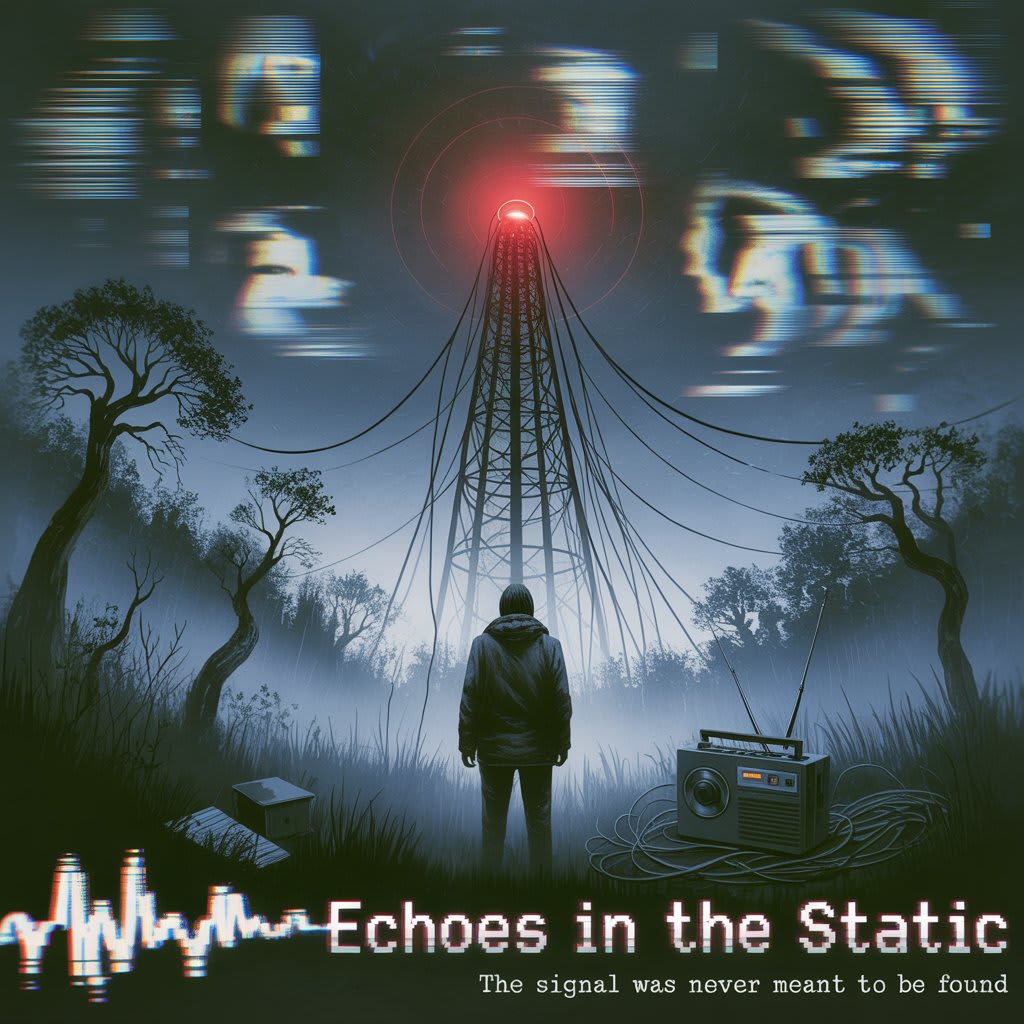
Tess McConnell didn’t believe in ghost stories.
But she did believe in patterns.
As an audio forensic analyst for a cybersecurity firm, her job was to find patterns no one else could — hidden messages in phone calls, manipulated recordings, unusual frequencies tucked deep in encrypted streams.
Most of the time, it was boring. Static, white noise, nothing useful.
Until she heard The Signal.
It arrived on a cold Thursday afternoon in an unmarked package. A flash drive, no return address. Just a note taped to it, typed in all caps:
“RUN THIS THROUGH YOUR SPECTRAL FILTER.
IF YOU HEAR HER VOICE, STOP LISTENING.”
She almost tossed it in the trash. Probably a prank. But something about the tone — cold, urgent, factual — made her slip it into her air-gapped laptop.
The file had no metadata. Just a strange .wav named echos_002.wav.
She hit play.
At first, it was just noise. The kind of static you’d hear between radio stations. But then — faintly — a tone shifted. Like something behind the noise was breathing.
Tess froze.
She ran it through her spectral analysis tool.
At the 37-second mark, a distinct waveform formed — symmetrical, patterned, repeating in intervals.
And then…
A voice.
Female. Mid-30s, flat but human.
“Can you hear me?”
“If you found this, they’re already watching.”
“Do not look for the tower.”
“Do not try to boost the signal.”
Tess paused the audio. Heart racing. This wasn’t synthesized. It had imperfections. Breathing. Natural inflection. Emotion — fear.
She checked her office window.
Just the same gray Portland skyline.
But for the first time, she closed the blinds.
She thought about deleting the file.
Instead, she played it again — with better headphones, this time. She slowed it to half-speed. Boosted the lower bands.
The woman’s voice came through clearer.
And now, there were new sounds under her speech.
Whispers. Too fast to catch. Something like Morse code layered over each syllable.
Tess ran it through a translator.
“REVERBERATION TEST 6 – UNSTABLE.”
“SIGNAL BREACHED. CONTAINMENT FAILING.”
“DO NOT RESPOND.”
Tess leaned back.
Whatever this was… it wasn’t a prank. It wasn’t art. It was a transmission. A warning. Maybe even a confession.
And someone didn’t want it decoded.
She yanked out the flash drive.
That night, her internet slowed to a crawl.
Her laptop fan spun loudly even though nothing was running. Her webcam light blinked on — just for a second. Then off again.
She taped it over immediately.
At 2:41 a.m., she woke to her radio turning on by itself.
An old analog one she hadn’t used in years — one her grandfather left her. It only picked up shortwave stations.
Static filled the room.
And beneath it… the same voice.
Faint. Cracked. Like it was struggling to reach her.
“They know you heard it.”
“Don’t go looking.”
“Please... don’t go.”
Then the signal cut out.
Tess didn’t sleep.
By morning, she'd convinced herself she was imagining things.
Sleep deprivation. Audio pareidolia. Her mind hearing messages where none existed.
She drove to the office early. Tried to laugh it off with her coworker Ray, who joked that maybe she’d stumbled on a numbers station run by ghosts.
But when she returned from lunch, the flash drive was gone.
And Ray’s desk was empty.
She texted him.
No response.
By that evening, his apartment was dark. Locked. No one answered.
Tess went home shaking.
She didn't mean to open the map.
It just… happened. A late-night Google search for "military signal testing NW Oregon" led to an obscure amateur radio forum.
There, buried in a 2018 post, was a thread titled:
“UNCLAIMED FREQUENCIES AROUND MT. BELDON”
She had never heard of Mt. Beldon. It wasn’t on any normal map. But one user had uploaded a topographical scan — and circled a specific ridge marked “F5.”
Underneath, someone had written:
“This is where the signal was first received.”
“Tower still exists. Off-grid. Scrambled.”
“NO ONE who goes hears the same thing twice.”
She tried sleeping.
She failed.
Tess drove out the next morning.
Fog clung to the two-lane road like a film. Trees blurred into one another. Her GPS lost signal twenty miles in. Her phone died, even though it was fully charged.
But she found it.
An unmarked dirt path veered off the main road. No signs. No tire tracks.
At the end of it, she found the tower.
Maybe 60 feet high. Steel, rusted. Still faintly humming. Around its base, cracked concrete and what looked like shattered soundproof panels.
And an open door — leading into a structure underground.
Tess hesitated.
Then stepped inside.
The hallway sloped downward into thick darkness. Cold. Metallic. The walls were lined with insulation foam, long since rotted. Her flashlight flickered as she passed through.
Then she heard it.
Not her footsteps.
Another.
Behind her.
She turned — no one.
She pressed on.
At the end of the hall: a control room, powered by some unseen source. Old tech — reel-to-reel machines, analog dials, a radio transceiver blinking slowly.
One button was labeled in faded paint:
“ECHO LINK”
She pressed it.
The static returned.
Then the voice.
“I told you not to come.”
Tess froze.
The voice was hers.
Exactly.
Every breath, every inflection.
“You brought the signal with you,” the voice said.
“It’s not contained anymore.”
“Now they can hear you too.”
Then everything went dark.
They found her car two days later.
Empty. Keys still in the ignition. Her phone melted from the inside.
Ray was never found.
The office scrubbed her records.
No trace of the file. No log of the flash drive. The security cameras at the station glitched out during her last day. All files corrupted.
But if you tune a shortwave radio to 147.73 MHz around 2:41 a.m., on a foggy night near Mt. Beldon…
You might hear it.
A whisper. A voice in the static.
And if it says your name—
Do not answer.
About the Creator
Keep reading
More stories from Asif Nawaz and writers in Horror and other communities.
The Whispering House
The house on Grayer Street had been vacant for six years. A two-story colonial with sagging shutters, cracked siding, and ivy crawling up its face like veins on old skin—it stood like a forgotten relic among modern homes. No one mowed the lawn. No one asked why.
By Asif Nawaz9 months ago in Horror
The Lantern of Hollowmere
The village of Hollowmere sat quietly between two dark forests in the northern countryside of Europe. It was the kind of place travelers rarely visited and maps sometimes forgot. Only one narrow road led in and out of the village, winding past an old lake that locals refused to go near after sunset.
By Iazaz hussain6 days ago in Horror
Thief In The Night
To the thief in the night that took and replicated what once was mine: Honestly, I feel kind of bad for you. It’s funny, because we hardly know each other. I only know of you through the magazines you’ve written and the broadcasts you have televised in the past — as well as through the public mentions of you from your show business connections there.
By Snarky Lisa7 days ago in Humans




Comments
There are no comments for this story
Be the first to respond and start the conversation.