

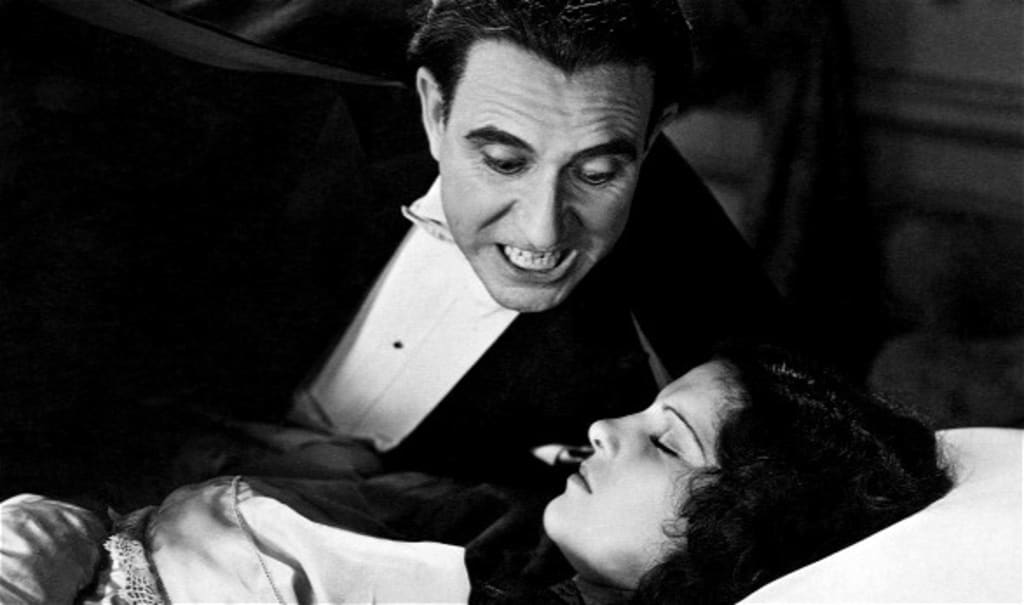
I had heard for years of the Spanish-language version of the original Dracula, filmed concurrently with Todd Browning's well-known adaptation, the second (perhaps third if you include the lost silent Dracula Halala, an Austrian film (with the eerily creepy silent Drac played by Paul Askonas; a film that is, unfortunately, believed to be "lost") adaptation of Stoker's saga of the Deathless Count. Bela Lugosi was immortalized as the wearer of the red satin-lined black cloak and the high widow's peak hair. Carlos Villarias plays the Count here, and his performance stands in stark contrast to Lugosi’s reserved, sepulchral interpretation.
Villarias greets Renfield, here played by Pablo Alvarez Rubio in a frenetic manner, as though he is mentally spiraling into hell, becoming increasingly unhinged—this, of course, is the opposite of the intensely understated, disturbingly creepy Renfield of legendary actor Dwight Frye. (Alvarez also bears a weird, passing resemblance to the slain anarchist writer and outlaw Renzo Novatore, who was killed about ten years earlier in Arcola, Italy.)
The film has been noted for its superior touches compared to Browning's version. The cinematography and camerawork are more elaborate, scenes are extended, and there is a greater verisimilitude to the classical Gothic tropes, and a resulting spookshow ambiance that hints at a haunted realm. Extreme close-ups of Dracula’s eyes and his bottom-lit face as he emerges from the glowing, misty confines of his coffin are in stark contrast to the often stiff-as-a-corpse direction of Browning and the shuffling, plodding speeches of Lugosi. Though these interpretations seem no less valid in their way of building up a world of intense creep, the Spanish version—shot on many of the same sets, at night—offers a perfect spiritual ambiance to the vampiric saga being filmed. It exudes an entirely different form of... life. (Would that be the correct word?)
Renfield, driven mad by the Count, is carried back to England aboard the ill-fated Varna, presumably to Whitby. The same old story is set up: slaying of sailors, scarfing of spiders and flies, the handsome Harkers, poor Lucy ("Lucia"), who becomes the "White Lady" vampiric ghost, preying on children as she emerges from the cemetery at night. Van Helsing and Dr. Seward (as in the English version, the characters of Quincy Morris and Lord Godalming are omitted), portrayed respectively by Eduardo Arozamena and José Soriano Viosca, are stiff-necked authority figures coming to the rescue of "Juan Harker" (Barry Norton) and "Eva" (Lupita Tovar). Scene for scene, it is essentially the same film, shot in the same locations after the English version wrapped for the day. But in many ways, it is of a different, even superior quality.
The camerawork possesses a more artistic vitality, and the performances reach beyond the somnambulistic gait of the English-language version. In that film, Dwight Frye has all the best lines, with he and Lugosi marking their territory in eerie, often understated, lunar lunacy. In contrast, here Villarias begins the film with a wild-eyed, round-eyed stare that should have sent Renfield running for the exit.
The heightened energy of Villarias’ performance brings a dynamic intensity that propels the film forward, making every scene feel charged with an underlying madness that builds to a fever pitch. His portrayal of Dracula is both more overtly menacing and erratic, breaking away from the more methodical and stoic presence that Lugosi masterfully presented. Villarias’ Count is not merely a figure of eternal dread but an active, unpredictable force of nature, one whose every movement feels driven by an insatiable, chaotic hunger.
Moreover, the film’s pacing seems to embrace a more fluid rhythm, breathing life into moments that might otherwise feel stagnant. The slow, deliberate build-up in the English version, which sometimes feels like an exercise in Gothic formality, contrasts sharply with the Spanish film’s livelier sequences, where tension simmers at the surface, only to erupt when least expected. The overall atmosphere is darker, more brooding, as the camera lingers on shots that seem to pull the viewer deeper into a world of shadows and whispered threats.
The lighting, too, plays a crucial role in this version, enhancing the film's ethereal qualities. Where Browning’s film often relied on stark contrasts, the Spanish version drenches its subjects in thick shadows, creating a more palpable sense of claustrophobia and dread. Dracula’s descent from the coffin, bathed in a ghostly glow, stands as one of the most visually arresting moments, evoking a sense of the supernatural that transcends the ordinary. The resulting imagery lingers in the mind long after the film ends, cementing its place as an enduring piece of cinematic art.
While both versions of Dracula have merits, the Spanish-language adaptation offers a unique perspective, capturing the essence of the story through a more vivid, emotionally charged lens. Its differences are not just superficial; they reflect a deeper, almost subconscious desire to explore the darker facets of the legend, imbuing the familiar tale with new life—or, perhaps more fittingly, new death.
Spanish Drácula (1931) - Intro with Lupita Tovar Kohner Featurette
My book: Cult Films and Midnight Movies: From High Art to Low Trash Volume 1
Ebook
About the Creator
Tom Baker
Author of Haunted Indianapolis, Indiana Ghost Folklore, Midwest Maniacs, Midwest UFOs and Beyond, Scary Urban Legends, 50 Famous Fables and Folk Tales, and Notorious Crimes of the Upper Midwest.: http://tombakerbooks.weebly.com



Comments
There are no comments for this story
Be the first to respond and start the conversation.