

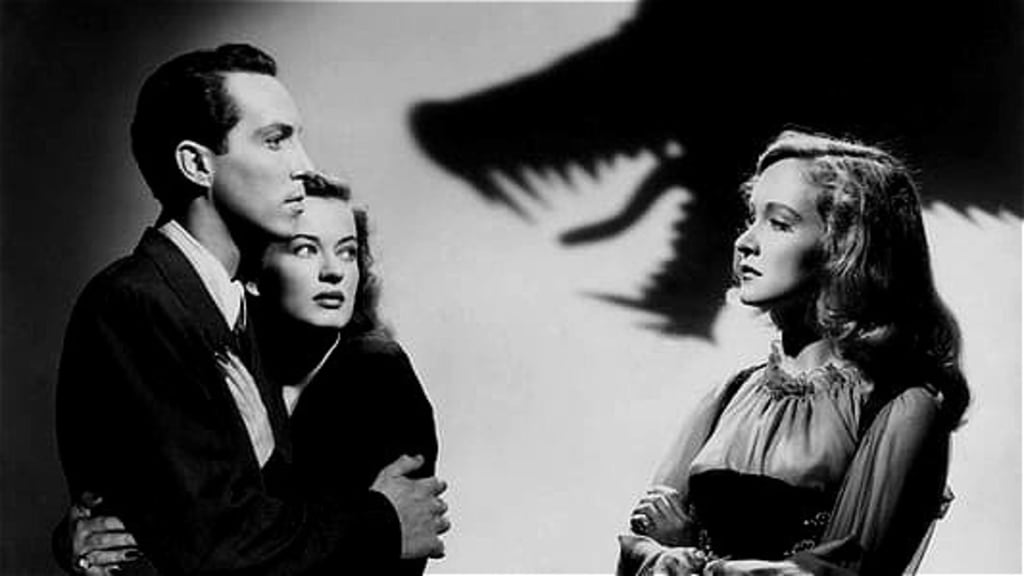
Cry of the Werewolf is a surprisingly atmospheric old horror film whose chief drawback is the fact that, unlike Lon Chaney Jr., actress Nina Foch doesn't go about with yak hair glued all over her face. Instead, she transforms (this is shown only in shadow) into a literal wolf, not a wolf-human hybrid horror. Strike number one.
I'm not sure what strike number two would be, except there are some pretty sloppy scenes wherein Police Lt. Barry Lane (Barton McLane) points the muzzle of his police revolver around in a manner most unprofessional. Recalling, faintly, the cop in the graveyard in Plan Nine From Outer Space who also is reckless and careless with his gun, using the barrel of the thing to scratch his noggin and push up the brim of his hat. (I can't remember the name of the actor or even his character, offhand, but it isn't Paul "Kelton the Cop" Marco or Conrad Brooks, that's for sure.)
Getting back to it, Cry's plot revolves around the "La Tour Museum" which is a spooky waxwork "House of Horror" place where everything is lit from beneath to make it spookier, and they offer tours because a werewolf woman (shades of Emily Isabella Burt, the "Georgia Werewolf Girl") lived there in voodoo times and died when her husband burned her at the stake or something. Now, it's all the fault of the gypsies somehow, and the film has an ugly subtext of bigotry which I at first didn't expect because Nina Foch, in a courtroom scene, seems to give an impassioned defense of the Romani people, saying, "What to you is superstition to me is religion." But, no dice. (I however believe it is wrong-headed to judge a film or book or song, or, really, much of anything, made so long ago based on modern standards. So there.)
An old curator, specialist, or whatever is writing a book on La Tour and discovers her crypt, and they find out about it at the local gypsy encampment (every town in these old monster pictures had one), and Foch, who is werewolf woman La Tour's daughter, transforms and begins to eighty-six anyone that could reveal the secret tomb. The manuscript is burned but that's okay because Robert 'Bob' Morris (Stephen Crane) is going to use infrared to see what was on those ashy pages (how this process works is never described to us). His girlfriend is the beautiful Transylvania lass Elsa Chauvet (Osa Massen) who has a weird accent I at first took to be a speech impediment, but is glamorous in the way of 1940s actresses and wonderful to look at. (But if I had a dame like that was pure Transylvanian, I would invest in a stainless-steel chastity collar with a lock and key. Never hurts to be too cautious.)
Cult Films and Midnight Movies
"From High Art to Low Trash" Vol 1
By
Tom Baker
Celeste the Romani Princess goes about committing murders, but not as a full-blown werewolf, but simply as a common wolf. BIG disappointment. There are a number of nice touches, including "Devil Dolls" and "Love Dolls" hinting at rites of voodooism which make the film, like the rest of these old occult thrillers, seem as if it is just a little more placed in that world, that mentality, that...I don't know how to describe it, but it maybe gives it a verisimilitude. Don't know.
I both liked and disliked this film for different reasons. It was, as I previously stated, atmospheric, with beautiful cinematography from the monochromatic era. Performances were not bad. The plot was interesting and enhanced with the backstory making it even more kitsch and gothic. But no werewolf equates to a let-down, and the anti-Romani stuff annoyed me. No, despite what 'Bob' says, Romani are NOT 'devil worshippers,' and this film portrays them in a negative light. Which I dislike, although I don't, obviously, think it should be "canceled" or anything.
(While this little horror epic was being made, by the way, over in war-torn Europe, the Romani people were being rounded up, put on trains to Hitler's death camps, and murdered. Of the estimated 2 million European Romani and Sinti people, about 1.5 MILLION were thus murdered. The killing is called the Porrajmos, or "the Devouring"; also referred to as the Pharrajimos, or "Cutting Up." Alternately, according to Wikipedia, it is called the Samudaripen or "Mass Killing.")
The Romani are fortune tellers, and so am I. So I hold them in special regard. So this film and its ignorant subtext annoyed me. What the hell? They should have known better. Even in 1944.
Mediocre little movie with a few deft touches here and there. It's only an hour long, which is a saving grace. No yak hair. Not a single solitary fiber. I mean: WHERE WAS THE HAIR?
Finito. Im'a go howl at the Midsummer Moon. Ciao dahlinks!
Cry of the Werewolf (1944)
About the Creator
Tom Baker
Author of Haunted Indianapolis, Indiana Ghost Folklore, Midwest Maniacs, Midwest UFOs and Beyond, Scary Urban Legends, 50 Famous Fables and Folk Tales, and Notorious Crimes of the Upper Midwest.: http://tombakerbooks.weebly.com


Comments (1)
Interesting movie. Excellent review, Tom.