
Charred
"Thou shalt see Lethe, but outside this moat, There where the souls repair to lave themselves, When sin repented of has been removed."

He didn’t die quietly. How could he have? Flesh was being seared from his body, cooked, crisped and crackling, and he was screaming accordingly. I remember hearing that the smoke normally suffocates you before the flames burn past your skin and fry your nerve endings. Maybe it would have if he’d been tied to the chair properly. If the slick gasoline he was doused in hadn’t allowed him to loosen out of his bonds. Certainly Father’s men didn’t expect him to crash through the drawing room window pane, making for the deep dark relief of the garden lake. The sizzle and hiss as he plunged in were almost worse than the screams, extinguishing the last of the agonized cries. The body floated limply for a while. Later the men waded in, fastened bricks and rocks and pushed him out to the centre of the lake to sink. I drew my curtains, held Bear close to my chest and went back to bed.
*
I was the only one who seemed to notice. I pointed it out to Cook and Ouma but they never seemed to see it. Grey tendrils of smoke hovering over the surface of the lake, like a campfire dampened and put out by the rain. They would billow for hours, then go. How can water be on fire? I kept asking Cook that week. It can’t, she said. Even on grey days, with a bite of cold in the air, you could see the smoke, the dull puffs of a cigarette end that wouldn’t go out. One afternoon I pulled on wellies and went to the water’s edge. No smog. Just still. I peered into the water, down into the murk where the tendrils of the reeds emerged. Nothing. Just the koi.
*
Father was throwing a party downstairs. I could hear laughter and shouting and clinks of glasses, and Ouma had put me out the way into bed an hour or so before. It was cold and she’d tucked me and Bear in tightly and drawn the canopy around the bed frame. To keep the warm in, she said. I couldn’t even fidget and get comfy. Eventually the noise from the party died down and I went to sleep.
*
I didn’t want to look. It took me so long to turn my head that my eyes were welling up and I was gripping Bear so hard my knuckles were white hot and my fingers were cramped. He was there. In the top right hand angular of my four poster bed, arms flush against the beams, head lolling, hanging like a crisp, crucified Christ. His skin was burned black and flaky. He didn’t move. Surely he couldn’t. There was nothing holding him in place, no ropes harnessing his arms. Ash floated off his body and hung in the air where the moonlight was shining through. His head began to roll. It slowly jerked up, the seared neck rasping and scraping against itself, revealing two sunken inlets where his eyes had been. The tongue-less, lipless mouth tried to move, straining, but no sound came out. I screamed.
*
Ouma and Cook were nice the next morning and acknowledged my tears and my shaking and made me hot chocolate, but of course they didn’t believe me. I spent the day with Bear looking out the window to the garden, calling them every time I saw black smoke issue from the water. But they never came in time. In the afternoon Father returned home and took me outside for some fresh air and play. When it began to rain, and Father picked me up to take me inside, I saw him again. On the other side of the lake, at the far end of the garden, he was standing on the bank. A tarred silhouette. He went to raise his arm, as if for a wave or gesture. I buried my face into Father’s shoulder and refused to verify.
*
On Saturday the sun broke through and Father insisted we take the row boat out onto the lake. Looking back there was something sadistic about it. It wasn’t really any different from repeatedly marching over a man’s grave, a grave that you’d made him dig. And Father wasn’t an easy man to sway, never moved by tears or pleas, always resolute. So we set out. I anxiously watched Father’s oar strokes, praying they didn’t splash and disturb the lake too much. When we got to the center Father stopped rowing and pulled out a cigarette, leaning his considerable bulk back on the prow. The boat rocked, enough to send me into the side and drop Bear over. Crying out, I tried to reach him but he disappeared instantly, as if his paws were filled with lead. Father scolded me for my carelessness.
*
Ouma promised to get the groundskeeper to keep an eye out for him and Father lathered me with replacements but I was convinced. Bear was gone. Though sometimes I wish we’d never been reunited. It was the breathing that woke me. The desperate rasps. Sooty, carbonised lungs trying to suck in air. He was standing over the head of the bed. I could see him up close. His skin was black and dead but dripping and soggy like a tea bag, a patchwork of wet fallen leaves, the crunch of autumn combined with the damp rot of winter. A charred, cindered mummy. Life clung to him like a disease. He leaned over, his breaths shortening with the exertion. He pulled back the sheet, the skin of his hand disintegrating, scattering crumbs of charcoal over the starch white. His other hand was holding Bear. He placed him next to me and tucked him in. We were almost nose to nose. His stench was pond and burnt skin. What remained of his face swam in grime. I grasped Bear, expecting his fur to be wet and clammy. But it was singed and rough and coarse to my touch. I pulled the sheets over us, hoping he would leave. I heard him straightening up, his vertebrae grinding against each other, discs long melted. Through my sheet I saw him pause, darting his head from side to side like a bird before shrieking, a cry of primordial, guttural pain. He dragged his legs to the door and disappeared. I drew breath, not realising I’d been holding it, then promptly threw up over my pillow.
*
I’m sat cross-legged on the kitchen floor, watching Bear be circulated and tossed around in the washing machine, soaked, drowned and disorientated. I spot Father in the reflection of the glass walking up behind me, his bulk warped and distorted in the plastic window. He asks if everything is ok. Ouma must have told him. Or Cook maybe. I give a perfunctory answer and he leaves, satisfied. The machine beeps and I take Bear out and put him in the dryer, turning the dial to 44 minutes. I leaned against the door, letting the dull buzz and dry heat stupefy me.
*
Over the next month I saw him sporadically. Once, when I walked into the main bathroom, he was in the shower, under the hot water and steam, excoriating his dirty, black oat skin with soap. Another time, from the kitchen window, I saw him crawling out of the lake, struggling to climb the embankment, his body smoking. And one evening, he appeared in my room again. I opened my eyes and he was hanging from the canopy of my bed frame, directly above me, briefly made visible by a glimpse of moonlight. He squirmed and mouthed something wordless. The light fell back behind a cloud and the room returned to pitch black. I had long given up telling Ouma and Cook, who, while concerned, had agreed to dismiss it as a phase. Father, when home, kept would insist on doing some fun activity, distractions from his days awash with sin. I remember one day asking Father if he was a bad man. He replied no, but that sometimes the world needs bad men to keep the worse ones out. It would have been a little comforting if he’d said it with any truth or conviction. Eventually he made plans to move away, as we always used to, this time to the Flegetown Estate, an even bigger house with even bigger grounds. Normally I resented having to uproot and leave, but this time I welcomed it.
*
The boundary of the Flegetown Estate ended at a looping, meandering river at the bottom of a hill. The water was dark but clear, clean and fresh enough to swim in. Reassured by the transparency, I spent a moderately happy summer where I would occasionally wade in there and feel the smooth pebbles crunch underfoot while I tried to catch dragonflies or admire the kingfishers. I don’t know how he managed to find us there. At school they taught us that all rivers and lakes lead back to the sea, so maybe there was a path. Maybe he was destined to haunt Father forever, to the deepest circle of hell. That seemed to be the fear in Father’s eyes when one of his men informed him that a dark, sopping figure had emerged from the river, still chained with bricks and rocks, calling Father’s name. That’s why he went himself, telling me to stay in the house, hurrying down to the bank with his men. The figure stood in the centre of the river, where it was surely too deep for any man to stand. They riddled him with bullets, which landed with dull, wet thuds. He staggered forward and then collapsed, quickly consumed by the river. Father directed them to pull the body out. Two men waded in, to about waist high. Nothing, they shouted back. Frustrated, Father went in himself. He pushed past them, to the deeper section, until the water lapped at his collarbones. He blindly groped around, treading water. Suddenly, he cried out. The river seethed and hissed, as if it had quickly come to a boil. The other men howled too, hands instantly covered in sores and blisters. The river flashed red, a tide of flowing, boiling blood. Father’s cries were drowned out, he was submerged to the eyebrows. The top of his head flailed for a moment, his hair crumbling up like wisps of burned paper, then went still.
*
The men waited until the next day to pull him out, when they were sure the river had cooled. It was a closed casket funeral, and Ouma had whisked me off the estate that night just after it happened. So the last time I saw Father was from the flower bed I’d been hiding in as he went in after the body, which they never did find. They both visit me regularly, but only in nightmares. And I still have Bear.
About the Creator
Keep reading
More stories from Louis Allen and writers in Horror and other communities.
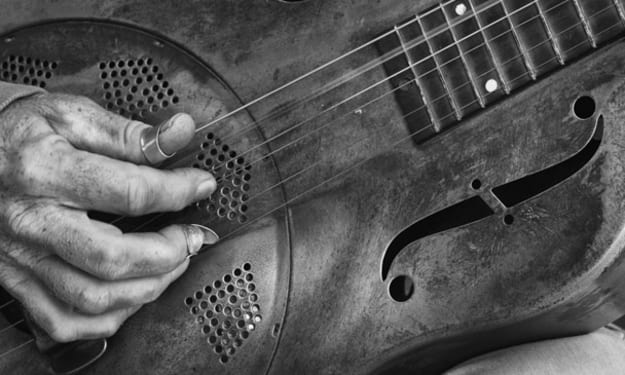
The Last Jam of Fat Foggy Waters & The Streetcar Band
It was a huge club, well over one hundred foot square. The air was humid, real heavy delta air. Cigarette smoke greyed and dulled the crimson lights. There was tremendous noise and chatter, booming voices calling out to old friends and locals across the room. The walls were wooden and disrepaired, like an old dying plantation house, slowly eaten away by the lethargy of the tropics. Perspiration was slick on everyone’s faces, the crowd rippled with white handkerchiefs mopping up brow sweat. I raised myself on the edge of the bar, peering over the throng to try and locate him. I could see the band setting up on stage, clarinet, guitar, drums, double-bass: Joe Miami, The Flannel, Triple Dixon, Cole Stanley. A few couples had got up to dance already and Joe Miami pulled a harmonica out of his pocket to oblige them with a few notes.
By Louis Allen4 years ago in Horror
5 Most Haunted Objects in History: From Annabelle to Robert the Doll
I have a confession to make: I am obsessed with European history, specifically castles. There’s something about a stone fortress that feels like a magnet for the paranormal. In my mind, every castle is haunted, usually by a lady in a white dress, a headless nobleman, or (the absolute worst) creepy ghost children.
By Areeba Umair4 days ago in Horror


Comments
There are no comments for this story
Be the first to respond and start the conversation.