
Capons, Cooks, and Cannibals
An Essay on Tales from the Crypt Season 4, Episode 6: "What's Cookin'?" and The Haunt of Fear # 12

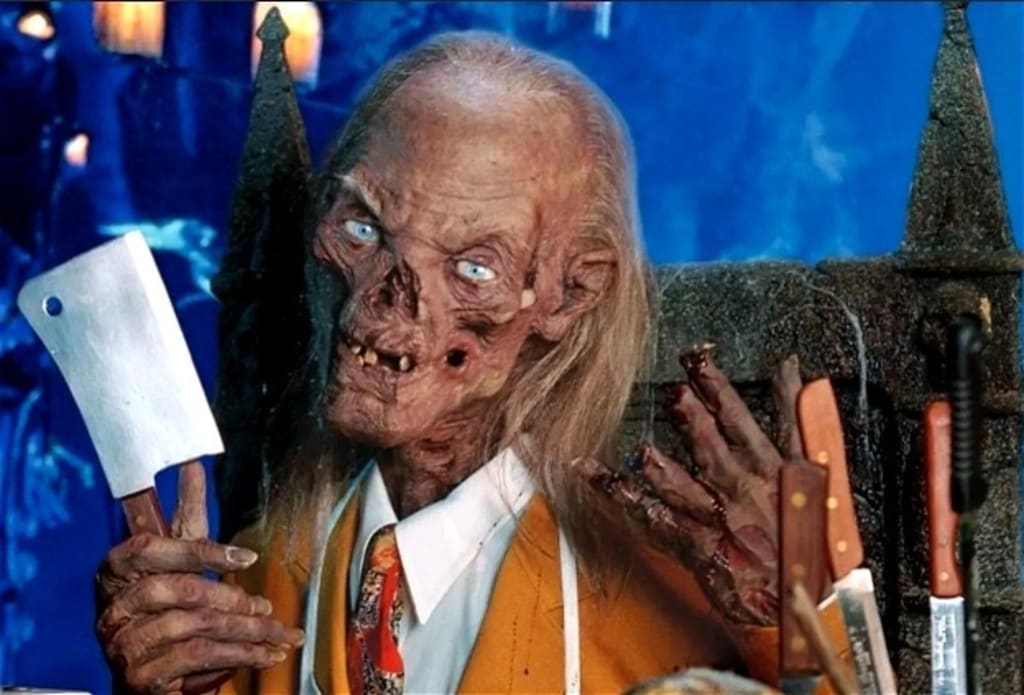
"Honey, you have to remember what they said to Colonel Harlan Sanders back in 1956: 'A chicken restaurant, Colonel Sanders? You must be mad.' If that's madness you can count me in!"
Tales from the Crypt, "What's Cookin'?"
Judd Nelson carves a tremendous, bloody chunk from a fat man's ass. This is so he can fry it and serve it as steaks. He's come a long way since his role as John Bender, a few years earlier. He's still hot, hot, hot. At least, he was three decades ago.
It's a fourth season episode of HBO's famous series Tales from the Crypt.
Said fat man, and his gory, bloody, but thoroughly ripe-for-the-preparation ass, belongs to the late Meatloaf—who, as far as this role is concerned, was most aptly named. Count on Meatloaf to provide for the viewer a bit of a nosh, old bean. Nankee-Poo and Yum Yum approve most heartily. Yum, yum, yum.
Nelson is assisting Christopher Reeve, the late Man of Steel, in the operation of a restaurant based entirely on the serving of squid. Squid is a horrifying creature, but offered up as calamari with wine it could be rather a sumptuous treat. However, Reeve is having trouble convincing the respective diners of the value of squid soups, sandwiches, salads, and the ever-so-bold squid-flavored ice cream delight.
Wife Erma (Bess Armstrong) wants to bury the hatchet (well, in this case a cleaver) in the back of his head. Something, by the way, he discourages, as it might ruin the blade.
Judd Nelson is a rather handsome and well-groomed, well-dressed "Drifter" who cleans up at the wacky failed eatery. Meatloaf is "Chumley," the white-suited landlord who gets the axe. He ends the episode hanging around in a meat locker, not in a very happy state, but in one surprisingly graphic for even pay-cable television.
✨Tales From The Crypt✨ 1080P "Whats Cookin"
Nelson is a cannibal psychopath. He cuts the butt of Chumley, and Reeve and wife unknowingly profit and increase their business exponentially by feeding American diners their own fat asses to them. A scrumptious parody of consumer culture and bourgeois capitalist appetite; you could feed some people dog turds or, in this case, a fat man's ass, and they would love it provided you told them it was filet mignon.
Of course, this happy, happy situation does not long remain so, as Reeve soon is appraised of the origin of his restaurant's so-succulent cuts of meat. Murder is thus in the offing, and Nelson does not fare well in the end, as might be imagined. (We find it rather curious that Nelson is credited here as "Special Appearance," as he's hardly the episode's side dish. He ends up rather the Main Course.)
The outro has the Crypt-Keeper, the curiously engaging animatronic corpse-puppet, who previously had been seen corkscrewing out an eyeball, engaging in some closing repartee with his penchant for bad, ghoulish puns, such as "restaurateur in peace." That sort of thing.
"It's a Dog-Eat-Dog World Out There, and We're All Just Different Flavors of Alpo."
The Haunt of Fear #12 Audio Comic - What's Cooking?
Haunt of Fear #12 featured the original EC Comics story "What's Cookin'?", written by Bill Gaines and Al Feldstein, with pencils by Jack Davis—a tale flavored by murder and double-crossing, as the TV episode it inspired decades later. Two bumbling restaurant owners, Charles and Herman (Herman being the fat man here) are approached by another Creepy Drifter (one not half as handsome and elegantly attired as Nelson in the Tales episode), who makes the brothers a deal they can't refuse: if he can turn their dying business around, they must split with him the profits and proceeds. He does so, and we're off.
He builds a giant chicken sign on the roof, a huge brick-laden barbecue pit in front, and a huge boiling vat (for "Southern Fried" chicken) in back. Suddenly, serving the tasty birds, business instantly begins booming. No cannibalism here; that doesn't come until later. (At least, the suggested cannibalism.)
Herman and Charles are greedy and unscrupulous. When the filthy lucre comes pouring in, they decide that they want to cut Eric, the Drifter, out of the equation, although he helped bring the business back around. Stealing into his old farmhouse (shades of Ed Gein, perhaps) they tie him up, set fire to the dwelling, and go outside to watch it burn. But that doesn't end the show, dig?
From out of the burning embers, the pile of ash, a zombie Eric emerges, hellbent, from here to eternity and beyond, on getting revenge. This is pure EC horror comics trope exploited again and again, but also is reflected in stories across the Golden Era comic book spectrum, from the origin of The Spectre to El Diablo. But here the corpse does not make out as a superhero.
Herman the Fat Man hangs in the barbecue pit. Brother Charles is boiled in oil. The cops come in and discover all of this, nearly puking in revulsion. I don't suppose anyone, not the least the reanimated, revenge-seeking corpse of Eric, actually ate either of the bodies, as in the Tales from the Crypt spin-off.
Oh well.
In the Crypt show, the cop, played by Art LaFleur, enters in the end and reveals that he's quite suddenly acquired a "special taste"; presumably for well-prepared anthropophagous repast. As the symbol of conventional morality and "law and order," this reveal is the linchpin of the show, as we've already scoured the surface of an affluent, upscale dining experience and found corruption, bestiality, betrayal, and homicide beneath. Utter corruption beneath the placid, banal, dependable veneer. The Blue Velvet syndrome, in other words.
Servin' 'Em Up
This sort of ghoulish urban legend has a long pedigree.
The story of Sweeney Todd (Todd being the German word for "death"), the "Demon Barber of Fleet Street," London, is one example. He and his common-law spouse, accomplice Margery Lovett, were said to dispose of the bodies of Sweeney's barbershop victims (throats slit and dumped down a greased chute beneath the barber's chair, which revolved on an axis) by baking them into "meat pies" (we think these must have been rather like pot pie) that became very popular as sold in her adjoining shop. Hence, from production to profit, this becomes an unintentional satire of the entire capitalist system; which, as much prosperity as it brings, often cuts out those whose hands were not born already grasping the capital. Thus, in these tales, it is the lower class who (forgive us) "cut corners" to try and get to the top of the pyramid—the (ha-ha) "food chain."
Real-life examples of cannibals range from Albert "The Gray Man" Fish, the "Werewolf of Wisteria," who kidnapped and cannibalized twelve-year-old Grace Budd from her tenement home in New York City and, taking her to his secluded cottage in upstate New York, killed and ate her in a stew with carrots and onions over a three-week period. Fish was apprehended by his penchant for sending dirty letters and shocking missives, one of which he sent to the mother of Grace Budd. He was executed at Sing-Sing in 1936 in the electric chair. (An apocryphal legend concerning this execution is that the needles Fish lived with, which he had shoved into his scrotum as a source of sadomasochistic pleasure, short-circuited the electric chair's mechanism; a claim patently untrue and absurd.)

Decades later, Wisconsin ghoul Ed Gein lived in rampant squalor in a decrepit farmhouse stuffed with pieces of cadavers the grave-robbing little maniac (who bore a curious, passing resemblance to an AI-generated Elmer Fudd) had repurposed into furnishings: rocking chairs with human femurs for armrests, lips on a drawstring, that sort of thing. Ed had vulvas in a box, and a heart on the stove in a saucepan. But was he a cannibal knowingly giving packages of "venison" to his unsuspecting neighbors? Who, at this late date, can say?
We also have the example, in more modern times, of Jeffrey Dahmer, the sexually demented cannibal also of Wisconsin, Milwaukee, who worked at a chocolate factory when not pouring acid into the craniums of his victims in an attempt to create "living zombies" for sexual purposes. We have no record of Dahmer ever offering any of his particular brand of "long pig" to his neighbors in Apartment 213.
It Tastes Pretty Good!
Tantalus, most beloved son of Zeus and Plouto perhaps, was punished by Zeus for trying to feed him the body of son Pelops. Suspended forever in Hell from a sacred tree, the low-hanging fruit before him constantly just out of his grasp; the waters at his feet receding when he attempted to drink thereof. Thus, to be tempted perpetually is to be "tantalized." And all of this for a little necro-incestuous cannibal feast. Shudder.
Laocoön likewise attempted to feed the flesh of his son, or one of his children, to a god; thus, incurring divine wrath, he transformed into the proto-werewolf. But, coming out of myth and the ancient world, we have the story of Daniel Rakowitz, who walked around Tompkins Square Park feeding his special soup to the homeless. The soup was believed to contain the ground-up body of Swiss girlfriend Monika Beerle, a topless dancer, whom Rakowitz killed for reasons unclear. (Rakowitz is severely mentally ill, and in an institution to this day for the criminally insane.)
Rakowitz led a "religious" movement that was mostly a product of his demented imagination, The Church of 966, and fed the homeless his cannibal stew. An informer informed, and he led the police to the storage facility wherein he had stored the skull and teeth of Beerle.
The homeless of NYC who had fed from Rakowitz's noxious meal reported that, when asked about the flavor of his food, exclaimed: "It tastes pretty good!"
Soup's on.
My book: Cult Films and Midnight Movies: From High Art to Low Trash Volume 1
Ebook
Print book
About the Creator
Tom Baker
Author of Haunted Indianapolis, Indiana Ghost Folklore, Midwest Maniacs, Midwest UFOs and Beyond, Scary Urban Legends, 50 Famous Fables and Folk Tales, and Notorious Crimes of the Upper Midwest.: http://tombakerbooks.weebly.com
"Scream 7" (2026): Running out of Fresh Screams
This is the seventh time we’ve had a Ghostface crisis. Scream 7 is the latest edition of the Scream franchise. Sydney Prescott and her family are under attack by another anonymous killer dressed in a Ghostface costume. While having issues with her daughter, Tatum, they run from the bloody murders, trying to determine who is behind it all.
By Marielle Sabbag6 days ago in Horror
A More Human Vocal
When we launched Vocal nearly a decade ago, the world was a very different place. LLMs did not exist, and stories were created one at a time by people sitting down to write, revise, and share something personal. Many of our assumptions about publishing, trust, and participation were built for a world where effort and output were inseparable.
By Justin @ Vocal3 days ago in Resources




Comments
There are no comments for this story
Be the first to respond and start the conversation.