
Bristow Spirits on Route 66 - Depot Museum Haunting
(Excerpt from Bristow Spirits on Route 66 by Pam Reeder)


Every town has its share of ghost stories. This book is a collection of the author's favorite eye witness accounts and personally related tales of spirits on Route 66 in and around Bristow, Oklahoma. Story topics include: - A lone cowboy walking eternity away at the stockyards; - Spirit guardian at the Frisco Depot; - Haunted help at a gift shop; - Ghost with a penchant for cleanliness- Vaporous attendant at gas station ruins; - Sorrowful siren; - Woman astral projects to give comfort; - In time of need, one woman's voice speaks through another; - A match made in heaven
CHAPTER 1: Depot Museum Haunting
(Excerpt from Bristow Spirits on Route 66 by Pam Reeder)
In 1897 in the northeastern part of Oklahoma’s Green Country was a trading area in the heart of Indian Territory known in that day as the Woodland Queen. The Creek name for the area was “Chaska Talfa” meaning “post oak town” after the trees which were plentiful in the area and remain so today. It has been said that many early day accountings boasted it was the most beautiful land they had ever seen. With the coming of the railroad into the area, the settlement grew and application was made for a post office. Thinking to increase their chances of an award, one of the names submitted was “Bristow” after J. L. Bristow who was the fourth Assistant Postmaster General at the time. During his lifetime, J. L. Bristow was many things, including a newspaper man, Senator of Kansas (for one year only), and Chairman of the Kansas Public Utilities Commission. However, of all the things he was, Bristow never was a resident or even a visitor to his namesake town. In 1901 Bristow was surveyed and its 130 acres was platted into 108 blocks consisting of anywhere from 12 to 24 lots each. By the time statehood rolled around in 1907, Bristow was an established, thriving community connected to the east and west by the railroad.
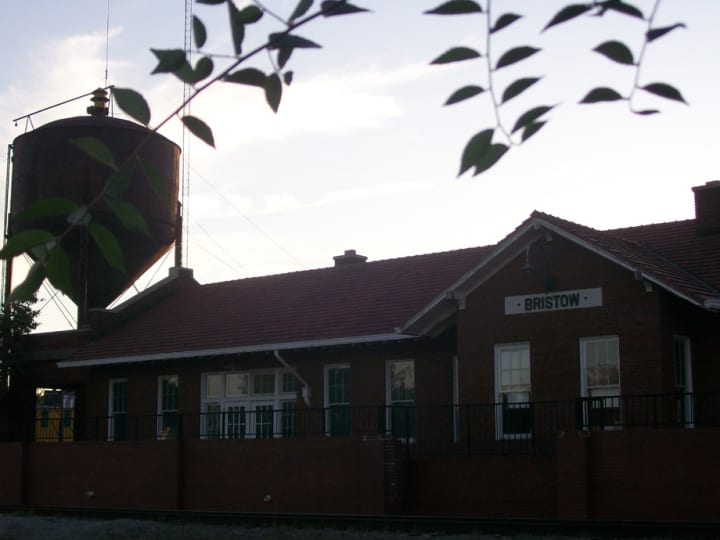
In 1898 the San Francisco Railroad Company (the “Frisco”) acquired 104 miles of right away for tracks from Sapulpa to Oklahoma City. When the line was completed between Sapulpa and Chandler, Bristow’s first depot was built, a wood frame structure located one block north of the current depot. In 1923, a “modern” structure was built between Sixth and Seventh streets, one block east of Main. It was all brick sporting a stucco interior and tile roof. It had a small baggage room, and, being built during segregation, had separate waiting rooms for blacks and whites divided by the ticket office. Use of the old frame depot was then dedicated to freight. Young and old alike find themselves highly fascinated by the overhead pull chain toilets still in use today, while a favorite of the youngsters is the Frisco caboose on display.
For forty-plus years, the new Depot was used for passenger train stops with up to six trains a day. Trains included such names as the Texas Special, Meteor, Will Rogers, Blue Bonnet, the Oklahoman, and the Firefly. The final passenger train ran on May 13, 1967 with runs between St. Louis and Oklahoma City.
With the halt of daily use, the Depot fell into a great state of disrepair. Somewhere along the way, the structure became the property of Burlington Northern (“BN”) and was eventually put on its “hit list” for demolition. Local historical building activists launched a campaign to save the building. After twelve years of lawsuits and intense negotiations to obtain the building, the group’s persistence paid off and BN signed the Depot over to the City of Bristow for the price of $1. The Bristow Historical Society then raised monies through private donations and fund raisers, including commemorative bricks still sold today, to refurbish the building. Today, the building, along with a matching town square, serves as museum of both static and rotating exhibits about area history and town founders from its early Indian Territory days to modern times. But the past reigns in the Depot building in more ways than one.
In 2006, a woman working at the Depot Museum began to experience some odd and even spooky happenings. Full of enthusiasm for her job, she began to rearrange things, moving a small railroad engineer doll from the main display room to be seated on a table in the lobby to greet guests. However, each time the woman left the museum and returned, the doll's detachable little engineer hat would be tossed onto the floor. Initially, she thought perhaps the table was being bumped by visitors and the hat was slowly working loose until it toppled from the doll's head. However, that theory was quickly ruled out when it happened even on days that the museum had no visitors at all. Her next theory was that perhaps the trains passing by on tracks very close to the building were shaking the floor, thus vibrating the table and dislodging the hat. Thinking to prove this theory, the woman vigorously shook the table the doll was seated on for some time but failed to make the hat pop off the doll's head. Making sure it was firmly in place, the woman went to lunch and returned to find the hat once again on the floor. She began to suspicion there was an entity in the museum that was unhappy with the relocation of the doll. Using scotch tape, she firmly affixed the little hat to the doll's head. For a week the hat stayed in place. However, promptly upon removal of the tape, she returned from lunch to find the hat on the floor.
Having heard stories that you could address a ghost and ask it to please stop causing a fuss, the woman gave the ghost a name, “Charlie” and asked him to stop throwing the hat on the floor because it was getting it dirty and could ruin it and if he liked the doll so much, surely he didn't want that to happen. She said, “I don't know why the name Charlie popped into my mind but that's how I addressed him - and I don't even know why I thought it was a “him”. Anyway, I just told him to stop throwing the hat on the floor and it stopped - at least on a daily basis. He only did it after that when big groups of children visited the museum. And it was during those times that he had a go at the shades as well.”
It seems Charlie wasn't too happy with lots of boisterous children in “his” Depot. On days when grade school groups visited the museum for “Pioneer School Days” to tour the museum and experience the early day school house exhibit, Charlie would express his unhappiness by causing the pull shades to fly up. The shades were raised and lowered on a daily basis and never malfunctioned but when the youngsters would enter the display room and were focused on the Founder of Bristow panel listening to their guide, the shade behind them would suddenly fly up and give the children a good startle. First there were yelps of surprise, followed by lots of giggles and many times the supervising teacher, with hand at throat, would laugh and remark that there must be a ghost in the Depot. The guide would smile in return and say, “It's been said we do have one.” The children's eyes would grow widely round. But, with no further elaboration, the guide would redirect their attention to the Early Statehood Main Street panel and the groups would move on.
Over time, the woman working at the museum began to notice other eerie things. For instance, when working late at night in a small office flanked by a panel of floor-to-ceiling windows, she felt as though she were being stared at and the hair on the back of her neck would stand up. Sometimes she chided herself for being a nervous Nellie and it would subside. Other times it would persist and seem to get stronger. On these times she would say, “Ok, Charlie. You're right. It's been a long day. I'm going home.” Then she would quickly clear out and leave Charlie to the darkness of peace and quiet.
On another day when entering the main display room, being somewhat of a “sensitive”, the woman “sensed” a presence just inside the door. She stopped and closed her eyes and let the vision unfold. What she got was images of a man in manacles waiting to be shipped out on the train. She also got images of a cowboy hat, boots with spurs, and a sheriff's badge. The woman tried asking historical society members if there had ever been any prisoners shipped through the Depot but if there had been there was none of such notoriety so as to have left local tales of it. However, this experience, together with the doll hat, shades, and being stared at, gave rise to her inviting someone in to do a paranormal investigation.
First, she called on a local man a Bristow newspaper article had indicated as having been involved some years back in an investigation done by a now disbanded paranormal investigation group called PROOF. That investigation had been of a local convenience store that had gained notoriety for being haunted. When the two of them entered the main display room, the man indicated that he immediately felt a temperature change but it was duly noted that there was no air conditioning in that part of the building so a temperature change wasn't particularly surprising. As they worked their way through the display room, the woman began to relate to the man the series of events that had prompted her to call him in. As they neared the far end of the room, the man held up one hand to silence her and then he stood very still. His pallor changed and he said he didn't like what he felt in that area. That it was a very “heavy”, “oppressive” feeling making his stomach feel extremely ill feeling. He apologized, indicating that he needed to exit the building. As he prepared to leave, the shade close to him flew up with a resounding pop and the shade pull danced crazily about. The man quickly exited to the front porch. He confirmed that in his opinion, there was some sort of entity in the building but that it wasn't something he wanted to try to work with on his own.
That's when the woman began to solicit paranormal investigation groups and OKPRI (Oklahoma Paranormal Research & Investigations) of Oklahoma City answered the call.
On August 26, 2006, members of OKPRI (www.okpri.com) did an investigation at the historical Depot Museum at 1 Railroad Place. The group's founder and director, psychic Christy Selfridge, indicated that she picked up on two impressions or residuals that could be attached to some of the donated items in the museum and one intelligent. She explained that an intelligent is a spiritual being that has the capability to interact and communicate while residuals are like a point in time that replays like watching a movie.
One residual of a young couple in their twenties arguing was detected in the south end of the museum. Selfridge believes they were perhaps man and wife from the early 1940s. The man was leaving the woman and she was begging him to stay. This was the area the former PROOF investigator felt such strong discomfort, perhaps sensing the emotional upheaval.
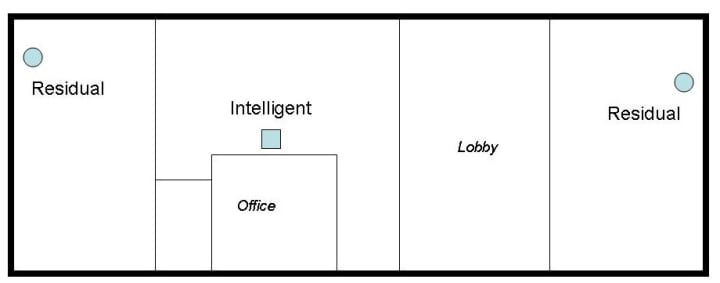
The other residual happened in the north end of the depot and was again a couple, but with darker skin, perhaps African American or Native American descent. The man, approximately late 30s or early 40s, was angry over either word or deed that he felt was an injustice and his smaller, lighter complexioned wife, or female companion was attempting to calm him down and get him to think before he acted.
The intelligent, however, was a middle aged man that Selfridge indicated was pacing agitatedly in the mid portion of the depot. He was clean shaven, light brown hair, denim overalls and a light colored cap that was flat on the top perhaps from the 1960s era. He was sullen and wouldn’t speak with her but she sensed he didn’t appreciate all the bustle and intrusion, preferring the quiet and wanted everyone to leave. He paced continually watching the investigation. Selfridge was confident that though he was resentful of the intrusion, he was not a spirit to be feared and would cause no harm. She felt he was merely territorial or protective of his domain.
Interestingly enough, in the 1960s, a railroad worker died in what is now the lobby but he was a much older man at the time of his death than the spirit Selfridge described. Could it actually be the railroad worker appearing as he was in his prime when he started his job at the depot? Or could it be the spirit of someone reported to have been killed nearby in a long ago car-train accident as others have suggested?
And finally, right before the woman left her employment at the Depot she may have actually heard Charlie. She had her small puppy with her in a pet carrier sleeping peacefully while she worked at the computer. Suddenly, the usually quiet puppy awakened and began to fret. As the woman turned to check on the puppy, he was backing away from the side of his carrier, as though retreating from something and whining. It was at this point the woman heard a distinct voice say “helloooo”. The puppy yelped and the woman became startled. She immediately toured the building and looked out windows to see if anyone were on the premises but found no one in the immediate area. Going into the lobby, she saw a vehicle parked curbside in front to make deliveries of items for an auction to be held later that week. The woman stepped out to greet the deliverer and laughingly told the delivery driver how she had frightened her with her “hello” a moment ago. The delivery woman looked puzzled and said she had only just arrived and exited her vehicle that very moment. So, who offered the “helloooo”, and why at that particular time? Perhaps Charlie had a fondness for puppies?
If ever you are in the neighborhood, be sure to stop by the Depot Museum and tell Charlie hello. Perhaps he'll roll a shade up for you or respond with a personal “hello” of your very own.
***********************
I hope you enjoyed this excerpt from my book. Other stories are:

***************
For more about me:
Other stories by me on Vocal:
About the Creator
Pam Reeder
Stifled wordsmith re-embracing my creativity. I like to write stories that tap into raw human emotions.
Author of "Bristow Spirits on Route 66", magazine articles, four books under a pen name, technical writing, stories for my grandkids.
Keep reading
More stories from Pam Reeder and writers in Horror and other communities.
"Scream 7" (2026): Running out of Fresh Screams
This is the seventh time we’ve had a Ghostface crisis. Scream 7 is the latest edition of the Scream franchise. Sydney Prescott and her family are under attack by another anonymous killer dressed in a Ghostface costume. While having issues with her daughter, Tatum, they run from the bloody murders, trying to determine who is behind it all.
By Marielle Sabbag9 days ago in Horror



Comments
There are no comments for this story
Be the first to respond and start the conversation.