

Telling lies had never really been a talent of hers, despite what everyone said.
And despite their best attempts- the word ‘best’ being used here sparingly- the people of Medenbrooke’s mutterings were not quite as private as they thought they were.
To be fair, it was a small town, nestled within a rocky tangle of mountains so settled they could now only be considered glorified foothills. The nearest grocery store was thirty miles away. Their sister school was close to fifty. Every citizen could name at least five of their neighbors, mainly because that was about the number of houses placed in a mountainside cluster.
There were no suburbs in Medenbrooke, and the only real civilization to be found was whimpering among the shambling remains of Main Street, the businesses there either limping stubbornly for sixty years on the corner or pitifully dying out in a matter of weeks.
It was easy to be pulled into the lull of passerby conversations as a person walked among the storefronts, picking out names like they were objects in the world’s worst scavenger hunt, the shapes they took obvious and familiar.
So, when Ms. Peterson approached her at the tender age of seven and asked her why she let the house burn, Tara wasn’t surprised. To be honest, the gossip was such a town comfort, she couldn’t really fault them for it.
It was when they didn’t like the answer that things got a little messy.
In seventh grade, Remington Malone decided to place the events of her life on a timeline and pin it to the school’s bulletin board.
It started with the fire because of course it did. To everyone else, Tara didn’t have a life before the night the moon was blotted out by smoke. She didn’t exist before the headlines of the local paper claimed her name and face on its measly front cover.
A short snippet of the story had separated her own picture from that of her mom and dad’s in the eulogies column. A simple overhanging of fifty-sixty words, a change in perspective, and her family had been cut in half-- her parents on the side of peaceful mourning, and she a seven-year-old murder suspect.
Mr. Thompson, the editor of the local paper, was always pleased to remind her it had made great news.
The timeline ended with a little stick figure drawing of her waving a fan at the flames bursting from behind a cafeteria counter, the word arsonist arched above her simple circle head like a strange pantomime of an angel’s halo. Scattered around her legs were the burnt remains of the French fries meant to be served last Friday.
And, seeing everything laid out as it was, her life bookended by ash and smoldering all the years between, the title of arsonist settled on her shoulders with the same familiarity of an old coat, radiating a warmth that felt a lot like those first faint flickers of flame.
Her grandmother adopted her the way people adopt strays that linger outside their homes for too long. At a certain point, it’s either time to take ownership or send them out to a nice field where other animals go when it’s no longer convenient to keep them around.
Since there weren’t any lovely little fields for children to go to, Mamaw really only had pick of the former.
Tara’s belongings had fit into a worn K-Mart shopping bag, its plastic littered with so many tears and punctures it wasn’t even suited to hold a person’s groceries, much less the contents of their entire world.
None of her clothes survived the fire. Her stuffed animal friends had also found their end the same night her parents did. Tara used to like thinking they had found the field where all the other animals go to when they leave. When she told her grandmother this, Mamaw settled deeper into her chair on the porch, her face pinched as if she smelled something awful, and said, “Ash can’t find salvation. It gets sucked down to the flames of Hell.”
Mamaw and Tara didn’t speak much to each other after that.
The only things that had made it into her bag was the teddy bear the town therapist had given her, affectionately gifted under the name Teddy Trauma, and a sleek black book Tara had found lying outside the flames’ reach the night of the fire. Half-submerged within the weeds surrounding her mom’s garden, she would have missed it entirely had its cover not reflected the light of the house so easily.
It had been confiscated by the police during their initial investigation. They had analyzed it for fingerprints, thinking maybe it belonged to the person who lit the match, but everything came back inconclusive. To this day, they were still divided on whether or not the case was even criminal in nature. The fire wasn’t right, they said. There was no origin point that they could find, and from what Tara overheard sitting in the sheriff’s office, that was apparently impossible.
At least, it was supposed to be.
After finding no fingerprints other than her own and sifting through the book’s pages only to have blank ones stare back, the police didn’t see a reason to keep it from her. They didn’t react when she told them about the drawings on the inside cover, or the strange words bordering the pages’ corners. She was their problem child, the darling victim of the week, and the only plausible subject in a double homicide that probably wasn’t even that, all in one. They set up her therapy appointments like they were checking off boxes on a list, gave her a coloring book and a few crayons to keep her occupied until social services could pick her up, and didn’t pay attention to how her eyes unfocused on the book’s oily cover, how her fingers traced designs only she could see.
Not that their disregard had mattered to her at the time, Tara was just happy she got her book back.
When Tara was seventeen, the edge of Mamaw’s dress went up in flames and took her with it.
She’d burned like kindling, lighting up like the ready end of a match and consumed just as quickly. There’d been no time to help her, and some withered part in Tara liked to ask if it would have been worth it had they been able to. It liked to ask these questions at night. When the darkness outside was just begging for a spark to light up the gloom.
She hadn’t been expecting the $20,000 left in Mamaw’s savings.
If there had been any other relatives, she probably never would have seen it, to be honest. But, in the end it had only been the two of them, so everything slid neatly into her hands. And it was enough. Enough to pay the bills, enough for food and water until she could graduate high school in the next few months and pin down a job, no matter how unlikely that was with her sparkling reputation.
Now that the house was empty, she kept the book out more.
It had always unsettled Mamaw, with its sleek cover and perfect pages. The way it wouldn’t catch flame when she lit a match beneath it or would somehow always appear right back in Tara’s K-Mart bag, whole and intact, after being torn to shreds and buried beneath the damp soil in the backyard.
Tara would sit with it during the evenings, while the sun was dipping low beneath the worn tops of the Smokies outside and watch as day by day the ink grew darker on its blank pages. She would watch as the designs on its inner cover grew and spiraled, bleeding into the next page and the next, its pages turning like eyes blinking.
Watching and being watched.
It made her wonder what the trade was. Because that was what it felt like, with each new dark tendril reaching towards her.
Like a purchase and a promise all in one.
Remington Malone’s timeline had apparently been updated.
It had greeted her differently this second time around, nailed to her front door. Without an audience it felt less like a schoolyard taunt and more like the scared question that came after the taunting had gone on long enough.
The old I know I broke you, are you going to break me now?
Bold of him to assume he had even left any cracks.
Murderer was now sprawled alongside arsonist, twin titles circling her head like a crown. The little figure of her was sitting on Mamaw’s grave, a lit lighter resting in her hand. Funny how inaccurate it was. Tara had never touched a lighter in her life.
The book hung at her side, clutched against her as it always was now. Its cover burned against Tara’s palm.
She thought about taking the timeline down, but her hand stalled before she could tug at its edge.
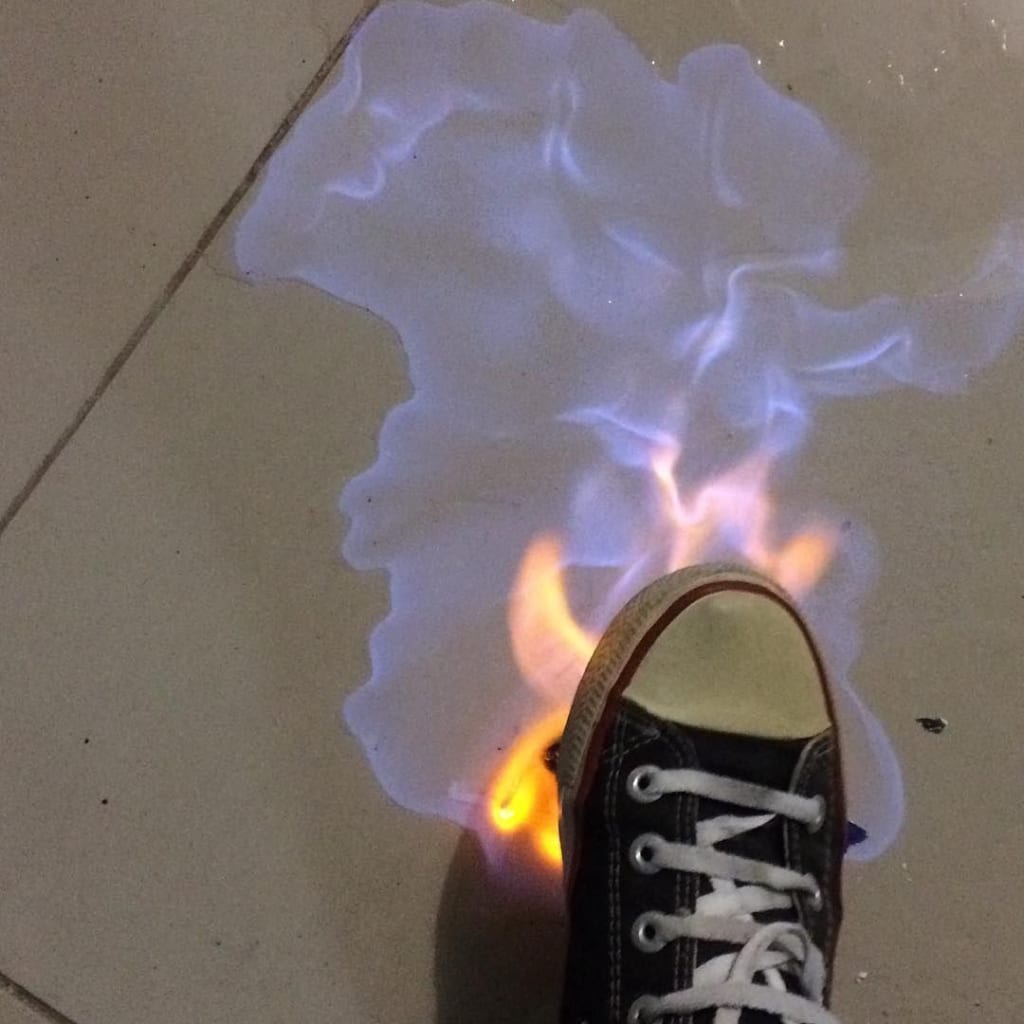
Instead, that old warmth began to grow inside her, rippling beneath her skin, crawling from the pages tucked against her. It ripped through the middle of the timeline first, consuming the French fries at her seventh-grade feet in an ironic second death. Pockets of embers erupted from the paper’s edges inward; they clawed their way from the middle-out, until nothing but the metal nail lodged in her door remained.
And as Tara watched the ashes sift lazily in the breeze, she could almost hear Mamaw’s words in her ear, sharp and cold.
She smiled.
The book was right. Better to let it burn.
About the Creator
One to See, One to Speak, One to Listen
Contains gore and horror some readers may find disturbing. Rated 14+ Author's Intro: This story is meant to revive the Gothic literature so famously crafted by one of my favourite writer's, Edgar Allen Poe, and as such, the language and style is deliberately antiquated. Thank you for reading my all time favourite work of horror - Les
By Call Me Les18 days ago in Horror




Comments
There are no comments for this story
Be the first to respond and start the conversation.