
Beyond the Trees: The Unforgettable Whispers of the Forest
When Darkness Devours All You Know, Leaving Only Haunting Memories


Do not venture into those woods after dark. It was one of those admonitions you grew up hearing, whispered by everyone in this town, as though it were a sacred truth passed down through generations. A warning etched into the very fabric of our childhoods, like the old tales of monsters under the bed or the dangers of swimming too soon after eating. Stories you eventually outgrew, realizing they were little more than tools to keep you safe, to keep you in line when you were too young to understand the world’s true dangers.
But as we grew older, those little myths unraveled. We learned the truth about Santa Claus, dismissed the idea that swallowed gum would linger in our stomachs for seven years, and shed the naivety of childhood. All except for the woods. The woods remained shrouded in mystery, in fear. There was something wrong with them—something no one could explain, but everyone felt. My parents spoke of it, my grandparents, my teachers, my neighbors. "Do not go into the woods after dark," they would say, their voices firm, their eyes dark with something unspoken. And that was that. No further explanation. No room for questions. Any attempt to ask was met with sharp rebukes, with a fear so palpable it silenced you.
It wasn’t like the other lies adults told us. Those were met with gentle smiles or awkward deflections. But this? This was different. There was a weight to it, a dread that clung to their words. And it wasn’t as though anyone had made it up. No one went into those woods after dark, and those who did either returned broken or didn’t return at all.
John Pfeiffer, the man who used to own the liquor store in town, was one of them. He’d gone deer hunting one crisp November morning. I suppose he must have followed a path too far, lost track of time, and found himself caught in the woods as the sun dipped below the horizon. His wife spent the entire night at the edge of the trees, screaming his name, her voice raw and desperate. The sheriff had to tie her to a tree just outside my bedroom window to keep her from running in after him. She stayed there, her arms bound, her cries piercing the night, until the first light of dawn. My parents sat on the back porch, watching her, ensuring she didn’t break free. I stayed in my room, as I was told, but her sobs seeped through the walls, through the window, into my very bones. I can still hear them, still see her silhouette under the cold moonlight, already mourning though he was not yet gone.
They found John the next day, but he wasn’t the same. He muttered incoherently, his body trembling, his eyes vacant. I never saw him myself—I was too young—but that’s what people said. That’s how they all were when they came back. They wouldn’t eat, wouldn’t drink, wouldn’t speak. It was as though the last of their strength had been spent stumbling out of the woods, and there was nothing left. Nothing at all.
The one I saw like that was Doreen. She and her twin sister, Becca, had decided the stories were nonsense when we were sophomores in high school. They went into the woods at night, despite all our warnings, despite everyone’s warnings. I don’t know if that made Doreen brave or foolish. I don’t even know if it matters. Doreen came back, but Becca did not. We tried to ask her what happened, but she just stood there, her body rigid, before collapsing to the floor, foaming at the mouth, murmuring something no one could understand. Her eyes were bloodshot, wide and darting, the only movement she made. And Becca? Becca was never found.
I suppose that’s why I’m writing this now. Because I know that in a few hours, I’ll either be a Becca or a Doreen. I hope someone finds my body with this note, so my parents aren’t left with the horror of seeing me wide-eyed and bloodied, my soul shattered by whatever lurks in those woods.
Take this as my apology. For what it’s worth, I am truly sorry. Maybe this is dramatic, but I need to explain. I don’t think smoking weed was morally wrong, but I know my parents will be disappointed to learn what I was really doing. I wish it wasn’t something that would hurt them. Fred and I panicked when the cops showed up at our door. We jumped out the back window and ran straight into the woods. We weren’t high, just not thinking clearly, not realizing the gravity of our mistake until it was too late.
It took us a while to understand what we’d done. Not the running from the law—the running into the woods. By the time we realized where we were, the adrenaline had worn off, and we were surrounded by nothing but trees and darkness.
We tried not to panic. We’d both heard the stories, knew what had happened to everyone who’d done what we’d done. So I’m writing this, hoping that if I record what happens here, it might help someone understand. I don’t have much time left, and I’ve already wasted too much of it explaining.
Fred froze when he realized where we were. He just stood there, shaking, silent. I tried to snap him out of it—shaking him, yelling, even slapping him—but nothing worked. He was paralyzed by fear. So I told him to stay put while I tried to retrace our steps. There was a small path that seemed to lead back toward town, or at least in the direction I thought town was. I followed it, leaving Fred by a massive, egg-shaped boulder.
I walked for about ten minutes, rounding the side of a steep hill. I could hear a river to my left, and the moonlight provided just enough light to see. The sound of crickets was oddly comforting. But then the path led up the hill, and when I reached the top, everything changed.
It was like stepping into another world. The air, once cold and crisp, became heavy with heat and humidity. The crickets fell silent, and the river’s sound vanished. The silence was deafening, the kind that makes your ears ring. I started sweating, my body trembling as though it knew something was wrong. The back of my neck prickled, the way it does when you feel someone watching you in the dark. And I knew—I knew with absolute certainty—that something was out there, watching me.
I looked around, but the darkness was impenetrable. I thought I saw faint dots of light in the trees—eyes, perhaps. I didn’t wait to find out. I turned and ran back toward Fred as fast as I could.
But Fred wasn’t where I’d left him. He was gone. I called his name, screaming into the darkness, not caring if whatever was out there heard me. For a moment, there was no response. Then I heard his voice in the distance. I ran toward it, stopping to call his name again, hoping to gauge how close I was.
Fred’s voice called back, closer this time, but something was wrong. It wasn’t Fred. The voice was off, distorted, like a bad imitation. It was subtle but unmistakable—a guttural, nails-on-a-chalkboard sound that sent chills down my spine. And it was calling my name.
How did it know my name? The pronunciation was slightly off, like a parrot mimicking human speech. I ran in the opposite direction, as fast and as far as I could, before collapsing behind a tree to catch my breath. And now I’m here, writing this, the sound of that voice still echoing in the distance.
It’s calling my name, over and over, growing more desperate, more afraid. It’s trying to sound like Fred, trying to lure me in. But it doesn’t matter how far I run or how well I hide. It’s following me, and I can feel it getting closer.
About the Creator
Pedro Wilson
Passionate about words and captivated by the art of storytelling.
Keep reading
More stories from Pedro Wilson and writers in Horror and other communities.
The Nightly Reaping: When Shadows Come for Our Souls
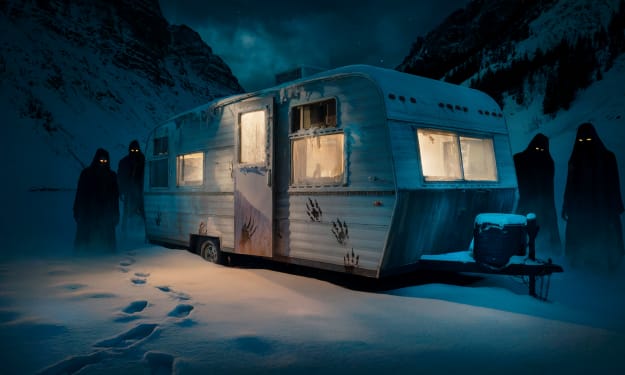
I was but fifteen years old when my father and I sought refuge in that ancient trailer nestled deep within the valley. It was a wretched place, barely functional, where the bathroom doubled as the kitchen, and there was no shower to speak of. In the winter, the pipes would freeze, and the tiny room we shared was scarcely warmed by a feeble space heater.
By Pedro Wilsonabout a year ago in Horror
The Vanishing Lighthouse Keepers
The Flannan Isles Lighthouse stands on the largest of a group of remote islands in the Outer Hebrides of Scotland, built in 1899 to warn ships away from dangerous rocks that had claimed countless vessels over the centuries, and it was staffed by teams of three lighthouse keepers who rotated in shifts to maintain the light and keep detailed logs of weather conditions and everything that occurred during their watch, following strict protocols established by the Northern Lighthouse Board that governed every aspect of their duties and responsibilities. On December 26, 1900, the relief vessel Hesperus arrived at the island to bring supplies and rotate the keepers, but when Captain James Harvey approached the landing area, he immediately sensed something was wrong because there was no flag flying on the flagpole as there should have been, no storage boxes waiting on the platform for the supplies being delivered, and no keepers waiting at the landing to help secure the boat and unload the cargo as protocol required, and when he sounded the ship's horn repeatedly and fired a flare to signal their arrival, there was no response from the lighthouse despite the fact that someone should have been on duty and watching for the relief vessel.
By The Curious Writerabout 14 hours ago in Horror


Comments
There are no comments for this story
Be the first to respond and start the conversation.