
Beneath Paris: The Cruel Kingdom of the Catacombs
“Arrête! C’est ici, l’empire de la mort.” Halt! Here is the Empire of Death.

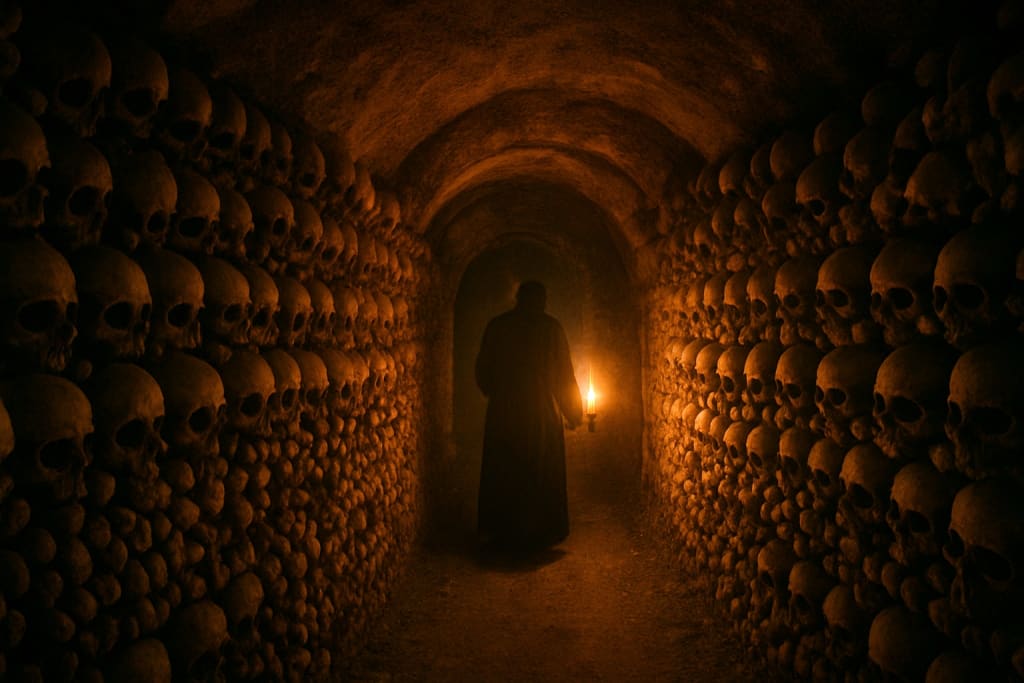
The warning carved above the entrance to the Paris Catacombs is not a metaphor—it’s a promise. Thirty meters beneath the boulevards of the City of Light stretches a labyrinth of bones and silence. A subterranean empire built from cruelty, disease, and fear. Six million dead arranged into art. Six million stories silenced.
When Cemeteries Became Death Traps
By the mid-1700s, Paris was choking on its dead. Centuries of burials at Les Innocents Cemetery had turned the ground toxic. The stench of rotting flesh thickened the air, while overflowing pits sent corpses spilling into cellars. Neighbors fell ill from contaminated wells. Residents wrote of nights when a foul mist rose from the cemetery and blanketed entire streets.
The city needed a solution—and chose brutality masked as practicality. Between 1785 and 1787, wagons creaked through Paris after dark, stacked high with bones. Processions of the dead moved silently from cemeteries to abandoned limestone quarries beneath the city. There, engineers created a vast ossuary—an underworld carved out of rock and grief.
Louis-Étienne Héricart de Thury, the inspector charged with organizing the Catacombs, didn’t settle for anonymity. He arranged skulls and femurs into walls, arches, and mosaics. The dead became decoration, stripped of names and dignity, rebuilt as grotesque monuments. Equality at last—paupers, plague victims, nobles—all reduced to pattern and spectacle.
A Candle Goes Out
No story embodies the cruelty of the Catacombs more than that of Philibert Aspairt.
In November 1793, Aspairt, a doorkeeper at Val-de-Grâce Hospital, descended into the tunnels—perhaps seeking a rumored cache of liquor hidden by monks. His candle sputtered out, leaving him alone in infinite blackness. For eleven years, his body lay undiscovered, only meters from an exit. When cataphiles finally found him, a key ring identified his remains.
His grave still lies within the Catacombs. Some say his spirit wanders every November 3rd, searching for light that never comes. But the true horror isn’t spectral. It’s the thought of his final moments—his breath quickening, hands outstretched in suffocating dark, as Paris continued to laugh and live above him.
The Cataphiles: Dancers in the Dark
Official tours show just two kilometers of the Catacombs. But beyond sealed gates stretches a forbidden maze of more than 300 kilometers of tunnels. Since 1955, it has been illegal to enter—but that hasn’t stopped the “cataphiles,” urban explorers who slip past barriers and vanish into the labyrinth.
They speak of underground gatherings, graffiti-covered chambers, secret concerts, and even a fully equipped movie theater once hidden in the depths. When police discovered it in 2004, a note was left behind: “Ne cherchez pas.” Don’t search.
But cruelty stalks trespassers as surely as shadows. In 2017, two teenagers became lost for three days. When rescuers finally pulled them out, their bodies were hypothermic, their minds fractured by fear. The Catacombs have no mercy for those who underestimate them.
Legends Etched in Bone
The Catacombs invite myth as much as they hold history.
• Explorers whisper of a camcorder found in the 1990s, its footage showing a man running, panicked, before the recording cuts off. He was never seen again.
• Visitors report phantom lights, disembodied voices, and footsteps echoing just behind them. Some claim to hear faint singing, as though the dead themselves hum lullabies to the lost.
• Guides have spoken of sudden cold drafts that extinguish lamps without warning—reminders that in this kingdom, light is a luxury easily stolen.
Whether legend or truth, one fact remains: even the living walk here at the mercy of the dead.
The Cruel Beauty of the Empire of Death
The Paris Catacombs are a paradox—an atrocity turned into attraction, cruelty arranged as beauty. They were born out of necessity, yet curated with indifference. Millions reduced to ornamentation, stripped of identity, forced into patterns meant to awe the living.
And still, people line up every day to descend into the tunnels. They pass beneath the arch that declares, "Here is the Empire of Death," and step willingly into history’s coldest embrace. Some leave with photographs. Some leave unsettled. Others swear they hear whispers urging them to stay.
Soon, the Catacombs will close temporarily for restoration, preserving fragile bones and damp walls for future generations. But no renovation can erase what lies at their core: the cruelty of a city that transformed death into spectacle—and built a monument not to remembrance, but to forgetting.
Why This Story Endures
The Catacombs are more than Paris’s underworld. They are proof of humanity’s strange relationship with death—our ability to turn tragedy into art, suffering into tourism, cruelty into curiosity.
And as long as people keep descending into the tunnels, the dead will keep their silent watch, reminding us: in the end, we all join the empire.
About the Creator
E. hasan
An aspiring engineer who once wanted to be a writer .


Comments
There are no comments for this story
Be the first to respond and start the conversation.