

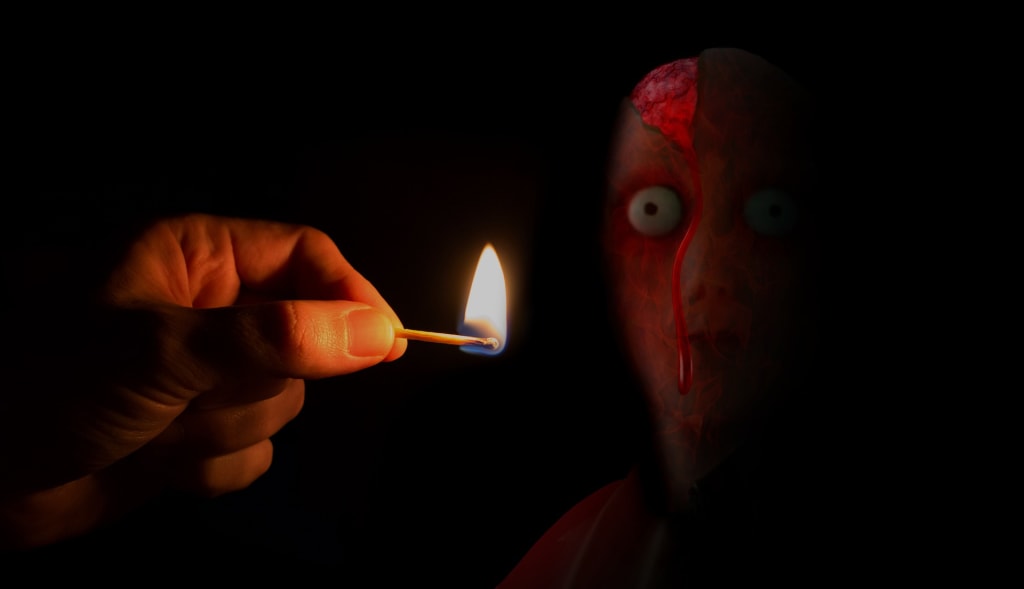
The last bit of orange faded from the sky, leaving behind a bruise of purple. Ten-year-old Leo curled up on his bed, making it feel like a lonely island amid the growing darkness of his room. His parents were downstairs, laughter echoing faintly. But up here, in the deepening shadows, something else stirred.
It began quietly. A faint creak of the closet door, a whisper that almost sounded like his name, carried by a breeze that didn’t exist. Leo shut his eyes tight, trying to will it away. He remembered the rules: don’t look, don’t listen, don’t even think about it.
But the fear crept up his spine like a cold, clammy hand. He glanced towards the space under his bed, a black void now yawning wide. He could almost sense something lurking there, heavy and breathing, unseen eyes locked onto him.
A slow, deliberate scrape echoed from beneath. Not the noise of dust bunnies shifting, but something purposeful. Leo’s breath caught in his throat. He tugged the duvet closer, hoping the thin fabric could protect him from the fear he couldn’t see.
Another scrape, this one closer. The wooden floor vibrated with an unsettling energy. Leo could picture it now—a formless shadow pressing against the dusty underside of his bed, long, spindly fingers reaching out, reaching…
He squeezed his eyes shut again, tears threatening to spill. He wanted his mom or dad, anyone. But deep down, he knew that if he called out now, it would only draw it nearer.
Then, a final chilling rasp came from beneath the bed, followed by an eerie silence that felt heavier than the darkness itself. Leo held his breath, every muscle tense. Had it left? Was he safe?
Then came the slow, deliberate creak of his closet door.
He didn’t scream. He couldn’t. A pair of glowing yellow eyes, impossibly large, blinked in the small crack of light. And a wet, close whisper brushed against his mind—not his ears.
“Sleep now, little one…”
The Boogeyman: A Shadow in Our Shared Nightmares
We’ve all experienced it, right? That feeling of being watched from the shadows, the creak of floorboards sending chills through us, the irrational fears hanging just out of reach of the bedside lamp. For many of us, these childhood terrors manifest in one haunting figure: the Boogeyman. This shadowy creature lurking under our beds, hiding in closets, or just beyond our line of sight. But who is this eerie being that has haunted kids' dreams for ages? Let’s explore the strange origins and the lasting power of the Boogeyman as a captivating yet unsettling folk figure.
Whispers in the Dark: Unearthing the Origins
The Boogeyman isn’t a new concept. Its roots dig deep into the history of storytelling, intertwined with our instinctive fear of the unknown and the dangers that lay hidden in darkness. Before we had electric lights to cast away the night, that darkness was a very real menace, a time when predators were real threats, and our imaginations could conjure up all kinds of horrors.
Consider this: early humans faced genuine dangers after dark. The rustling of leaves could mean a wild animal was nearby, and the snap of a twig could indicate an approaching enemy. The Boogeyman, in its earliest forms, likely represented those very real fears, a way to explain the unexplained noise in the night and that unsettling sense of being watched.
As time went on, these fears evolved, weaving their way into folklore and passing down through generations. Many cultures have their own interpretations of the Boogeyman, each one with slight variations but sharing a common theme: creatures of darkness that prey on the vulnerable, often children.
The Many Faces of the Boogeyman
What we call the Boogeyman in English-speaking cultures goes by many names elsewhere. In Spain and Latin America, you’ll find “El Coco” or “El Cucuy,” a shape-shifting being that snatches up naughty kids. In Portugal, it’s known as “O Bicho Papão,” which literally translates to “the beast that eats mush,” a frightening figure used to get kids to finish their meals. France has "Le Bonhomme Sept Heures," or the seven o'clock man, who targets children still awake past their bedtime. Even in Slavic folklore, there are similar figures tied to forest spirits or dark entities that punish misbehavior.
These varied names and slight differences in appearance showcase the adaptable nature of folklore. The Boogeyman is not a singular, fixed being but rather an amalgamation of fears and anxieties that manifest differently in various cultures. What remains constant is the Boogeyman’s role as a cautionary figure, a creature used to enforce rules and keep children safe—or at least attempt to.
Why the Boogeyman Gets Under Our Skin
What makes the Boogeyman so powerful is its skillful wielding of suspense. Unlike a clearly defined monster with exact powers and weaknesses, the Boogeyman is deliberately vague. We don’t know what it looks like. Is it a hulking brute? A shadowy figure with glowing eyes? A whispering presence? This lack of detail lets our imaginations fill in the gaps, often creating something far more terrifying than any creature from a horror movie.
The suspense also comes from the Boogeyman’s preferred method of attack; the unseen. It hides in darkness, underneath beds, in closets—places the light can't reach, where our vision is limited and fears can run wild. This taps into a deep-rooted human instinct to fear the unknown, what we can’t see or understand.
Think back to the story at the start. The real terror wasn’t in a gory display but in the gradual buildup of dread, the presence lurking just out of sight, the whispers in the dark. This is the essence of the Boogeyman’s chilling power—it feeds on our anxieties, vulnerabilities, and vivid imaginations.
The Boogeyman's Impact
While the Boogeyman may seem like just a figure meant to scare kids, its impact is much more complicated. Traditionally, the Boogeyman has been used by parents to enforce discipline. “Behave, or the Boogeyman will get you!” is a warning that, although perhaps ethically questionable today, was effective at instilling fear and compliance.
Additionally, the Boogeyman helps children confront their fears of the dark and the unknown. By giving these abstract fears a tangible form—even a frightening one—kids can start to face and process them. The fear of the Boogeyman, while disturbing, often serves as a stepping stone toward understanding more rational fears.
Furthermore, the Boogeyman has inspired countless works of art, literature, and film. From classic horror stories to modern thrillers, the concept of an unseen, malevolent force lurking in the dark continues to fascinate and terrify audiences. The Boogeyman, in its many forms, enables us to explore our deepest fears in a safe, if unsettling, manner.
The Enduring Shadow
The Boogeyman might be a product of our collective imagination, but its power and influence are undeniable. It’s a reminder of our primal fears, a testament to folklore's strength, and a compelling study in the psychology of suspense. While we might outgrow our childhood fear of the monster under the bed, the underlying anxieties that gave rise to the Boogeyman—the fear of darkness, the unknown, and vulnerability of childhood—often persist, shaping our fears and influencing our stories for years to come. So next time you hear a creak in the night or feel a chill run down your spine in the dark, remember the Boogeyman, that lingering shadow in our shared nightmares, and the long, fascinating history it carries. Just try not to look under the bed. You never know what you might find.
About the Creator
Ashraf Almamlouk
A passionate writer, graphic designer&animator. I have a deep love for storytelling and a talent for creating engaging content from children’s fairy tales to explorations of the world’s mysteries, My works aim to entertain, and inspire.
Keep reading
More stories from Ashraf Almamlouk and writers in Horror and other communities.
Bloody Mary
For as long as we can remember, people have had a penchant for sharing eerie tales that send chills down our spines and make us glance nervously at our reflections or in the shadows of dimly lit rooms. Among these unsettling stories, one name looms large: Bloody Mary. This figure has been a staple of playground myths, sleepover dares, and campfire scares for decades, if not centuries. But who exactly is Bloody Mary? What’s the story behind this legend, and why does it continue to captivate our imaginations? Let’s explore the lore, origins, and lasting influence of this notorious figure.
By Ashraf Almamloukabout a year ago in Horror
Someone Has Been Watching Me My Whole Life
The first time I saw him, he was standing beside my mother’s grave. Clad in a black coat, with no umbrella and an emotionless face, he stood perfectly still. Rain soaked his hair, yet he didn’t move, only gazing at her name carved into the stone. When he caught me watching, he looked up and smiled.
By Rosalina Jane7 days ago in Horror

Comments
There are no comments for this story
Be the first to respond and start the conversation.