
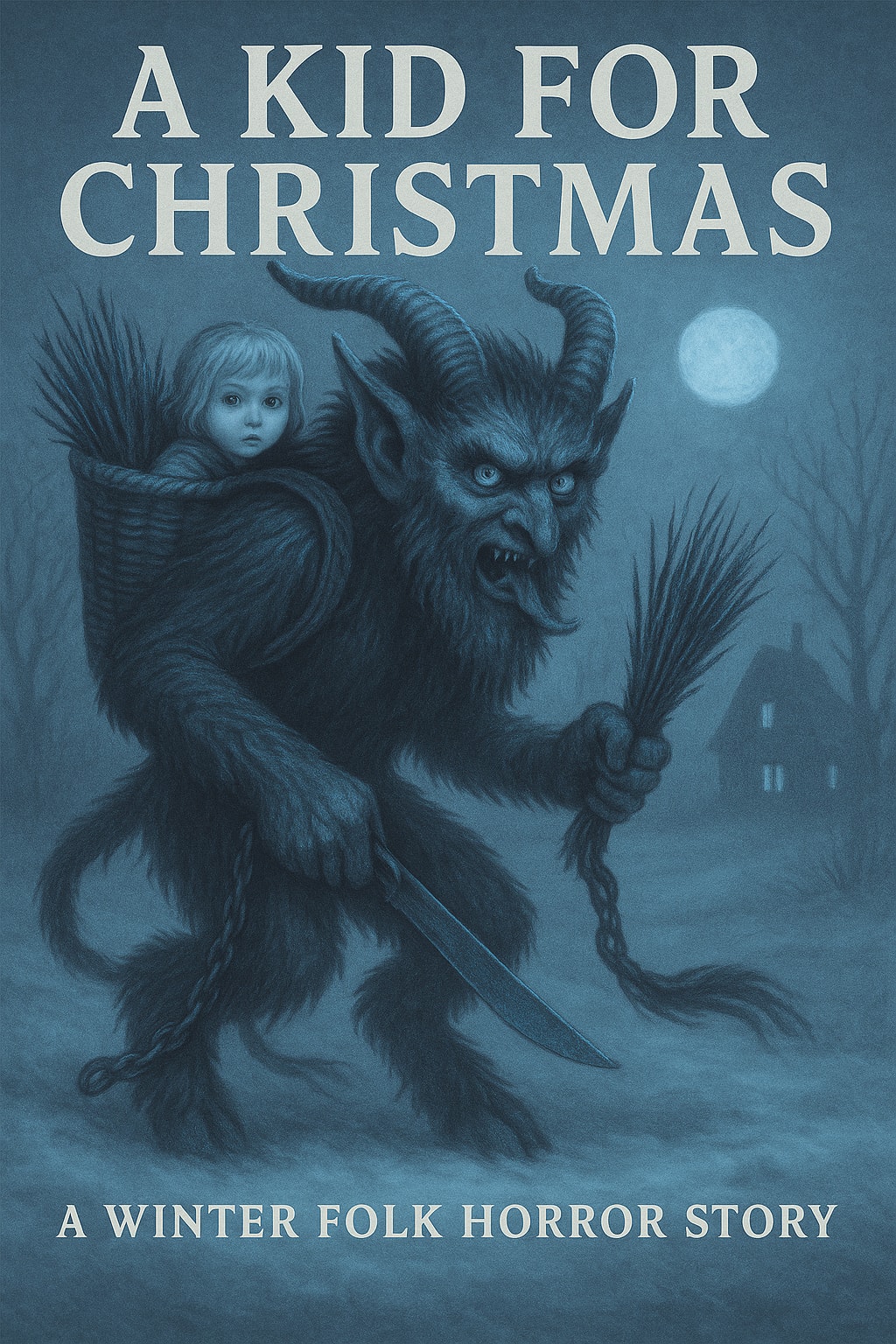
A Kid For Christmas – A Horror Story
Part 1 – The Frost Begins
In the remote, snow-choked village of Ghrimwald—nestled like a forgotten secret between the jagged teeth of the northern Carpathians—winter came not with warning, but with vengeance. The first frost arrived in late October, weeks before the solstice, creeping across windowpanes like skeletal fingers clawing from the other side of the glass. Trees groaned beneath a weight they hadn't carried in decades. Smoke from chimneys twisted unnaturally, curling back toward the earth as if afraid to rise.
Children, wide-eyed and shivering despite layers of wool, whispered after bedtime of strange sounds in the night—deep, rhythmic thuds that shook the snow from pine boughs, leaving behind prints too wide for wolves, too deliberate for bears. deer. Never deer. These tracks bore the mark of something older. Hungrier.
The elders—those weathered souls whose eyes held memories of famines and silent nights—would cross themselves at the mention, repeating the same warning like a prayer:
“When the air tastes like iron… he walks.”
And that night, as if in reply, every fire in Ghrimwald sank low—
as though even the flames feared to burn too brightly.
Part 2 – The Forgotten Bell
At the heart of the village stood St. Hedwig’s Chapel, its stones blackened by centuries of smoke and sorrow. The bell tower leaned slightly, bowed beneath the strain of time, and within it hung a bell forged not of bronze, but of an alloy said to contain melted-down church silver and the teeth of repentant sinners. The villagers called it Die Stille Glocke—the Silent Bell.
Legend claimed it would ring only when the veil between worlds grew thin enough for darkness to step through.
It had not tolled in over a hundred years. since the Great Winter of 1825, when three children vanished without a trace and the snow turned crimson near the well.
But on the third night of the early freeze, as the wind shrieked through the pines like a chorus of lost souls, the bell rope—dry-rotted, brittle—began to tremble.
No hand touched it.
No wind stirred it from below.
And yet…
Bong.
A single, shuddering note rolled across the village—deep enough to rattle teeth, slow enough to echo in the marrow.
At the edge of the forest, something stirred.
And from the throat of the black woods came a reply—
not a howl, not a growl,
but a low, guttural chime.
As if chains were being dragged
across frozen bones.
Part 3 – The Child in the Basket
Little Ilsa Kruger was seven winters old, with hair the color of winter wheat and a laugh like snow sliding off a roof. She vanished on the third night, just after curfew. Her mother, Marta, had tucked her in with a kiss and a whispered carol. When she checked at midnight, the bed was smooth, the covers neatly drawn, the porcelain doll still propped against the pillow.
Only the window held a new signature: frost etched into the unmistakable shape of a forked hoof—steaming faintly in the cold.
By dawn, the entire village was out with torches and hounds. They combed the forest for miles, shouting Ilsa’s name until their throats burned raw.
Nothing.
Only a woven basket—crafted from river reeds and bound with black twine—found half-buried in a drift near the old birch grove.
Inside:
a single lock of blond hair, tied neatly with red thread.
And on the snow beside it—
the faint impression of a child-sized handprint…
frozen solid.
Part 4 – The Old Stories
That evening, the tavern—normally a place of warmth and gossip—sat in trembling silence. The fire burned low, as if remembering the night before. At last, old Henrik Voss, the innkeeper whose face resembled cured leather, broke the hush.
“Krampus,” he rasped, fingers tightening around his mug. “the masked fool they parade in city markets. the drunkard’s jest at Yuletide. The real one. The punisher.”
He leaned closer, breath fogging in the air.
“Saint Nicholas carries gifts. Krampus carries scales. And this time… he didn’t come for naughty children.”
A woman near the back whispered, “Then why?”
Henrik’s eyes darkened.
“Because something worse than sin sleeps beneath our feet. Something we buried. Something he was meant to guard.”
No one spoke after that.
Outside, the wind began to keen like a grieving mother.
Part 5 – The House on the Hill
The manor stood atop Gallow’s Ridge, a crumbling relic of baronial arrogance, its windows shuttered since the plague year. Yet tonight, one window glowed—a sickly, flickering amber that pulsed like a heartbeat. Drawn by dread and duty, a dozen villagers climbed the slope, boots crunching on ice-laced stone.
Halfway up, chains rattled in the fog—not from the manor, but from above, as though dragged across the sky itself.
Then, against the bruised moon, a silhouette passed: towering, crooked-horned, shoulders hunched beneath a shaggy pelt that stank of wet earth and burnt hair.
In one hand, a birch switch, knotted with red ribbon and teeth.
In the other, a blade—black, narrow, and cold as a starless sky.
It wasn’t made to cut flesh.
It severed hope.
Stripped it clean,
like bark from a dying tree.
Part 6 – The Bloody Footprints
At dawn, they found the trail.
Hoofprints—massive, cloven, steaming faintly—led from the manor gate down toward Blackwater Lake. Between each step, dark pools marked where something heavy had paused, dripping. blood. exactly. Something thicker. It smelled of copper and frost.
At the lake’s edge, Ilsa’s boots sat neatly side by side, as though she’d removed them before stepping onto the ice.
But the prints didn't end there.
They continued—across the frozen surface—as if the lake itself bowed to receive their maker.
And then…
Nothing.
Mid-lake, the trail simply ceased. The ice remained unbroken. Untouched.
Yet the villagers knew:
Something had gone through.
Part 7 – The Pact Unburied
Father Anselm, the village priest whose faith had long ago calcified into ritual, met them at the chapel door. His hands trembled as he unlocked the forbidden chest beneath the altar. Inside lay a scroll wrapped in wolf pelt, sealed with black wax stamped with a cloven hoof.
“The founding families,” he began, voice hollow, “made a pact in 1725. A bargain with… him. Prosperity. Protection from war and famine. In exchange, every hundredth winter, one child—pure of heart, unblemished by sin—would be given. A ‘gift’ to the dark that guards the boundary.”
He unrolled the parchment.
Names, fading with age, rippled down the page.
The last line was blank.
Waiting.
“The chapel was built to seal the pact,” Anselm whispered. “They thought stone and scripture would dismiss it. But oaths like this…”
He lifted his gaze, eyes wet and terrified.
“…they don’t expire. They wait.”
This was the hundredth winter.
And Krampus had come to collect.
Part 8 – The Moon for Witness
That night, the moon hung low—so close it seemed to brush the treetops, its face swollen and crimson like an open wound in the sky.
Krampus walked the village streets openly, chains slithering behind him like serpents made of frost. At his side, in the woven basket, sat Ilsa. Silent. Her eyes wide and glassy, her breath drifting in pale plumes. She didn't cry. Did not struggle. She simply watched, as though already dreaming of a world beneath the ice.
Doors slammed. Shutters bolted. Candles were snuffed in fear.
Only one figure remained in the square.
Marta Kruger.
Barefoot in the snow.
Holding a single beeswax candle.
Its flame didn't flicker.
It burned steady—blue-tinged at the edges—
as though fueled by something far older than wax.
Part 9 – The Reckoning
Marta didn’t plead. She didn’t scream.
Instead, she spoke words no villager had heard in generations—words the Church had forbidden. Words that tasted of ash and elderberry and blood spilled beneath oak trees.
“Take me,” she said, her voice ringing clear as the Silent Bell. “Not her. I offer my breath, my years, my name. Let her forget this night. Let her live.”
The candle flared—not with warmth, but with a cold, white fire that cast no shadow.
The wind stopped.
The chains fell still.
Even the moon seemed to hold its breath.
Krampus paused.
His horned head tilted.
From beneath the tangled pelts came a sound—not a growl, not a sigh, but the hush of winter accepting a debt.
Slowly, he lowered the blade.
Nodded once—
a judgment passed.
Then turned, chains rattling softly now, and walked back into the forest—
the basket empty
at his side.
Part 10 – The Long Winter Ahead
They found Ilsa at sunrise, curled beneath the Silent Bell, wrapped in her nightgown, shivering but alive. Her hair—once gold—had turned bone-white overnight, like frost given form. She never spoke of what she saw.
But sometimes, on still nights, she will stare toward the treeline and whisper,
“He’s still watching.”
The villagers now bind the bell rope in iron every November 1st. They keep a candle burning in every window from dusk until dawn, all through the Yule season.
For god.
even for saint nicholas.
For light—
because light, they’ve learned, tempers evil faster than any prayer.
And though the frost no longer tastes of iron…
…some nights, when the moon hangs low
and breath turns to steam in the air…
a clatter of chains
still echoes
from the edge of the woods.
Because Krampus does not forgive.
He only waits.
And Ghrimwald knows—
the next hundred years are already counting down.
A Kid For Christmas – Part II: The Hundred-Year Thaw
Part 11 – The Girl Who Returned
Ilsa Kruger didn't speak for seventeen days after her return.
She ate little. Slept less. Stared at windowpanes as though expecting another face in the reflection. The villagers treated her with cautious reverence—some as a miracle, others as a warning. Children were told not to play too near her house, lest her silence prove contagious.
But on the eighteenth night, beneath a waxing gibbous moon, Ilsa walked to the chapel alone.
She laid her bare palm against the iron-bound bell rope and whispered a single word:
“Soon.”
No one heard her but the wind.
And the wind told the trees.
And the trees told the snow.
Part 12 – The Thaw That Shouldn’t Be
By late December, something impossible happened:
The frost began to melt.
Not with the slow mercy of spring, but in jagged, feverish patches—as though the earth itself had begun to sweat. Puddles formed overnight, steaming faintly, smelling of wet iron and crushed pine needles. Wells ran warm. Livestock grew listless, eyes glassy and pupils blown wide, as if they'd glimpsed something staring back at them from the water troughs.
Old Henrik, the innkeeper, was the first to notice the birds had stopped singing. They had not fled—only fallen silent.
As if warned
not to draw attention.
Then came the dreams.
Every villager, from cradle to deathbed, dreamed the same thing:
A child's hand rising from beneath the ice of Blackwater Lake.
Ilsa’s.
A different child—
hair black as coal,
eyes like polished river stones.
The child mouthed two words, over and over:
“He’s lying.”
Part 13 – The Second Basket
On New Year’s Eve, another basket appeared.
at the edge of the woods—
but on the steps of the chapel.
Wrapped in birch bark.
Tied with a lock of white hair.
Inside lay a small wooden doll, crudely carved, its face smooth and eyeless. But its hands were clenched into fists…
And between them, a note
written in ash and melted snow:
“The pact was broken.
One taken. None given.
Now the debt doubles.”
The priest burned the note at once.
But the doll?
It would not burn.
They buried it deep
in the churchyard.
By morning,
it sat on Marta Kruger’s doorstep.
Part 14 – The Hollow Saint
Ilsa started drawing in the margins of hymnals—
not just the horned figure the villagers feared,
but a second presence.
A tall man in tattered bishop’s robes,
his face featureless
save for two sunken hollows
where eyes should be.
She named him:
“The Hollow Saint.”
“He walks with Krampus,” she whispered to her mother one night, her voice thin as ice.
“But he doesn’t punish the wicked. He replaces them.”
Marta tried to dismiss it as trauma.
Then young Tomas Feller vanished.
Gone from his bed.
No frost on the glass.
No hoofprints in the snow.
Only a single birch leaf—
desiccated, and impossibly green—
resting on his pillow.
And from within the chapel,
the Silent Bell rang twice—
though no rope moved.
Part 15 – The Truth Beneath the Church
Driven by terror, Father Anselm descended into the catacombs beneath St. Hedwig’s—a place sealed since 1825.
There, behind a wall of cracked slate, he found not bones…
…but records.
Dozens of ledgers, bound in human skin, detailing every “gift” given over the centuries.
But the final entry was not from 1725.
It was dated 1625.
And beneath it, in ink so fresh it still glistened, someone had written:
“The first child was never taken.
The first child refused.
And what refused… remains.”
As Anselm finished reading aloud, the ground trembled.
From below came a sound
like stone grinding against bone.
And then—
a child’s laughter.
Cold.
Familiar.
Ilsa’s.
Older.
Hungrier.
Part 16 – The Unbound Debt
The truth unraveled like rotten thread:
The original pact had not been broken by Marta’s sacrifice.
It had been broken centuries earlier—when the very first chosen child, a girl named Elke, fled into the woods and cursed Krampus.
She didn't die.
She waited.
And in her waiting,
she learned to wear the cold like a second skin.
She learned to become the thing that collects.
Krampus wasn’t just a punisher.
He was a jailer.
And Elke—the first child who refused the pact—
had been imprisoned beneath the village,
bound in frost and silence,
fed only by the fear of those who came after.
But Marta’s act of defiance had cracked the seal.
And now…
Elke was free.
And she wanted more than one child.
She wanted all of them.
Part 17 – The Night of the White Choir
On the longest night of winter, every child in Ghrimwald woke at once.
Without speaking.
Without dressing.
They stepped from their homes in unison, barefoot through the snow, heading toward Blackwater Lake. Their eyes were wide, unblinking, their breath rising in perfect, silent spirals.
The adults ran after them—shouting names, seizing arms—but the children moved as though pulled by strings of frost.
At the lake’s edge, they stopped.
And from the water, a figure ascended.
Krampus.
A girl in a tattered white shift,
hair black as crow feathers,
skin blue with cold.
She held out her hands.
“Come,” she whispered, her voice like cracking ice.
“The debt is paid in song.”
And then the children began to sing—
An old carol,
reshaped into something slow and scraping,
each note freezing the air around them.
The lake began to open.
Part 18 – The Mother’s Choice (Again)
Marta Kruger stood at the center of it all, clutching Ilsa to her chest.
But Ilsa stepped back.
“No, Mama,” she said softly. “It’s not him. It’s her. And she’s been here all along.”
She walked toward Elke.
The children parted around her like reeds bowing to the current.
“You took my winter,” Ilsa said.
“Now I take your name.”
And she grasped Elke’s outstretched hand.
The lake erupted in white mist.
The singing ceased.
The children collapsed—unharmed, but unconscious.
When the mist settled, Elke was gone.
And Ilsa…
Ilsa stood taller.
Her white hair now veined with black.
Her eyes carried centuries.
Part 19 – The New Keeper
Krampus returned that night—
not with chains,
but with silence.
He stood at the treeline watching Ilsa as she moved among the sleeping children, tucking scarves around their necks, whispering forgotten lullabies into their ears.
He didn't raise his blade.
He didn't drag his chains.
Instead, he bowed—once, deeply—
then vanished into the snow.
By morning, the villagers found his birch switch leaning against the chapel door, tied with a red ribbon.
A gift.
Or a warning.
Part 20 – The Candle That Never Burns Out
Ilsa lives in the manor on the hill now.
The single window always glows—not with flame, but with a soft, blue-white light that turns aside blizzards and keeps the wolves circling at a respectful distance. She never ages. Never leaves.
But each Yuletide, she places a basket on every doorstep.
filled with coal.
birch switches.
A single white candle.
And a lock of hair—
sometimes blond, sometimes black.
The villagers burn the candles through the longest nights.
They say if you listen closely, you can hear two voices in the wind now—
one deep and rattling,
the other soft and young—
singing an old song
that keeps the true dark at bay.
But the lake remains frozen all year.
And on still nights, if you walk too close to its edge…
you might feel a small, cold hand rise from beneath the ice—
not to pull you under,
but to warn you.
Because the pact was never about punishment.
It was about balance.
And balance, like winter,
always returns.
Final Line
This year, as the first snow falls, Ilsa places a new basket at the edge of the woods…
…and inside,
there’s room for two.
2025 Pagan – All rights reserved.
This work is protected under UK and International copyright law.
No part may be reproduced, distributed, or adapted without written permission from the author.
Unauthorized use will result in immediate takedown action.
About the Creator
Keep reading
More stories from writers in Horror and other communities.
Part 6 Vampire Story
So here I was. Now I had a whole dysfunctional family, and they were vampires. Hermosa and Ivory were sharing the same bedroom. She wanted to share my room with me. Not hardly. I didn’t want to get that friendly. She seemed to be fascinated with the weather up here. I couldn’t understand it. It was becoming winter. The sun began to disappear more quickly and hover around the horizon as people prepared for all of the months of darkness.
By Om Prakash John Gilmore2 days ago in Horror


Comments
There are no comments for this story
Be the first to respond and start the conversation.