
A Dragon in Disguise
Amara was devastated by the death of her mother. But the discovery of a mysterious notebook of her mother's writings revealed a woman who was much more than she claimed to be and catapulted Amara into a world she never knew existed.
Amara stood outside The Boastful Roast coffee shop, her mother’s journal clenched to her chest, wondering whether she could ever again have the courage to be genuine in a room of cheerful faces and warm embraces. She knew it was a mirage, but the entire world seemed to have lost its luster now that her mother wasn’t part of it. Her bank called. The rep inquired as to why her account had suddenly grown by one hundred thousand dollars. Amara heard the hint of suspicion in his voice, but she just couldn’t bring herself to say the words “My mother died” out loud. So she hung up on him. She exhaled and shouldered the coffee shop’s thick wood door. A cow bell announced her entry. She hurried through the doorway as a brisk New England cold chased her through the doorway and kissed her exposed neck. She tucked the notebook underneath her arm and used her free hand to grab her wallet out of her pocket. She stepped up to the counter and took a deep breath, savoring the distinct aroma of chocolate-infused coffee beans.
“Hey Amara!” a mousy haired cashier said. He flashed a welcoming smile. “I haven’t seen you in a while. You want your usual?”
Amara responded with a half smile and a quick nod of her head. She still hadn’t gotten used to being recognized by strangers, but she’d come to accept the local notoriety TBR offered. Today though, she wished she were anonymous. The pain of her mother’s sudden death still resonated within her heart and she didn’t know whether she could endure a world ignorant of her loss. But she had to try. I think that’s what momma would have wanted, she thought. Amara caressed the smooth rounded corners of the notebook’s well-worn black leather. Her grandmother had handed her the notebook during the reception after the funeral. “I found this in her room,” her grandmother had whispered in her ear, “it belongs to you now.” Amara wasn’t aware that her mother wrote anything down, never mind keeping a journal. As she read the thoughts, dreams, and desires her mother left behind in its ivory pages, she was stunned to learn how much she didn’t know about her mother’s life. She hid so much from me. I wish I could ask her why.
It was the end of one brutally hot summer and Amara was leaving for the start of her freshman year of college. The air conditioner in their little country-in-the-city home had broken and the humidity had swallowed the house whole. “Momma,” she remembered saying, “maybe now is not the best time for me to be leaving. We need the money to fix the AC. I can get a job, save up, then go to college next year.”
“Nonsense,” her mother said. The word purred from her lips in that way mothers speak when they’re so full of love that even scolding brings comfort. “You go to school and make your momma proud.”
All Amara could manage was an affirmative nod as her mother hugged her tight and then shooed her out the door. Amara’s grandmother arrived in her black pickup and helped stow her luggage in the truck’s bed. Her mother stayed behind to wait on the repairman, but she excitedly waved her apron from the porch upon their departure. That was the last time Amara saw her mother alive.
She was told that there had been a fall. Her mother slipped on the slick stone steps leading to the garden, hit her neck in just the wrong place, and died upon impact. In the days following her mom’s death, Amara wondered a lot. She wondered why her mother had taken out such a large life insurance policy. Like the tuition, Amara knew they couldn’t afford it. “Your mother loved you so much,” her grandmother explained, “she wanted to make sure that if anything happened to her that you would be able to live the life of your dreams.” That answer brought more tears than closure, but no amount of tears could wash away the grief she felt for not being able to tell her mother that she loved her.
The cashier handed her a large cup. “One raspberry italian cream soda for the lovely lady.”
“Thank you,” she said.
The cashier craned his neck toward her and pointed to the rear of the shop. “You know your drawing is still on the board. The owner said that nobody but you was allowed to erase it.”
Amara felt her cheeks redden. “Thank you,” she said again, turned, and headed in that direction.
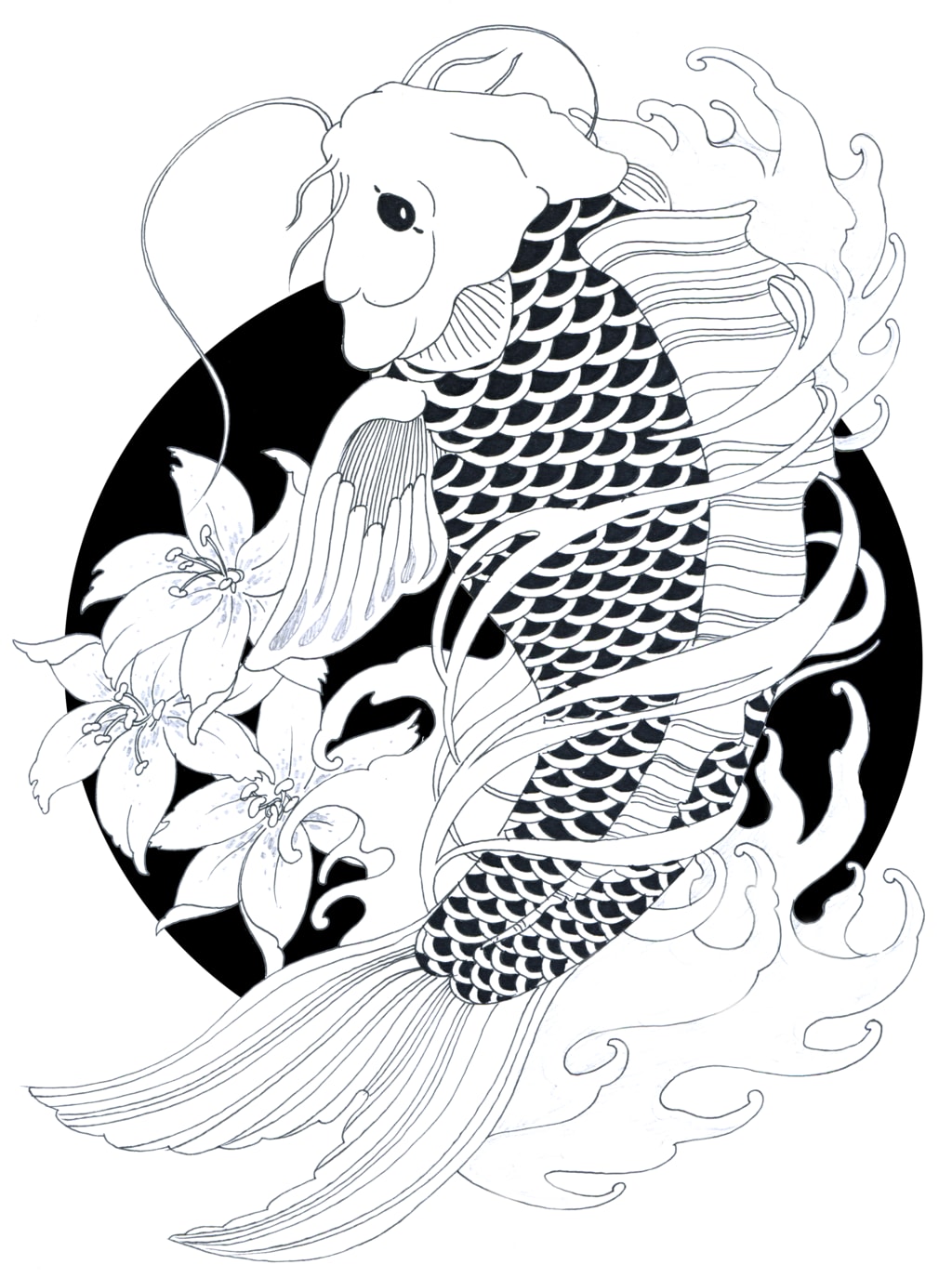
The east and north walls of TBR Coffee were composed of floor to ceiling blackboard. Amara arrived at her “usual” spot and stared at the board on the east wall. It was brimming with doodles, math problems, and phone numbers. Glass jars containing sticks of soft white chalk lined the counter space. The mural she drew so many weeks ago was still there, a giant Koi fish that consumed a third of the blackboard’s eighteen foot length. It was adorned with scales of layered white powder, each smoothed into a monochromatic gradient. Amara's mother, an avid aquarist, passed on her love of Koi to Amara, and she infused that love into her art. Her mom always kept a few Koi in the small garden pond behind their home. When she was little, Amara would sit on the edge of the water, pull her scabbed knees up to her collar bones, and watch the fish for hours. Her mother would sit on the ledge beside her, pull Amara tight to her rose-scented chest, and tell her fairy tales of good conquering evil while the sun melted into a million candy-colored clouds.
Amara grabbed an eraser from the small ledge that ran along the bottom of the blackboard’s entire length. She cocked her head to the side and stared into the eyes of her former creation, wondering if the Koi would swim away. She sighed, then pressed the eraser to its cool body, and carefully wiped it away.
Then she heard it.
Maybe she wasn’t paying enough attention beforehand, but now the song from the overhead speakers flowed clearly into her mind. It felt familiar, but she couldn't remember ever hearing it before.
How can you see into my eyes, like open doors
Leading you down into my core
Where I've become so numb
She raised the back of her hand to her forehead and frowned. Flashes of white and gray played over and over behind her eyelids. What the hell, she thought, where do I know this song from?
She squeezed her eyes shut. When she opened them again, her headache had dissipated somewhat, but the lyrics of the song swirled around her brain like a school of hungry piranha. Amara reached for a jar, and drew from it a bright, white, slender piece of chalk. She shook her head and raised her left hand to the board. The piece of chalk in it gleamed with an unfamiliar light.
Without a soul
My spirit's sleeping somewhere cold
Until you find it there and lead it back home
Wake me up inside
Amara jerked the chalk quickly across the dark slate. There was nothing careful about her movements, nothing particular about the marks left in the chalk’s wake, yet an image began to take shape. She smudged, drew, and blended with rapid fire precision. The song’s melody shot through her fingertips; visions of Koi fish darted along her sightline, white dust fell like snow from their marble black eyes.
Call my name and save me from the dark
Bid my blood to run
Before I come undone
Save me from the nothing I've become
Scratches and marks began to form the frame of a picture. Amara recognized the smudged chalk mass in the corner of the board as the rough outline of a face. In it, big, deep set eyes gazed up at the ceiling and plump lips formed the beginnings of a smile. Amara felt her fingers bend along the smooth rim of the chalk, still drawing somewhere over her head. The song’s melody faded and the lyrics again came into focus. She blinked. She knew that face. It belonged to her mother.
Now that I know what I'm without
You can't just leave me
Breathe into me and make me real
Amara’s frantic movements drew the attention of the coffee shop’s other patrons. But in her trance like state, eyes glazed, ears filled with the familiar music, Amara didn’t notice. Her hands were a blur, one drawing and the other smudging. White chalk dust ebbed and flowed in smoky waves off the board.
All this time, I can't believe I couldn't see
Kept in the dark, but you were there in front of me
I've been sleeping a thousand years it seems
I've got to open my eyes to everything
Without a thought, without a voice, without a soul
Don't let me die here
Suddenly, Amara’s concentration was broken by an awful screeching sound. It was her nail scratching against the blackboard. The little chalk that remained crumbled in her hand. No matter, a thought came to her, it is done. The mental haze that clouded her vision cleared, and when she stepped backward to see what she had done, her eyes welled with tears.
It was a garden. In it were rows of planted vegetables which sprouted from the salt and pepper soil. A stone divider separated the vegetables from the flowers. Large white petals reached up towards a bleached white sun. In the center of the garden was a pond. The stone ledges sat just as they were when Amara perched on them so many years ago. Her mother’s face looked up at her, just as it often did in her dreams, but her mother’s expression was different. It was wrong. Her mother lay on the ground in an awkward contortion, one leg bent back at an impossible angle. Her left arm lay across her abdomen, her hand still loosely tucked in the fold of her apron. What Amara mistook for a smile was not a smile at all. Her mother’s mouth was frozen in an expression of surrender and acceptance. Her eyes were open, but soulless. A crack in the pond spilled white water around her mother’s body, drowning the gingham print of her dress in blackness. Her cheek was pressed to the ground, partially obscured by shadow. Hundreds of Koi swarmed around her. And in the doorway that led from the garden to the house, a hulking figure of black shadow, with broad shoulders and sunken eyes, towered over the scene. The man stared solemnly at the corpse at his feet; a single white tear etched a trail down his left cheek. In the man’s face, Amara saw the look of deep pain and a profound weariness.
Everyone in the shop had gathered around the mural. Some stared at Amara, others at her creation. Amara staggered backward awkwardly. She suddenly realized that she hadn’t heard those lyrics before. She’d read them. In her mother’s journal.
The mousy haired cashier steadied her by the shoulders. “Are you okay?” he asked.
Amara turned towards him, eyes watering and lips trembling. “What is the name of that song?”
“What song?”
“The song!” Amara grabbed his shoulders, pushing her fingers into his flesh. “The song that was just playing. I need to know.”
“Um, it’s a song from the early two thousands, I think…” The cashier’s gaze reflexively looked upward, trying to remember.
“What is it called?” She pleaded.
“Are you sure you’re okay?”
“No, I’m not okay!” she moaned. “Something terrible has happened! Please tell me the name, I think my mom is trying to—I think someone did something to her.”
“I think it’s called, um…” The cashier shook his head abruptly. He remembered the name.
“Bring me to life,” he said.
About the Creator
R. Tilden Smith
Since I've been old enough to earn my own money, have preferred to spend it buying the stories that have gripped me by the throat and squeezed my imagination until I've passed out from exhilaration (metaphorically speaking).
Keep reading
More stories from R. Tilden Smith and writers in Horror and other communities.
Keepsake
The movers had finally gotten the last of the cardboard boxes removed from the bowels of the semi-trailer and into the house. They looked tired but determined—scurrying about in that way one does when one gets paid by the job and not by the hour. They hurried from room to room, leaving boxes stacked high and irregular, like half finished games of Jenga. The boxes were all stamped with the moving company logo—the big smiling faces of three corporate-looking hipster dudes who looked like they had just dropped a tab of PCP. Their busts were underscored with the caption, 3 MEN AND A TRUCK. WE MOVE SO YOU DON’T HAVE TO!
By R. Tilden Smith5 years ago in Horror
5 Most Haunted Objects in History: From Annabelle to Robert the Doll
I have a confession to make: I am obsessed with European history, specifically castles. There’s something about a stone fortress that feels like a magnet for the paranormal. In my mind, every castle is haunted, usually by a lady in a white dress, a headless nobleman, or (the absolute worst) creepy ghost children.
By Areeba Umair6 days ago in Horror
Miss Persephone's Manual to a Seemingly Ordinary Life
Miss Persephone was found at the dining table, her blue eyes swollen, her tears arriving and retreating like the tides of the ocean. Earlier that day, her family had visited her in the retirement home where she had lived for eight years. It was her eightieth birthday.
By Imola Tóth2 days ago in Fiction



Comments
There are no comments for this story
Be the first to respond and start the conversation.